Chính's News

  • Subscribe to our RSS feed.
  • Twitter
  • StumbleUpon
  • Reddit
  • Facebook
  • Digg
Showing posts with label China's threat. Show all posts

Friday, 6 December 2013

China's ADIZ Challenges the Pacific Defense Quadrangle

Posted on 00:41 by Unknown
By Robbin Laird and Ed Timperlake

The PRC has recently declared an Air Defense Identification Zone, which covers not just its territory but those of Japan as well.
A key consideration as well is the NATURE of the rules, which the PRC is seeking to enforce in their self-declared ADIZ.
The PRC is seeking to enforce rules that are different from standard rules for an air identification zone. 
The Chinese authorities require reports from all aircraft that plan to pass through the zone, regardless of destination.
In contrast, Japan and the United States have their own air defense zones but only require aircraft to file flight plans and identify themselves if those planes intend to pass through national airspace. 
And in Japan, the Air Self Defense Force receives information on flight plans of incoming civil aircraft from the Ministry of Land, Infrastructure, Transport, and Tourism, but does not seek reports directly.
As Bonnie Glaser put it:
China’s Aircraft Identification Rules make no distinction between aircraft flying parallel with China’s coastline through the ADIZ and those flying toward China’s territorial airspace.
Secretary of State Kerry highlighted this issue in his statement, saying that the US “does not apply its ADIZ procedures to foreign aircraft not intending to enter US national airspace,” implying that the US would not recognize China’s claimed right to take action against aircraft that are not intending to enter its national airspace.

The PRC Air Defense Identification Zone may seem an anomaly or an irrational act challenging multiple players in the Pacific.
But what it is in reality is the opening gambit in trying to impede and defeat the formation of a 21stcentury Pacific defense and security strategy by the U.S. and its allies.

The PRC and its newly declared Air Defense Identification Zone is about taking a bite out of 21st century approaches of the US and its allies for Pacific defense. 

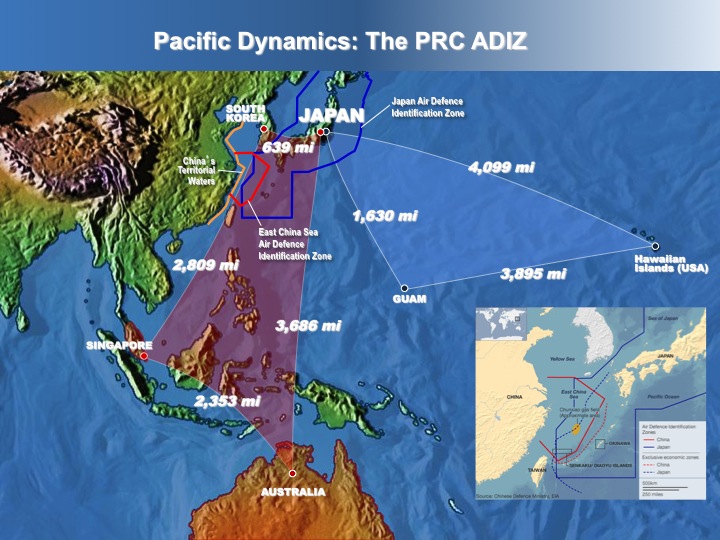
What we have called the strategic quadrangle in the Pacific is a central area where the U.S. and several core allies are reaching out to shape collaborative defense capabilities to ensure defense in depth.
This area is central to the operation of forces from Japan, South Korea, Australia, India, Singapore and the United States, to mention the most important allies.
These allies are adding new air and maritime assets and are working to expand the reach and range of those assets through various new capabilities, such as air tanking and the shaping of electronic surveillance and defense assets.
Freedom to operate in the quadrangle is a baseline requirement for allies to shape collaborative capabilities and policies. 
Effectiveness can only emerge from exercising evolving forces and shaping convergent concepts of operations.
This requires time; this requires practice; and this requires introducing new systems such as A330 tankers and F-35s, P-8s, or Wedgetails into the operational area.
In our book on the shaping of a 21st century strategy, we highlight Pacific operational geography as a key element for forging such a strategy.
In effect, U.S. forces operate in two different quadrants—one can be conceptualized as a strategic triangle and the other as a strategic quadrangle.
The first quadrant—the strategic triangle—involves the operation of American forces from Hawaii and the crucial island of Guam with the defense of Japan. 
U.S. forces based in Japan are part of a triangle of bases, which provide for forward presence and ability to project power deeper into the Pacific.
The second quadrant—the strategic quadrangle—is a key area into which such power needs to be projected. 
The Korean peninsula is a key part of this quadrangle, and the festering threat from North Korea reaches out significantly farther than the peninsula itself.
The continent of Australia anchors the western Pacific and provides a key ally for the United States in shaping ways to deal with various threats in the Pacific, including the PRC reach deeper into the Pacific with PRC forces. 
Singapore is a key element of the quadrangle and provides a key ally for the United States and others in the region.
A central pressure in the region is that each of the key allies in the region works more effectively with the United States than they do with each other.
This is why the United States is a key lynchpin in providing cross linkages and cross capabilities within the region. 
But it is clear that over time a thickening of these regional linkages will be essential to an effective 21st-century Pacific strategy.
The distances in these regions are immense.
For the strategic triangle, the distance from Hawaii to Japan are nearly 4,100 miles. 
The distance from Hawaii to Guam—the key U.S. base in the Western Pacific—is nearly 4,000 miles. 
And the ability of Guam to work with Japan is limited by the nearly 2,000-mile distance between them as well.
For the strategic quadrangle, the distances are equally daunting. 
It is nearly 4,000 miles from Japan to Australia. It is nearly 2,500 miles from Singapore to Australia and nearly 3,000 miles from Singapore to South Korea.
Clearly, air and naval forces face significant challenges in providing presence and operational effectiveness over such distances.
This is why a key element of shaping an effective U.S. strategy in the Pacific will rest on much greater ability for the allies to work together and much greater capability for U.S. forces to work effectively with those allied forces.
In an interview we did earlier this year with Lt. General Robling who is MARFORCPAC, the General highlighted the significance of the geographical challenge to the kind of persistent presence the US is seeking in working with allies:
To get from Hawaii into the strategic triangle or quadrangle takes significant time. 
 Between Hawaii and Okinawa is about 5 steaming days. 
 It is longer to get to Australia and Guam and then back up to Okinawa and Tokyo within the Quadrangle.
Strategic aircraft lift – C-17s – cuts that time down significantly…hours vice days. 
However, they are expensive to use, take several sorties to move the same amount of equipment you could move on shipping and are not always available.
Our strategic partners and allies are spread out over a significant geographical area.
They want to train with us, but not always bilaterally, they sometimes want us to work with them and some or several of their partner countries.
That means we must take the training to them.

Enter the PRC and its attempt to declare an Air Defense Identification Zone or ADIZ.
This is clearly a significant gambit to take a bit out of the strategic quadrangle and to foment discord among allies.
According to a Japan Times article about the ADIZ:
The (Japanese) government branded as “very dangerous” China’s announcement Saturday that it has set up an East China Sea air defense identification zone that includes the Japan-held Senkaku Islands.
The Chinese Defence Ministry said the zone was created to “guard against potential air threats,” but the move will only inflame a bitter sovereignty row over the islets.
Later Saturday, China scrambled air force jets, including fighter planes, to patrol the new zone…..
(The new zone) covers a wide area of the East China Sea between South Korea and Taiwan, and includes the Senkaku islets…..
Along with the new zone, the Chinese ministry released a set of aircraft identification rules that it says must be followed by all aircraft entering the area, under penalty of intervention by China’s military.
Aircraft are now expected to provide their flight path, clearly mark their nationality and maintain two-way radio communication in order to “respond in a timely and accurate manner to identification inquiries” from Chinese authorities….
This last point is an important one: for the PRC is asserting its right to verify the operations of all aircraft, whether commercial or military and whether intending to enter PRC territory or not.
This might seem a irrational act of a power hungry power but seem from the perspective of the strategic geography of the Pacific it is not.
The PRC is putting down its marker onto the quadrangle and if not dealt with will undoubtedly expand its definitions of air and maritime defense outward.
We have placed the ADIZ down upon the strategic geography we have identified and a key reality quickly emerges. 
Just by chance the zone covers reinforcements to Taiwan.
This is clearly a backhanded attempt to promote the PRC’s view of the nature of Taiwan and the South China Sea in their defense calculus.
There have been hints as well that the PRC is looking to do something similar with Vietnam in mind.
China is about to establish a second air defense identification zone over the South China Sea, Qin Gang, spokesperson for China’s foreign ministry, said on Nov. 25, according to the Moscow-based Voice of Russia.
Qin said the air defense identification zone over the East China Sea announced by Beijing on Nov. 23 was a buffer zone to defend the territorial integrity of China and said a second air defense identification zone which may cover the disputed South China Sea will be established in due course.
The Vietnamese case could prove interesting, not only in terms of expanding the Pacific defense equation dealing with the PRC seeking to expand its area of control out into the Pacific.
We have made the case in the book that focus of a 21st century US strategy is Pacific defense, not simply a U.S. military strategy in the Pacific.
The PRC focus on Vietnam is a good case in point because it will lead immediately to PRC-Indian “discussions.”
The recent Indian and Vietnamese summit focused among other things upon the further development of Vietnamese resources and augmenting its defense capabilities.
According to a Thanh Nien story drawing upon a Times of India story:
India’s navy is training over 500 Vietnamese submariners as part of the countries’ resolution to expand bilateral military ties, the Times of India reported last week.
During talks between Indian Prime Minister Manmohan Singh and visiting Communist Party general secretary Nguyen Phu Trong last Wednesday, it was decided that India would issue Vietnam a US$100 million line of credit for the purposes of enabling the latter to acquire four naval patrol vessels from the former, the report said.
The ongoing training of Vietnamese sailors in “comprehensive underwater combat operations” at the Indian Navy’s submarine training center,
INS Satavahana in Visakhapatnam, is a major bilateral initiative of the nations’ emerging strategic partnership.
Over 500 Vietnamese sailors will be trained in batches at the center, which is equipped with state of the art technology, by the Indian Navy, according to the report.
In December 2009, Vietnam signed a $2 billion deal to buy six submarines from Russia, which is due to deliver them all by 2016.
The Indian Navy’s extensive experience in operating Russian
Kilo-class submarines, which dates back to the mid-1980s, will be invaluable to Vietnam as its navy learns how to handle their new underwater vessels, according to the Times of India.
In the past, India has supplied spare parts for Russian Petya class warships and Vietnamese OSA-II class missile boats.
“India will continue to assist Vietnam to modernize and train its defense and security forces, including via the $100 million line of credit for defense purchases,” said PM Singh.
And The Japan Times added additional information, which highlighted the importance of the recent Vietnamese-Indian summit:
India and Vietnam made serious efforts to upgrade their bilateral relations earlier this month during the visit to New Delhi by Vietnamese Communist Party Secretary General Nguyen Phu Trong.
Eight pacts were inked, including ones on energy cooperation and protection of information, which are strategically significant areas that will influence the trajectory of this bilateral relationship.
Vietnam has offered seven oil blocks to India in South China Sea, including three on an exclusive basis where Hanoi is hoping for production-sharing agreements with India’s state-owned oil company ONGC Videsh Ltd. (OVL).
In a significant move, India has also decided to offer a $100 million credit line to Vietnam to purchase military equipment. 
Usually a privilege reserved for its immediate neighbors, this is the first time that New Delhi has made such an offer to a more distant nation.
Delhi and Hanoi have been working toward building a robust partnership for the past few years.
It is instructive that India entered the fraught region of the South China Sea via Vietnam.
New Delhi signed an agreement with Vietnam in October 2011 to expand and promote oil exploration in the South China Sea and then reconfirmed its decision to carry on despite the Chinese challenge to the legality of an Indian presence.
Beijing told New Delhi that its permission was needed for India’s state-owned oil and gas firm to explore for energy there. 
But Vietnam quickly cited the 1982 United Nations Convention on the Law of the Sea to claim its sovereign rights over the two blocks in question.
Hanoi has been publicly sparring with Beijing over the South China Sea for the last few years, so such a response was expected.
What was new, however, was New Delhi’s newfound aggression in taking on China.
It immediately decided to support Hanoi’s claims.
By accepting the Vietnamese invitation to explore oil and gas in Blocks 127 and 128, OVL not only expressed New Delhi’s desire to deepen its friendship with Vietnam, but also ignored China’s warning to stay away.

A clear message from our recent discussion with General Hawk Carlisle, the AFPAC commander, was that enhancing allied cooperation among themselves as well as working with the U.S. was a core American objective in shaping Pacific defense.
In the interview, he noted that the U.S.-Japanese relationship is undergoing a fundamental transformation. The Japanese are clearly rethinking their defense posture and he argued that the U.S. was working much more deeply and comprehensively with the Japanese defense forces than even two years ago. 
For example, “We have moved our air defense headquarters to Yokota Air Base and we are doing much closer coordination on air and missile defense with the Japanese to deal with a wider spectrum of regional threats.”
The Air Force is stepping up its collaborative efforts and capabilities with key regional air forces, including with Australia, Singapore, South Korea and Japan. 
And Carlisle emphasized that the service is pushing to enhance cross-collaborative capabilities among those allies as well.
While trying to get the allies to work more closely with each other, the Pacific commander also underscored that the US Air Force is adopting allied innovations.
“Singapore is doing very innovative things with their F-15s, notably in evolving the capabilities of the aircraft to contribute to maritime defense and security. We are looking very carefully at their innovations and can leverage their approach and thinking as well,” he said. 
“This will certainly grow as we introduce the fleet of F-35s in the Pacific where cross national collaboration is built in.”
Forging paths towards cross-domain synergy among joint and coalition forces is a key effort underway.
There is a tendency in Washington to believe that PRC actions are really just directed against the United States.
This misses a fundamental point: Pacific allies and the United States are seeking to shape an effective 21st century defense strategy, in which the US is clearly important but not the only player.
The PRC understands this and is working towards Ben Franklin moments for the US and its allies.
We must, indeed, all hang together, or assuredly we shall all hang separately.
The PRC leadership hopes that discord between the US and its allies and among the Pacific allies themselves will lead them to chose hanging separately.
It is a gamble but apparently one worth taking for the PRC leadership.
Read More
Posted in ADIZ, China’s aggressive expansionism, China's threat, East Sea, Pacific Defense Quadrangle, Pacific operational geography, security strategy, Vietnamese-Indian summit | No comments

Thursday, 28 November 2013

China's presence looms amid massive U.S.-Japanese AnnualEx war games

Posted on 03:16 by Unknown
  • USS George Washington in huge naval exercise -- AnnualEx 2013 -- off Okinawa
  • This year's games held against backdrop of tension after China imposes new air zone
By Paul Armstrong

As the United States prepared to mark Thanksgiving, the centerpiece of the U.S. 7th fleet in the Pacific, the USS George Washington, was deployed off the Japanese island of Okinawa.
USS George Washington, East China Sea -- The deafening roar of state-of-the-art warplanes being catapulted into the air from its huge flight deck signaled that the USS George Washington was back in combat mode after its recent detour to the Philippines to take part in the aid effort in the wake of Super Typhoon Haiyan.
Barely a week on and the 90,000-ton Nimitz-class aircraft carrier is now patrolling waters off the island of Okinawa as part a huge naval exercise -- AnnualEx 2013 -- involving dozens of warships, submarines and aircraft from the U.S. Navy's 7th fleet and the Japan Maritime Self-Defense Force (JMSDF).
The aim? 
To provide a stern test of their ability to effectively and mutually respond to the defense of Japan or to a regional crisis or contingency situation in the Indo-Asia-Pacific region, according to the U.S. Navy.
But this year's war games have taken on an added dimension given the high-pressure atmosphere in the region at present -- they take place in the shadow of a controversial new Air Defense Identification Zone announced by the Chinese last weekend.
Map showing the controversial air defense identification zone in the East China Sea.

This zone, which incorporates among other areas an East China Sea island chain at the center of an acrimonious tug of war between Tokyo and Beijing, requires that all military aircraft in the area must report their flight plans to China, maintain two-way radio and clearly mark their nationalities on the aircraft. 
China has warned it will take "defensive measures" if their orders are ignored.
The commander of the U.S. 7th fleet, Vice Admiral Robert L. Thomas, appeared relaxed about the situation while addressing a group of reporters aboard the USS George Washington. 
He said while China's air defense zone did not appear to be "well thought out" given the overlap with both Japanese and South Korean territorial claims, he did not think U.S. military activity in the region would be negatively affected.
"We are going to continue with our operations in international airspace as we always have," he said.
"It's about international norms, standards, rules and laws. When anybody makes an extreme claim it is really an imperative that the international community can continue to operate in accordance with international law and not be distracted.
"So for us it's 'steady as you go.' Our operations in the East China Sea will continue as they always have."
Japan, which administers the largely uninhabited Senkaku island chain, has described China's move as "a profoundly dangerous act that may cause unintended consequences in the area," while U.S. Secretary of State John Kerry said "this unilateral action constitutes an attempt to change the status quo in the East China Sea. Escalatory action will only increase tensions in the region and create risks of an incident."
In recent months, both sides have been involved in a dangerous game of "cat and mouse," prompting fears that any miscalculation could set the two Asian powers on a collision course -- with the United States likely to be dragged into such a conflict to defend its Japanese ally. 
Tokyo says it has twice scrambled fighter jets this month after Chinese aircraft appeared on course to enter its airspace. 
For its part, China lodged a complaint after it said a Japanese warship recently entered waters where the People's Liberation Army (PLA) Navy was holding live-fire drills, noting "the provocative move may have led to unexpected emergencies."
Meanwhile, China's first aircraft carrier, the "Liaoning," set sail this week from its home port of Qingdao in eastern China. 
According to the PLA Navy's website, it will head for the South China Sea to "conduct scientific experiments and military training." 
This course would take it through the East China Sea accompanied by four other warships.
Yet with so many potential flashpoints in the region, Thomas is optimistic that conflict will be avoided. 
He pointed to the professionalism shown by the armed forces on all sides in the region as the basis for this confidence.
"The South Koreans have shown great restraint with regard to North Korea and those severe provocations, while the Japanese Self Defense Force has also been very measured," he said. 
Significantly, he pointed to China's development of a "world class" navy, with a level of professionalism that matches its improving infrastructure.
"The more confident they become in their own capabilities, then this will actually 'depressurize' the situation," he said. 
With F-18 fighters taking off and landing almost every few minutes, it was easy to forget the role the carrier played in the Leyte Gulf more than a week ago.
Many of its fighter jets were flown back to Japan to make room for more helicopters able to ferry in supplies to remote areas of the Philippines in the wake of Super Typhoon Haiyan.
"The ship became a 'lily pad' for relief operations," said the carrier's commander, Rear Admiral Mark Montgomery. 
"This is something we'll train more for," he added, citing the need for a modern navy to be able to adapt to an increasingly diverse range of challenges and missions within its theater of operations.
"It was humbling to be able to take part in the extraordinary humanitarian effort in the Philippines."
Yet the sight of dozens of warships in tight formation in high seas off Japan was another reminder of how serious the U.S. and Japan are taking the threat to regional security -- undeniably their biggest challenge.
Read More
Posted in air defence identification zone, AnnualEx 2013, Beijing's expansionism, China's threat, East China Sea, international law, naval exercise, USS George Washington | No comments

Wednesday, 27 November 2013

Paper Tiger

Posted on 11:50 by Unknown
China's move to establish air defense zone backfires
By Simon Denyer

BEIJING — It was designed as a forceful response to Japanese assertiveness, and a robust declaration of China’s maritime claims. 
But Beijing’s creation of an air defense zone may have backfired, experts said, after eliciting a strong joint response by the United States and Japan.
Instead of strengthening China’s position, the air defense zone has unsettled and united its neighbors. 
It provided Washington with a perfect opportunity to reassure its Asian allies that it remains committed to maintaining stability in the Asia-Pacific region.
On Saturday, Beijing said any noncommercial aircraft entering a broad zone over the East China Sea should first identify themselves, and it warned ominously that failure to do so could provoke “defensive emergency measures” by its armed forces. 
The statement heightened an already tense standoff with Japan over several tiny disputed islets in the East China Sea.
But the United States called China’s bluff by sending two warplanes into the zone Tuesday, and Beijing’s response was muted. 
The Defense Ministry merely said it had identified and monitored the planes, while the Foreign Ministry stressed that the zone was purely defensive and offered to strengthen communications with other regional players to maintain peace and security.
“We hope relevant countries do not make too much of a fuss about it, panic and read too much into it,” spokesman Qin Gang said.
Paul Haenle, director of the Carnegie-Tsinghua Center for Global Policy in Beijing, said the mild reaction was surprising. 
“It is almost as though they hadn’t anticipated the U.S. response and didn’t know what to do,” he said.
In Chinese eyes, the standoff began last September, when Tokyo purchased three of the Senkaku islands from a private Japanese landowner. 
In response, Beijing stepped up its own claims to the rocky landmasses, increasing sea patrols and pressing Japan to accept that the territory is disputed.
Japan, like numerous other countries, already has its own air defense identification zone. 
The country increasingly has used the zone as an excuse to warn or intercept Chinese planes in the area, according to military experts in Beijing. 
In September, Japan threatened to shoot down Chinese drones flying over the disputed islands; China warned that downing the drones would constitute an act of war.
The Chinese military had been considering establishing its own air defense zone for some time, and this increased tension may have tipped the balance, experts said.
“Japan has been acting more and more confrontational with regards to the Senkaku islands, so China had to roll out its own measures to balance it out,” said Zhou Yongsheng of the Center for Japanese Studies at the University of International Relations in Beijing. 
“Whenever Chinese aircraft entered Japan’s zone, they would dispatch fighter jets to intercept us, which put us in a very passive position.”
Popular sentiment within Japan and China has also become increasingly hostile toward the other country. Rising nationalism in China is now coupled with genuine concern about the intentions of a more nationalist Japanese government under Prime Minister Shinzo Abe. 
His government has raised military spending since coming to power last December.
Zhu Feng, professor of international studies at Peking University, said China had established the air zone to “curb the arrogance of the Abe administration.” 
Zhao Chu, a military affairs columnist, said China was responding to Japan’s more aggressive enforcement of its own zone.
“But the primary cause is that China needs a stronger foreign policy at present because an appeal for that has been gathering momentum in Chinese society for over a decade,” Zhao said. 
“It’s a hawkish voice that now dominates Chinese society.”
Beijing’s actions appear to fit into a recent pattern, experts said. 
Reluctant to be seen as the initial provocateur, China tends to respond forcefully to any provocations from others and to use those provocations to advance its own claims even more strongly.
But China may have overplayed its hand with Saturday’s relatively aggressive Defense Ministry announcement, which appeared to blindside regional neighbors as well as Washington, experts said.
Two cabinet secretaries, Secretary of State John F. Kerry and Defense Secretary Chuck Hagel, both made strong statements criticizing the move. 
Vice President Biden will also convey the administration’s concerns when he meets separately with the leaders of Japan, China and South Korea on a week-long trip to Asia starting Sunday, officials said.
Under President Obama, the United States has announced a “strategic rebalancing” — or pivot — toward Asia, a move that many in China see as an attempt to encircle and contain its rise. 
But when Obama, distracted by the federal government shutdown, failed to attend two important summits in Asia last month,doubts surfaced about the depth of the U.S. commitment. 
Biden will try to reassure the leaders of Japan and South Korea during his trip, but this week’s events may already have done the job for him.
Hagel called his Japanese counterpart, Itsunori Onodera, on Wednesday, described China's move as “a potentially destabilizing unilateral action” and commended the Japanese government “for exercising appropriate restraint,” spokesman Carl Woog said in a statement.
Acting on instructions from their government, Japan’s two biggest commercial airlines announced they would not relay plans to fly through the Chinese zone, while Onodera told reporters Wednesday that Japanese Self-Defense Forces jets would continue to operate in the East China Sea, without reporting their flight plans to Beijing.
“This announcement and quick U.S. response have clarified the U.S.’s siding with Japan much more than the past,” said Mathieu Duchatel of the Stockholm International Peace Research Institute in Beijing. 
“So there is some degree of miscalculation” by China.
Japan has voiced concern for years about what it sees as China’s increasing maritime aggression, but in recent days those concerns have been echoed by Taiwan and South Korea. 
The anger from South Korea is particularly notable, because Seoul, under President Park Geun-hye, has drawn closer with Beijing while sparring with Japan over historical issues.
On Wednesday, South Korea’s foreign minister, Yun Byung-se, said in a speech that China’s announcement had “made already tricky regional situations even more difficult to deal with.”
In the past few months, China had been working hard to reassure many of its Asian neighbors that its rise not only did not threaten them, but would actually be to their benefit. 
China’s leaders made successful visits to Malaysia, Indonesia and Vietnam and offered billions of dollars in trade and investment. 
Now, those reassurances may look less convincing.
“This will inject a large dose of anxiety and uncertainty into countries in the region about China’s rise,” said Haenle of the Carnegie-Tsinghua institute.
The episode also appears to underline China’s sometimes confusing foreign and strategic policy stance, with the armed forces often adopting more hawkish positions than the Foreign Ministry. 
That, said Haenle, was precisely why President Xi Jinping announced earlier this month that he would establish a new high-level committee to better coordinate national security policy.
Read More
Posted in air defence identification zone, China's threat, Chinese aggression, japan, paper tiger, US | No comments

China overplayed its hand on the Senkaku islands

Posted on 10:16 by Unknown
By David Pilling

About a year ago, I was in the office of Albert del Rosario, the foreign minister of the Philippines. 
What, I asked, would Manila say if Shinzo Abe, then running for prime minister of Japan, carried out his pledge to amend the pacifist constitution and “rearm”? (In fact, Japan is already fully armed, but its constitution bars use of force except in self-defence.) 
I fully expected him to reply that this would be a regrettable move. 
Not only would it be enormously provocative to China but memories of the country’s invasion of the Philippines were surely just as raw in Manila as they were in Beijing and Seoul. 
Not a bit of it, he said. 
“We would welcome that very much. We are looking for balancing factors in the region and Japan could be a significant balancing factor.”
Those remarks, echoed by Indonesia’s foreign minister, came back to me this week as China and Japan squared off dangerously over Japan's Senkaku islands in the East China Sea. 
At the weekend, Beijing took many by surprise when it announced the creation of an “air defence identification zone” covering the Senkaku islands.
There is nothing unusual about establishing such a zone. Many countries have them, including Japan and the US. 
Yet the move is provocative because China’s zone overlaps Japan’s. 
From now on, Beijing says, aircraft entering the zone will have to identify themselves to Chinese authorities or face unspecified “emergency defence measures”.
Mr Abe denounced the move, which he said had no legitimacy. 
Washington, too, has strongly objected. 
It sent two B52 bombers across the zone – without telling Beijing in advance – to underline its displeasure. 
Japan’s two main civilian airlines initially complied with the order but, under pressure from Tokyo, resumed flying across the zone on Wednesday without informing Chinese authorities.
China’s aim appears to be to change the facts on the ground – or, in this case, in the air. 
Its new zone challenges Japan’s longstanding de facto control of the islands, which it incorporated into its territory in 1895. 
In the short term, Beijing hopes to force Japan to admit that sovereignty over the islands is in dispute, something it refuses to acknowledge. 
In the longer run, China may seek to drive a wedge between Japan and the US. 
Although Washington takes no position on the islands’ sovereignty, it says they fall under the remit of the US-Japan security treaty. 
That implies it would come to Japan’s aid if the islands were attacked. 
Yet China cannot be the only country to wonder whether Washington would really risk American lives to defend a few barren rocks.
On the face of it, this is a good fight for Beijing to pick. 
One might advise it to do exactly the same as a way of ratcheting up pressure on Japan and advertising its regional ambitions. 
After all, one might argue, there is little love lost for Japan in the region.
Washington is desperate for Seoul and Tokyo to get along. Instead, they are barely on speaking terms. 
Park Geun-hye, the president, has refused to meet Mr Abe until he has developed a “more sincere” attitude towards Japanese history. 
She instead made a high-profile visit to Beijing.
Yet other Asian countries, even ones that suffered at the hands of Japan’s Imperial Army, do not harbour the same bitterness. 
Many of the region’s nations, including the Philippines, Vietnam and India, have become increasingly wary of a rising China as it becomes more assertive about its territorial claims. 
They have encouraged the US to “pivot” back to the region. 
And many of them have edged closer diplomatically to Japan, an important – in some cases, the most important – investor in their economies. 
In an unprecedented diplomatic charm offensive, Mr Abe has visited all 10 members of the Association of Southeast Asian Nations in his first year in office. 
Japanese companies, backed by the government, have sharply stepped up their presence in Indonesia, the Philippines and Myanmar. 
The latter, until recently firmly in China’s orbit, has slipped out of its diplomatic grasp as it opens up to the west.
The hedging against China is not just commercial. 
Many countries in the region, including the Philippines and Vietnam, are stepping up military co-operation with the US. 
Japan has supplied ships to Manila to patrol waters disputed with China, and is in discussion with Hanoi to do the same. 
Even South Korea has objected strongly to China’s new exclusion zone. 
China’s lack of soft power was on display in the days after Typhoon Haiyan ripped through the Philippines. 
The US sent the USS George Washington, Japan sent 1,000 self-defence troops and plenty of money. China’s initial contribution, a mere $100,000, was widely condemned as petty and mean-spirited.
One could argue that, as China’s economy grows, it is only natural that its regional footprint will also expand, not always to the liking of its neighbours. 
After all, as long ago as the Monroe Doctrine of 1823, the US declared Latin America off-limits to European powers. 
Yet Beijing may be overplaying its hand. 
In Japan, China’s action may make it easier for Mr Abe to scrap a self-imposed ban on collective self-defence or even eventually to ditch the pacifist constitution. 
Whether regional leaders like his nationalistic sentiments or not, many of them will be hoping he does not blink.
Read More
Posted in 1952 U.S.-Japan Mutual Defense Treaty, China's threat, Chinese aggression, East China Sea Air Defense Identification Zone, japan, Senkaku Islands, US | No comments

Beijing plays a longer game with its air defence zone grab

Posted on 09:35 by Unknown
Next step will be to work on other countries to cajole or intimidate them into at least tacitly recognising China’s sovereignty over the disputed airspace.
By Jamil Anderlini in Beijing
2011 Japan-US joint military exercise

The American B-52 bombers that flew over the East China Sea on Tuesday made something of a mockery of Beijing’s newly-declared “air defence identification zone”.
To the outside world China looks weak and ineffectual right now, as it obviously cannot match its blustery rhetoric with an actual defence of the uninhabited Japanese-administered islands it claims as its territory.
But viewed from Beijing and the longer-term perspective of the country’s strategic planners, the establishment of the new zone is a masterstroke that will change the facts on the ground (or in this case the air) pretty quickly.
For a start, the US cannot keep flying bombers over the region and say they are part of “long-planned exercises” (as they claimed this week’s flyovers were).
Doing so would quickly lose impact as a statement of principle and evolve into needless provocation, especially in the eyes of the Chinese public, who draw most of their opinions on such matters from tightly controlled state media.
There are already signs that Beijing will portray its response to Japanese and American “incursions” as proof it is exercising maximum restraint in the face of outrageous incitement.
Since Japan’s strongest claim to the Senkaku island group comes from the fact it has administered them for many decades, China is hoping to assert its own overlapping track record of “administration”.
The next step in China’s game-plan will be to work on other countries in the region and around the world to cajole or intimidate them into at least tacitly recognising China’s sovereignty over the disputed airspace.
When Chinese diplomats and politicians sit down for discussions with their counterparts from other countries, they usually have a very short list of things they want from the other side.
With the big shiny promise of Chinese markets looming behind them, they usually demand recognition that Taiwan and Tibet are part of China and they ask for general statements about open markets and anti-protectionism.
From now on they will start asking other countries to force their airlines to identify themselves to Chinese authorities when passing through the disputed airspace, thereby implicitly acknowledging that the territory belongs to China.
The pressure will be much greater on individual airlines hoping to capitalise on the tens of millions of new Chinese tourists flooding out of the country every year.
When they cave they can always justify their compliance on safety grounds.
That was the explanation from Japan’s two largest airlines, which immediately agreed this week to provide Beijing with co-ordinates for all flights entering the disputed airspace.
They changed their minds three days later under pressure from the Japanese government and now say they will not comply with the Chinese demand.
For evidence of how successful Beijing’s tactics are, just look at Taiwan, which lost diplomatic ties with the Gambia this month, leaving it with the Vatican, Burkina Faso, Sao Tome and Principe, Swaziland and less than 20 Latin American and Pacific states as its friends.
In its territorial disputes with all of its neighbours, China’s big advantage is that it wants to change the status quo while its opponents are all trying to keep things pretty much as they are.
That means other countries in the region have to prepare for an infinite number of possible Chinese actions while Chinese strategists only have to design one clever manoeuvre at a time.
What we are witnessing is just the early stages of China’s abandonment of its long-held foreign policy of minding its own business as Chinese President Xi Jinping, one year into the job, turns his attention to the “great rejuvenation of the Chinese nation” outside the country’s current borders.
China’s leaders know that time and global trends are on their side as long as nothing goes disastrously wrong domestically and as long as they do not actually provoke a war with Japan, the US or any other country.
That is where the danger lies.
As one senior Asian diplomat told the FT this week, China may think it has pulled off a clever tactical manoeuvre but clearly nobody in Beijing has properly studied European history before the first world war.
As the world prepares to mark the centenary of the “war to end all wars”, China would be better off learning how that conflagration started rather than dreaming up clever ways to antagonise and scare its neighbours.
Read More
Posted in air defence identification zone, China's threat, Chinese aggression, East China Sea, japan, Senkaku Islands | No comments

U.S. affirms support for Japan in island dispute with China

Posted on 09:21 by Unknown
BY MARK FELSENTHAL AND DAVID ALEXANDER
The United States pledged support for ally Japan on Wednesday in a growing dispute with China over islands in the East China Sea as senior U.S. administration officials said China's claim to air space over the islands had unsettled its neighbors.
U.S. Defense Secretary Chuck Hagel told his Japanese counterpart in a phone call that the two nations' defense treaty covers the small island group where China established a new airspace defense zone last week and "commended the Japanese government for exercising appropriate restraint," a Pentagon spokesman said.
U.S. Vice President Joe Biden is due to visit China, Japan and South Korea during a week-long trip and will seek to ease tensions heightened after China demanded that airplanes flying near the islands identify themselves to Chinese authorities, senior U.S. administration officials said.
China's declaration raised the stakes in a territorial standoff between Beijing and Tokyo over the Senkaku islands.
The United States defied China's demand on Tuesday by flying two unarmed B-52 bombers over the islands without informing Beijing. 
Flights of Japan's main airline similarly ignored Chinese authorities while flying through that air space.
China's defense ministry said it had monitored the U.S. bombers. 
A Pentagon spokesman said the planes had not be observed or contacted by Chinese aircraft.
Some experts say the Chinese move was aimed at eroding Tokyo's claim to administrative control over the area, including the tiny Senkaku islands.
Washington does not take a position on the sovereignty of the islands but recognizes that Tokyo has administrative control over them and the United States is therefore bound to defend Japan in the event of an armed conflict.
Biden will seek to ease the growing tensions in the region during his trip next week, U.S. officials said.
"The visit to China creates an opportunity for the vice president to discuss directly with policy makers in Beijing this issue to convey our concerns directly and to seek clarity regarding Chinese intentions," a senior administration official told reporters.
"It also allows the vice president to make the broader point that there's an emerging pattern of behavior that is unsettling to China's own neighbors," the official said.
The official said it raised questions about "how China operates in international space and how China deals with areas of disagreement with its neighbors."
Biden will not be making a demand on a specific issue but rather will raise the topic as part of talks spanning a range of themes, the official added.
The Pentagon signaled that more military flights into the defense zone claimed by China can be expected.
Colonel Steve Warren, a Pentagon spokesman, told Reuters: "We'll continue to conduct operations in the region, as we have" in the past. 
He declined to offer details on timing.
Japan Airlines and ANA Holdings said they had stopped giving flight plans and other information to Chinese authorities following a request from the Japanese government.
Both said they had not experienced any problems when passing through the zone. 
Japan's aviation industry association said it had concluded there was no threat to passenger safety by ignoring the Chinese demands, JAL said.
Read More
Posted in 1952 U.S.-Japan Mutual Defense Treaty, China's threat, Chinese aggression, japan, US | No comments

Airspace Claim Forces Obama to Flesh Out China Strategy

Posted on 08:31 by Unknown
The United States needs to project military power in the region, build up the defensive capacities of allies, and align the countries that ring China’s coastal waters to present a united front against Beijing’s aggression.
By MARK LANDLER
President Obama and Chinese president, Xi Jinping, in Russia in September.
WASHINGTON — While foreign-policy experts and risk analysts were riveted by the nuclear talks with Iran last weekend, the next major geopolitical crisis erupted a world away, over a clump of desolate islands in the choppy waters between Japan and China.
With the United States dispatching two B-52’s to reinforce its protest over China’s attempt to control the airspace over the islands, it served as a timely reminder that President Obama wants to turn America’s gaze eastward, away from the preoccupations of the Middle East.
Mr. Obama’s shift — once known as a pivot, now re-branded as a rebalance — has always seemed more rhetorical than real. 
But when Vice President Joseph R. Biden Jr. travels to China, Japan and South Korea next week, the administration will have another chance to flesh out the policy.
“What isn’t clear to me is whether they see this as a Japan-China problem that needs to be managed or as part of a longer-term test of wills with Beijing,” said Michael J. Green, an Asia adviser in the George W. Bush administration who is now at the Center for Strategic and International Studies.
If it is the latter, Mr. Green said, the United States needs to project military power in the region, build up the defensive capacities of allies like Japan and the Philippines, and align the countries that ring China’s coastal waters to present a united front against Beijing’s aggression.
The trouble, he added, is that “the administration is very worried about appearing to contain China.”
The cause of all this trouble are the flyspeck Japanese Senkaku Islands, that China, enticed that they may sit atop rich mineral reserves, now claims.
The dispute has mushroomed into a dangerous standoff between the world’s second- and third-largest economies — one that pits a conservative Japanese leader, Shinzo Abe, against a Chinese president, Xi Jinping, who is riding a nationalist tide in his country.
With so much at stake, Mr. Biden’s advisers say the dispute will intrude on every meeting he has in the region. 
That could come at a cost to an agenda that includes promoting a trans-Pacific trade deal and discussing how to deal with the nuclear threat in North Korea. 
“There’s an emerging pattern of behavior that is unsettling to China’s neighbors,” a senior administration official said on Wednesday, previewing Mr. Biden’s message. 
At the same, he added, “The vice president of the United States is not traveling to Beijing to deliver a démarche,” a diplomatic term of art for a slap on the wrist.
The delicate balancing act in Mr. Obama’s Asia policy, between cooperating with and containing China, is evident in the administration’s mixed messages over the last two weeks. 
Speaking before Beijing’s latest provocation, the national security adviser, Susan E. Rice, said the United States was seeking “a new model of major power relations.”
“That means,” she said in her maiden speech on Asia, “managing inevitable competition while forging deeper cooperation on issues where our interests converge.”
Referring to the territorial disputes between China and its neighbors — which flare up not just with Japan in the East China Sea but in the South China Sea, with the Philippines and Vietnam — Ms. Rice urged “all parties to reject coercion and aggression and to pursue their claims in accordance with international law and norms.”
To some critics, that smacked of moral equivalence: the coercion and aggression has been overwhelmingly on the part of China against its smaller neighbors. 
But on Saturday, when Beijing announced an “air defense identification zone” over a wide swath of air space above the islands, the United States jumped off the fence.
Secretary of State John Kerry immediately condemned what he called an “escalatory action” by China and Defense Secretary Chuck Hagel said the United States would not alter any military operations because of it, a promise he kept this week by dispatching the unarmed bombers from Guam on a routine mission off the coast of China.
Administration officials said it was important to push back against China’s dubious assertion of jurisdiction over international air space. 
The Chinese policy requires foreign planes flying through the zone to identify themselves and file a flight plan, even if they are not flying into Chinese air space.
The symbolism of B-52’s flying, with no advance warning, through China’s zone spares Mr. Biden from having to play the tough guy. 
But experts said he needed to leave no doubt in talks with President Xi that the United States thinks the Chinese move was ill-advised.
“It will have the Chinese scrambling aircraft time after time, especially if the Japanese play games with it,” said Kenneth G. Lieberthal, a China adviser during the Clinton administration.
Mr. Biden has cultivated an unusually personal relationship with Mr. Xi. 
The two traveled together in China and the United States, when Mr. Xi was vice president. 
That may make Mr. Biden more alert to the domestic political pressures the Chinese leader faces, as he embarks on risky economic reforms after a recent Communist Party congress.
“Chinese social media, official and semiofficial media are all playing up this dispute,” said Cheng Li, a senior fellow at the Brookings Institution. 
The tensions are likely to increase. 
The Chinese Navy has put its only aircraft carrier out to sea, on a course toward the South China Sea. 
In the East China Sea, an American carrier group is joining Japanese warships for long-planned naval exercises.
With so much firepower in such hotly contested waters, experts said there was a real danger of miscalculation by either side. 
Mr. Biden, who will begin his trip in Tokyo, is expected to urge Mr. Abe to show restraint as well.
The good news for all concerned, China experts said, is that Mr. Xi is much less interested in military adventurism than in overhauling China’s economy. 
“The chances of a real war are still low,” Mr. Li said. 
“But sometimes incidents will push leaders into a corner.”
Read More
Posted in B-52, China's threat, Chinese aggression, Chinese territorial ambition, japan, pivot to Asia, Senkaku Islands, test of wills, united front | No comments

Tuesday, 26 November 2013

All-Out Intimidation

Posted on 11:59 by Unknown
China carrier steams towards disputed South China Sea for "drills"
By Ben Blanchard

China sent its sole aircraft carrier on a training mission into the South China Sea on Tuesday amid maritime disputes with the Philippines and other neighbors and tension over its plan to set up an airspace defense zone in waters disputed with Japan.
The Liaoning, bought used from Ukraine and refurbished in China, has conducted more than 100 exercises and experiments since it was commissioned last year but this is the first time it has been sent to the South China Sea.
The Liaoning left port from the northern city of Qingdao accompanied by two destroyers and two frigates, the Chinese navy said on an official news website (navy.81.cn/).
While there, it will carry out "scientific research, tests and military drills", the report said.
"This is the first time since the Liaoning entered service that it has carried out long-term drills on the high seas," it added.
The timing of the drills is bound to raise eyebrows with its neighbors, given the overlapping maritime disputes. China has lodged formal protests with the United States and Japan after both criticized its plan to impose new rules on airspace over disputed waters in the East China Sea.
On Tuesday, Australia said it had summoned China's ambassador to express concern over its imposition of the Air Defense Identification Zone.
China also claims almost the entire oil- and gas-rich South China Sea, conflicting with claims from Malaysia, Brunei, the Philippines and Vietnam.
That dispute is one of the region's biggest flashpoints amid China's military build-up and the U.S. strategic "pivot" back to Asia.
Though considered decades behind U.S. technology, the Liaoning represents the Chinese navy's blue-water ambitions and has been the focus of a campaign to stir patriotism.

'NOT OVERLY CONCERNED'
Rommel Banlaoi, executive director of the Philippine Institute for Peace, Violence and Terrorism Research, said he thought the Liaoning was still years away from representing a real threat.
"China is still developing its own model of carrier operations and its technology is (far) behind the United States," he said. 
"Personally, I would not be overly concerned with an old diesel-powered aircraft carrier on a training mission."
The navy did not specify exactly what training would be done, only noting that previous exercises involving aircraft landing and taking off had gone well.
Previously reported training exercises have mostly been in the Yellow Sea, between China and the Korean peninsula.
"Obviously the Chinese authorities have been adopting a series of measures to strengthen their claim on the sovereignty of the disputed territories," said Joseph Cheng, a political science professor at City University of Hong Kong.
"You see Japan and Southeast Asian countries have also been making gestures and taking steps to strengthen sovereignty, so China has to respond."
China's navy said the mission was routine, adding that the Liaoning was still in a testing phase.
"This test visit to the South China Sea is part of normal arrangements for testing and training for the Liaoning," it said.
"...Long cross-sea voyages are a necessary stage of experimentation and training to test equipment and troops under continuous work and different hydrological and meteorological conditions."
Read More
Posted in China carrier, China's threat, Chinese aggression, East Sea, Liaoning | No comments

Japan Answers China’s Warnings Over Islands’ Airspace

Posted on 11:40 by Unknown
By MARTIN FACKLER

TOKYO — Matching China’s stern language with warnings of his own, Prime Minister Shinzo Abe of Japan vowed on Monday to defend his nation’s airspace after China declared an air defense zone over a Japanese group of islands in the East China Sea.
Speaking in Parliament, Mr. Abe called China’s move an unacceptable effort to change the status quo with threats of force. 
He described it as a dangerous ratcheting up of tensions in the standoff over the uninhabited islands, which are administered by Japan.
“We are determined to defend our country’s air and sea space,” Mr. Abe said. 
“The measures by the Chinese side have no validity whatsoever for Japan.”
China and Japan have been locked in an escalating war of words and nerves over the islands for more than a year. 
China’s declaration on Saturday that it would identify and possibly take military action against aircraft flying near the islands follows a long period of frequent dispatches of Chinese coast guard ships and aircraft to the area to challenge Japan’s control.
Mr. Abe’s effort to draw a line in the sand reflects his promises to lead his nation in standing up to China, which has eclipsed Japan as Asia’s top economic power. 
Since taking office in December, Mr. Abe, an outspoken conservative, has raised defense spending for the first time in a decade, and has increased military ties with the United States.
Japan has repeatedly signaled to China since Saturday that it has no intention of yielding control of airspace over the Senkaku islands.
On Monday, the Japanese vice foreign minister, Akitaka Saiki, summoned China’s ambassador to Japan, Cheng Yonghua, to demand that China repeal the air defense zone, the Foreign Ministry said in a statement.
Mr. Cheng replied that the Chinese air zone was not aimed at a specific country and would not affect civilian air traffic, according to Kyodo News. 
In Beijing, a Chinese Defense Ministry spokesman said that Japan had “no right to make irresponsible remarks,” because Japan has maintained a similar air defense zone over the islands, the state-run news agency Xinhua reported.
As the standoff has escalated, Japan has also sought to bind itself more closely to the United States, which has been the guarantor of Japanese security since the end of World War II. 
On Monday, the top Japanese government spokesman and chief cabinet secretary, Yoshihide Suga, said that Japan would work with the United States to urge China to allow aircraft to continue flying freely near the islands, which lie between Okinawa and Taiwan.
Read More
Posted in air defense zone, China's threat, Chinese aggression, East China Sea, japan, Senkaku Islands | No comments

US sends B-52 over China-claimed waters

Posted on 10:13 by Unknown
China has claimed a stretch of ocean and Japan and the USA will challenge that when a U.S. carrier battle group and Japanese warships arrive on Wednesday.
By Kirk Spitzer
  • China claiming nearly 1 million square miles of East China Sea
  • Japan Prime Minister Shinzo Abe confronts China
  • U.S. treaty obligates Pentagon to defend Japan

NAHA, OKINAWA, Japan — An American carrier battle group and a flotilla of Japanese warships will arrive Wednesday near a vast stretch of ocean claimed by China in what is shaping up as a test of how Prime Minister Shinzo Abe and the USA will stand up to the challenge.
The joint U.S.-Japan exercises in the sea are a direct challenge to China's claim. 
On Tuesday, the U.S. military said two Air Force B-52 bombers flew over the sea without notifying Beijing despite China's demand that it be told if anyone plans to fly military aircraft over its self-claimed "air defense zone.
The aircraft took off from Guam on Monday, part of a regular exercise, said a U.S. defense official who spoke to AFP news service on condition of anonymity because he was not authorized to divilge the information.
China has been laying claim to nearly 1 million square miles of ocean known as the East China Sea, insisting that the sea's energy resources and fisheries belong to China. 
Much of the ocean territory it claims is hundreds of miles from its shore, including waters off the coasts of Japan, Taiwan and South Korea.
On Saturday China went further than ever, announcing it had designated much of the sea as an air-defense zone it controls. 
The zone includes the Japanese Senkaku Islands, a string of uninhabited islets. 
The Chinese Defense Ministry said the zone was created to "guard against potential air threats."
"China has been pushing and testing Abe since he took office and for the most part he has been passing," said Brad Glosserman, executive director of the Pacific Forum Center for Strategic and International Studies, a think tank in Honolulu.
"This is a very dumb, very risky move by China," he said. 
"If the People's Liberation Army tries to interfere (with the US-Japan exercise), there will be real problems."
The challenge represents a test for Abe, a conservative party prime minister elected in 2012 who has vowed to shift Japan's deferential military posture to a more muscular stance that recognizes its right to defend itself.
On Tuesday, Abe directly confronted China, stating he would not recognize the Chinese air zone over the East China Sea or any of its claims to the Senkakus.
"We will take steps against any attempt to change the status quo by use of force as we are determined to defend the country's sea and airspace," Abe said.
For the U.S.' part, Defense Secretary Chuck Hagel said the Chinese action represents a "destabilizing attempt to alter the status quo" and "will not in any way change how the United States conducts military operations in the region."
To that end, the U.S. Navy arrived in force Tuesday off the coast of Japan for a complex exercise in which Japanese naval ships and U.S. fighter jets, warships and submarines will practice scenarios for a possible attack on Japan.
Sailing into the waters southeast of Okinawa on Tuesday to prepare for a long-planned exercise was the aircraft carrier USS George Washington, guided-missile cruiser USS Antietam, guided-missile destroyers USS Curtis Wilbur, USS Lassen, USS McCampbell, USS Mustin, maritime patrol and reconnaissance aircraft and a Navy submarine.
China issued a protest with Japan and the U.S. government over the exercises and opposition to China's self-claimed right to an air-defense zone over the sea. 
Defense Ministry spokesman Yang Yujun said Japan's complaint about the zone is "absolutely groundless and unacceptable," according to Japan's Kyodo news service.
Yang said Japan has "no right to make irresponsible remarks" on the sea's airspace, portions of which have been jointly administered by Japan and the United States for decades. 
Yujun also urged the United States to "not take sides."
Earlier this year, Japan scrambled fighter jets when Chinese planes flew near the Senkaku islands, a rich fishing ground annexed by Japan in 1895 and purchased by the legislature in 2012. 
Chinese interceptor aircraft conducted the first flights into the zone after it went into force at 10 a.m. on Saturday.
The Chinese moves have inflamed Japan and worried other nations that say they may now need to inform China when their commercial flights are heading over the East China Sea. 
It also has U.S. allies concerned that China is becoming more aggressive against them since the installation a year ago of Xi Jinping as leader of the Communist regime.
But Hagel reaffirmed the U.S. military commitment to the 1952 U.S.-Japan Mutual Defense Treaty that commits Washington to intervene in defense of Japan if there is an attack on Japanese-administered territory. And Abe has backed up his belief that Japan must modify its stance held since World War II that Japan's defense can be outsourced entirely to the United States.
Abe has been pressing for Japan to raise its readiness and play a bigger role in global security since he came to power in December 2012 and won a majority for his Liberal Democratic Party in the upper house of the Japan legislature in July.
Defense spending in Japan has seen its largest increase in 22 years, says Kyodo. 
The spending has zeroed in on boosting Japan's capabilities to defend against amphibious assaults.
But Abe has yet to garner the votes to change Japan's constitution so its defense forces can project the full military powers of a sovereign state. 
The constitution, written by the U.S. military after the defeat of Japan in WWII, restrains what Japan can do militarily.
The U.S. military retains bases in Japan, primarily in Okinawa, and exercises between the two militaries have grown in size and complexity in recent years.
Although precise locations have not been announced for the latest exercise, specific training events — which will include land-based patrol planes and other aircraft — are supposed to take place across large stretches of Japanese and international airspace, including parts of the East China Sea.
China's Ministry of National Defense announced that any foreign aircraft entering its newly drafted "East China Sea Air Defense Identification Zone" must file a flight plan with Chinese authorities, stay in two-way radio contact and follow other instructions.
Failure to do so will result in "defensive emergency measures" by China's armed forces, according to the statement.
It is not clear why China chose to announce the new air restrictions now, said Narushige Michishita, Director of the Security and International Studies Program at the National Graduate Institute for Policy Studies in Tokyo. 
Whether Xi Jinping approved of it or the military demanded it is unknown, Michishita said.
"It is a scary scenario," Michishita said. 
"What happens next is up to China."
Read More
Posted in 1952 U.S.-Japan Mutual Defense Treaty, B-52, China's threat, Chinese aggression, East China Sea, japan, Senkaku Islands, war | No comments

China must rescind its air zone over disputed islands

Posted on 01:10 by Unknown
The Washington Post

OVER THE weekend, China abruptly raised the stakes in a long-simmering dispute over Japanese-controlled East China Sea islands in a manner that is worrisome and reckless. 
China unilaterally announced the imposition of a new “air defense identification zone” over a broad swath of the sea, demanding that planes identify themselves to China and obey its orders or face potential military action. 
The zone overlaps a similar one maintained by Japan and is nothing less than an assertion of sovereignty.
At issue are a string of uninhabited islands that are claimed by both countries. 
Last year, Japan bought them from a private owner; China increased the frequency of patrol ships, and Japan responded with patrols of its own. 
The United States is neutral in the territorial dispute but committed to the defense of Japan, and it has repeatedly urged both Asian powers to negotiate.
The shadow-boxing with sea patrols was already unsettling before the Chinese announcement of the new zone in the air Saturday. 
China is saying, in effect, that it now controls the zone’s air traffic and could intercept planes that don’t follow its rules. 
The Chinese action creates a very real hazard of accident or error leading to open hostilities, which could draw in the United States through its commitment to Japan. 
Both Secretary of State John F. Kerry and Defense Secretary Chuck Hagel were right to immediately protest China’s action. 
Japan also called on China to step back. 
But Beijing has stood fast.
Some years ago, its leaders reassured the world that a rising economic superpower did not mean a more muscular China, in the region or beyond it. 
They called it “China’s peaceful rise.” 
The weekend’s announcement looks to be anything but. 
It is true that China’s territorial claim to the islands is long-standing. 
But to suddenly impose restrictions on air travel over such a wide territory is not a “peaceful rise” nor the sign of a willingness to negotiate. 
China claims another expansive territory in the South China Sea that has brought it in conflict with its neighbors there. 
If this air zone is allowed to stand, it may encourage China to step up the pressure in other ways, too.
Recent months had brought signs of some cooperation and dialogue between the military forces of the United States and China. 
This remains urgent and important. 
If China really feels the need for an air identification zone beyond its territorial waters, perhaps it should join with Japan and neighboring states to create a joint zone in which they share aviation data and agree to work out claims on the waters and islands below. 
That may be an optimistic goal, but China must realize that unilaterally grabbing control of the skies is not a path to tranquillity.
Read More
Posted in China's threat, Chinese aggression, East China Sea Air Defense Identification Zone, japan, Senkaku Islands | No comments

Saturday, 23 November 2013

China bolsters East China Sea claim, warns of 'defensive measures'

Posted on 01:16 by Unknown
Reuters

A Chinese military plane Y-8 airborne early warning plane flies through airspace between Okinawa prefecture's main island and the smaller Miyako island in southern Japan, out over the Pacific, in this handout photo taken on October 27, 2013 by the Japan Air Self-Defence Force and released by the Joint Staff Office of the Defense Ministry of Japan.


Cartographic aggression: "East China Sea Air Defense Identification Zone"
China on Saturday laid claim to a block of airspace over islands at the heart of a dispute with Japan in the East China Sea, threatening "defensive emergency measures" against aircraft that do not comply with new identification rules.
The Xinhua news agency published a map and coordinates of the area it called "the East China Sea Air Defense Identification Zone" as well as Defense Ministry identification rules for aircraft in the area, which covers most of the Sea.
The rules are likely to anger Japan.
Ties between the Asian powers have been strained for months by the dispute over the Japanese Senkaku islands, which are believed to be surrounded by energy-rich waters.
Patrol ships from both countries have been shadowing each other near the islets, raising fears that a confrontation could develop into a clash.
There have also been several incidents involving military aircraft flying close to each other.
In October, Chinese military aircraft flew near Japan three days in a row, and Japan scrambled fighter jets each time in response.
The Japanese Foreign Ministry did not have any immediate comment about China's announcement.
The Chinese rules mean aircraft have to report flight plans to China's Foreign Ministry or civil aviation administration, maintain radio contact and reply promptly to identification inquiries, keep radar transponders turned on, and bear clear markings of their nationality and registration.
The Defence Ministry said it was the "administrative organ" for the zone, Xinhua said.
"China's armed forces will adopt defensive emergency measures to respond to aircraft that do not cooperate in the identification or refuse to follow the instructions," it said, adding the rules came into force on Saturday.
Read More
Posted in China's threat, Chinese aggression, defensive measures, East China Sea, East China Sea Air Defense Identification Zone, Han hegemony, japan, Senkaku Islands | No comments

Thursday, 21 November 2013

China 'Challenging US Military Preeminence in Asia'

Posted on 07:51 by Unknown
by VOA News

A U.S. congressional panel reported that China's rapidly modernizing military is "altering the security balance in the Asia Pacific and challenging decades of U.S. military preeminence in the region."
That warning was given Wednesday in a wide-ranging annual report by the U.S.-China Economic and Security Review Commission, a body which advises U.S. lawmakers on Beijing-related policy.
The report also accused the Chinese government of "directing and executing a large-scale cyber espionage campaign against the United States." 
It said sanctions may be necessary to help deter the spying.
Last year, Beijing's foreign ministry condemned the panel's report for having what it called a "Cold War" attitude.
Though it is still far outpaced by the U.S. in defense spending, China has steadily increased its military expenditures in recent decades. 
Beijing, for its part, insists its rise is peaceful.
However, commission chairman William Reinsch said China is more aggressively projecting its power abroad. 
He noted that Beijing is using "coercive" tactics in the East and South China Seas, where it has overlapping claims with many of its neighbors.
"It is becoming clear that China does not intend to resolve its maritime disputes through multilateral negotiations or the application of international laws and adjudicative processes, but prefers to use its growing power in support of coercive tactics to pressure its neighbors to concede China's claims," said Reinsch.
This comes as President Barack Obama pledges to put a greater economic and military emphasis on the region. 
The commission welcomed the so-called "pivot," but noted many U.S. allies are concerned budget constraints could limit Washington's ability to follow through.
To address these concerns and to "offset China's growing military capabilities," the report recommended Congress continue to fund efforts to move 60 percent of U.S. ships to the Pacific by 2020. 
Currently, 50 percent are stationed there.
Commissioner Larry Wortzel told lawmakers urgent action is needed.
"By 2020, China's navy and air force will outnumber and almost match the technical capabilities of our own forces in the Asia Pacific. A shrunken military may be insufficient to deter China or to reassure our friends and allies in the region," said Wortzel.
The panel also spoke of an "urgent need" for Washington to convince Beijing to change its approach to cyber spying, which analysts claim has cost U.S. companies billions of dollars.
Wortzel said China's military views cyberspace as a "critical element of its strategic competition with the United States."
"The Chinese government is directing and executing a large scale cyber espionage campaign that poses a major threat to U.S. industry, critical infrastructure, military operations, personnel, equipment, and readiness," continued Wortzel.
To help "change the cost-benefit calculus" for China, the report said, sanctions may be necessary. 
It listed import bans, travel bans, and other economic restrictions as possible actions to be taken against those caught stealing U.S. secrets.
Read More
Posted in Asia Pacific, China's threat, coercive tactics, cyber espionage campaign, security balance, U.S. congressional panel, U.S.-China Economic and Security Review Commission, US military preeminence | No comments

Thursday, 14 November 2013

Danger of China conflict grows

Posted on 06:27 by Unknown
Beijing's inconsistent adherence to internationally accepted norms of air and maritime operations may contribute to operational miscalculations in the East and South China seas
By Bill Gertz
China is reportedly testing a precision guided maneuvering torpedo. A report concludes that "China's growing diplomatic, economic, and military clout is changing the regional security architecture."
As China steps up sovereignty claims over disputed waters in Asia, U.S. military forces face the growing risk of conflict with the Chinese military, according to a draft congressional report.
"Through its diplomatic actions and the rebalance to Asia, the United States has signaled its intent to strengthen its relationship with partners and allies in East Asia," the forthcoming report of the U.S.-China Economic Security Review Commission states.
"However, China's military modernization, coupled with the potential decline in U.S. power caused by sequestration, is altering the balance of power in the region and reducing the deterrent effect of the rebalance policy. The risk is therefore increasing that China's coercive approach to its sovereignty claims will lead to greater conflict in the region."
China is using its military forces to coerce Japan into giving up claims to the Senkaku Islands, and is also pressuring the Philippines to renounce its claims to the Spratlys in the South China Sea. 
Both regions are believed to harbor valuable undersea oil and gas reserves.
The report said the sovereignty disputes in the East and South China seas are not new. 
But it warned that "China's growing diplomatic, economic, and military clout is changing the regional security architecture."
"It is increasingly clear that China does not intend to resolve those disputes through multilateral negotiations or the application of international laws and adjudicative processes, but [it] will use its growing power in support of coercive tactics that pressure its neighbors to concede China's claims," said the report's chapter on Asian maritime disputes.
The late draft is dated Oct. 21 and the final report is set for release Nov. 20. 
A copy of the draft was obtained by Inside the Ring. 
A commission spokesman said the final report could change slightly from the draft.
"The commissioners are very concerned about the way that the [Defense Department] budget and force structure is shaping up," said a source close to the commission.
"We were pretty strong on the need to maintain a credible naval and air presence in the Asia-Pacific and to live up to the Pentagon's shift to a 60 percent force concentration in Asia. Obviously 60 percent of 200 ships is less than 60 percent of 300, and it looks like the [People's Liberation Army] is moving toward a 300-ship navy."
The report said China is fueling maritime disputes domestically through "ardent popular nationalism" and by asserting its claims are "central" to national security.
Key triggers to a future conflict are the Chinese system's weak crisis-management structure and apparent divisions between the powerful Communist Party-controlled People's Liberation Army and government Foreign Ministry.
In January, the Chinese navy came close to triggering a naval shootout after a Chinese frigate locked its weapons radar on a Japanese ship. 
U.S. officials said it was the closest to a shooting incident since China began aggressive maritime actions several years ago.
The report concludes that "Beijing's tendency to demonstrate resolve in its maritime disputes; its large and complicated political, foreign affairs, and military bureaucracy; and its inconsistent adherence to internationally accepted norms of air and maritime operations may contribute to operational miscalculations in the East and South China seas.
"Unyielding positions on sovereignty and nationalist sentiment surrounding these maritime disputes increase the risk of escalation from a miscalculation at sea to a political crisis," it said.
To reduce the war risk, the commission will recommend that the U.S. Navy increase its presence in Asia to 60 ships by 2020 and rebalance regional home ports in Asia to 60 percent by the same year.
The commission also wants the Pentagon to affirm treaty commitments and strengthen ties with partners and allies in Asia and to bolster air and naval forces, specifically by improving intelligence, surveillance and reconnaissance over the East and South China seas.
It also calls for a greater naval buildup.
"Congress [should] resource the U.S. Navy shipbuilding program so that the United States will have the capacity to maintain readiness and presence in the Western Pacific, offset China's growing military capabilities and surge naval assets in the event of a contingency," the report said.
Read More
Posted in Asian maritime disputes, balance of power, China's threat, Chinese aggression, japan, Philippines, regional security architecture, risk of conflict, U.S.-China Economic Security Review Commission | No comments

Monday, 28 October 2013

China nuclear subs ‘gallop to depths of ocean’

Posted on 01:57 by Unknown
By Demetri Sevastopulo in Hong Kong and Jennifer Thompson in Tokyo
The Type 092 Xia-class nuclear powered submarine
China has revealed that its first fleet of nuclear submarines has started sea patrols, in the latest sign of its military’s growing confidence which has raised concerns in the region.
Xinhua, the official news agency, released photographs of what appeared to be Xia-class vessels – China’s first generation of nuclear-armed submarines, which are several decades old – saying they were being “declassified” for the first time.
It said the submarines would “gallop to the depths of the ocean, serving as mysterious forces igniting the sound of thunder in the deep sea”, and be an “assassin’s mace that would make adversaries tremble”.
The Chinese navy has in recent years increased in assertiveness as it has enhanced its capabilities.
The US in June said Chinese warships had started patrolling its exclusive economic zone; the following month, Chinese destroyers passed through the strait between Russia and northern Japan for the first time.
In a bid to counter the growing power of the Chinese military in the region, the Pentagon last year said it would increase the proportion of US navy ships that are deployed to the Pacific as part of the Obama administration’s “pivot” to Asia.
While the submarines displayed on Sunday were the older generation of nuclear vessels that are part of China’s northern fleet – and not the more advanced Jin-class based at the southern Chinese island of Hainan – the display in the domestic media nonetheless reflects the Chinese military’s growing confidence.
“It is still the first time that the Xia class has been discussed in such detail in China’s state-run media,” said Taylor Fravel, an expert on Chinese security at the Massachusetts Institute of Technology in the US. 
“As China’s military modernisation continues to advance, the PLA has become more willing to discuss its capabilities.”
The People’s Liberation Army Daily also printed an unprecedented large spread on the submarines. 
Gary Li, a senior analyst at IHS Maritime, said the fact that China was showing off the submarines suggested they were “no longer considered an active vessel”, and would be replaced with the newer Jin-class submarines.
The Type 094 (Jin-class) is the second generation of the Chinese navy nuclear ballistic missile submarine (SSBN) to replace the type 092 (Xia-class) SSBN

Mr Li added that the release of the photos was a “sign of increased attempts at creating a sense of transparency to the world”. 
A Pentagon spokesman declined to comment on the photos, but said the US “welcomes increased transparency from China as it helps reduce regional tensions and promotes stability”.
Paul Haenle, former White House National Security Council China director and now director of the Carnegie-Tsinghua Center think-tank in Beijing, said China had three operational Jin-class vessels with another two under construction.
In recent years, the People’s Liberation Army Navy has become increasingly active in the Pacific, particularly in staking Chinese claims to disputed maritime territory in the South China Sea.
Chinese ships and aircraft have also become more aggressive in challenging Japanese control of the Senkaku Islands in the East China Sea. 
Japan scrambled fighter jets on Sunday for a third consecutive day in response to Chinese military flights in international airspace over Okinawa, as relations remain tense between the Asian powers. 
Tensions have mounted since the central Japanese government last year bought some of the Senkaku Islands from their private owner.
The Japanese response came as Shinzo Abe, prime minister, on Sunday told Japanese troops that Tokyo would not tolerate the use of force to change the region’s status quo, seen by observers as an implicit criticism of Beijing’s efforts to expand its maritime control in the East China Sea and the South China Sea.
The re-election of Mr Abe has also strained relations with Beijing, which regards him as an ultra nationalist. His Liberal Democratic Party’s election manifesto last year contained a pledge to consider stationing Japanese government officials on the Senkaku.
China has also criticised recent Japanese plans to shoot down foreign drones that enter its airspace, which Tokyo unveiled after a Chinese unmanned aircraft approached the Senkaku Islands in September. 
Japan next month plans a series of military exercises aimed at enhancing its ability to defend its small chain of islands.
Read More
Posted in China's threat, nuclear submarines, Type 092 Xia-class nuclear powered submarine | No comments

Sunday, 27 October 2013

China's threat: Japan won't tolerate use of force to change regional status quo

Posted on 04:15 by Unknown
By Kiyoshi Takenaka
ASAKA, Japan -- Prime Minister Shinzo Abe told Japanese troops on Sunday that Japan would not tolerate the use of force to change the region's status quo, comments likely to rile Beijing which is locked in a long and bitter territorial dispute with Tokyo.
"Use of force for changing the status quo" is an expression often used by Japanese politicians and security experts to refer to what they see as China's aggressive maritime expansion in the East China Sea and the South China Sea.
Abe's comment are the second in as many days in which he has effectively said Japan is ready to be more assertive towards China.
Abe is seen as a nationalist who wishes to revise a post-war pacifist constitution drafted by the United States and strengthen Japan's defense posture.
His comment, made at an annual troops review, come after the Chinese Defense Ministry warned Japan not to underestimate China's resolve to take whatever measures necessary to protect itself.
"Development of weapons of mass destruction and ballistic missiles by North Korea. Provocation against our sovereignty. The security environment surrounding Japan is getting tougher," Abe told the military review, which consisted of some 3,900 troops, 240 vehicles and 50 aircraft.
"In order to show our firm national intention that changing the status quo by force will not be tolerated, we need to carry out various activities such as surveillance and information gathering."
Ties between Asia's two largest economies deteriorated sharply after Japan bought three of the Senkaku islets from a private owner in September 2012, sparking large protests and boycotts of Japanese goods across China.
Patrol ships from both countries have been shadowing each other near the islets, raising fears that an accidental collision or other unintended incident could develop into a larger clash.
Abe said Japanese troops should discard the notion that all they should do in peace time was train, calling on them to contribute to peace and stability.
"It is your responsibility to resolutely defend the people's lives and property as well as our territory, waters and airspace, and to contribute to the world's peace and stability," Abe said.
"I need you to discard such old notions that all you need to do in a peace time is training, and that defense forces can be a deterrent just by existing."
Read More
Posted in China's threat, Chinese aggression, japan, regional status quo, Senkaku Islands, Shinzo Abe | No comments

Wednesday, 9 October 2013

Japan, Vietnam to tighten maritime relations amid China threat

Posted on 09:36 by Unknown
Kyodo
Vietnamese President Truong Tan Sang (L) and Japanese Prime Minister Shinzo Abe shake hands prior to their talks on Indonesia's Bali Island on Oct. 7, 2013, before the start of the summit of the Asia-Pacific Economic Cooperation forum.
Japan and Vietnam agreed Monday to promote maritime security cooperation between the two countries, apparently in response to increasingly assertive naval activities by China.
Japanese Prime Minister Shinzo Abe and Vietnamese President Truong Tan Sang met on the sidelines of the Asia-Pacific Economic Cooperation forum summit in Bali, Indonesia. 
They also shared the goal of encouraging more Japanese companies to invest in Vietnam for the country's economic development.
Japan "has been concerned about (unilateral attempts) to change the status quo by force," Abe told Sang, according to one of the officials, apparently referring to China's naval activities that have led to its territorial rows with other Asian countries, including Japan and Vietnam, in the East and South China Sea.
Sang agreed with Abe, saying that such disputes must be resolved in accordance with international law, the official added.
On the economy, Abe said Japan will further cooperate with Vietnam in improving the business environment in the country and promote additional investment by Japanese firms. 
He also promised Japan's support in developing human resources in Vietnam.
Abe asked Sang to keep pressing North Korea to help resolve the issue of that country's past abductions of Japanese citizens, which has prevented Tokyo and Pyongyang from normalizing relations.
Sang said Vietnam, which has diplomatic ties with the North, understands Japan's position, the officials said.
Read More
Posted in APEC, Bali, China's threat, japan, maritime security cooperation, vietnam | No comments
Older Posts Home
Subscribe to: Posts (Atom)

Popular Posts

  • Britain wins little reward from China in retreat on Tibet
    European countries think Cameron mishandled ties with Dalai Lama By Jamil Anderlini in Beijing David Cameron meets the Dalai Lama at the Hou...
  • Time To Get Tough With China
    Vice President Biden cooled tensions in his talks with Chinese leaders, but many in Asia and the U.S. now question whether that’s the right ...
  • Dark matter
    By G.e. A long way from his rightful place EVERY year at this time The Economist publishes an annual almanac predicting big events and tren...
  • Chinese Propaganda Expands from Washington Post to the New York Times
    By Washington Free Beacon The New York Times has joined the Washington Post Wednesday in hosting the paid advertisement supplement from Chi...
  • China’s Aggressive Expansionism Hits Archaeology
    China Has Begun Asserting Ownership of Thousands of Shipwrecks in the South China Sea By JEREMY PAGE A replica of a treasure ship sailed by ...
  • Lonely Chinese Men Are Looking to Vietnam for Love
    By  Freya Wang China's imbalanced sex ratio also contributes to the shortage of brides on the Chinese marriage marketplace. Unlucky in l...
  • China Declares Lunar Defense Obliteration Zone
    “China’s historical ties to the moon date back at least five thousand years, perhaps more.” -- Chinese expert w ww.miniharm.com BEIJING — Fo...
  • The Thorny Challenge of Covering China
    By MARGARET SULLIVAN HOW do major American news organizations write about a Communist country with the world’s second-largest economy — a co...
  • Japan caught in dilemma over China air defence zone
    By Jonathan Soble in Tokyo and Demetri Sevastopulo in Hong Kong Any Asian country trying to preserve its hold on remote territory coveted by...
  • China sex trade infiltrates international hotels
    On paper, prostitution remains illegal, but in practice the Chinese Communist party rules over a country in which sex is bought and sold on ...

Categories

  • “Marching Westwards” policy
  • “pivot” toward Asia
  • "Totally Ghoul" toy set
  • 11th Central Committee
  • 122nd self-immolation
  • 1952 U.S.-Japan Mutual Defense Treaty
  • 1989 Tiananmen Square Massacre
  • 2002 Declaration on Conduct of Parties in the South China Sea
  • 2007 Best Documentary Academy Award
  • 2013 Guangzhou International Documentary Film Festival
  • 204 Hikotai
  • 21st Century Fox
  • 35 hours
  • 50th Golden Horse Awards
  • 55 Tuan
  • 798 Art Zone
  • A Touch of Sin
  • A2/AD
  • Aba
  • Abbott
  • Abenomics
  • absolute corruption
  • Abu Dhabi Film Festival
  • abuse of foreign correspondents
  • abuse of power
  • academic freedom
  • accidental conflict
  • accountability
  • activists
  • ADIZ
  • Adobe Systems Inc
  • Advanced Persistent Threat
  • Africa
  • Africans
  • Ai Weiwei
  • Air China
  • air defence identification zone
  • air defense identification zone
  • air defense zone
  • air pollution
  • air purifiers
  • Air Quality Index
  • air-defense identification zone
  • aircraft carrier
  • airpocalypse
  • airport
  • AirSea Battle
  • Aksai Chin
  • Aksu
  • Alan Cantos
  • alienation
  • Alim Seytoff
  • All Nippon Airways
  • allenchow89
  • America-bashing
  • America's image
  • American academe
  • American betrayal
  • American consul general
  • American core values
  • American journalist
  • American media
  • American news organizations
  • American patriotism
  • American tradition of betrayal
  • amino acids
  • Amnesty International
  • amoral company
  • amphibious landing drill
  • Amphibious Preparatory Unit
  • ANA Holdings Inc.
  • anachronistic expansionist territorial claims
  • analysts
  • ancient Chinese relics
  • Andrea Yu
  • Andrew Higgins
  • Andrew J. Nathan
  • anger
  • Anglo-Chinese history
  • Anhui
  • animal waste
  • Ann Lau
  • annual maneuvers
  • AnnualEx 2013
  • Anthony Tao
  • anti-American conspiracy film
  • anti-bribery laws
  • anti-bribery measures
  • anti-censorship group
  • anti-China containment policy
  • anti-China protests
  • anti-China resistance
  • anti-China sentiment
  • anti-Chinese sentiment
  • anti-corruption campaign
  • anti-corruption drive
  • anti-firewall app
  • anti-hero
  • anti-Japan sentiment
  • Anti-Rightist Campaign
  • anti-satellite test
  • Anti-Ship Missile systems
  • anti-surveillance technology
  • anti-terrorism case
  • antimony
  • antipathy
  • antiques
  • APEC
  • Apple
  • Apple self-censorship
  • APT
  • aquatic delicacy
  • Arab Spring
  • arbitrary jailing
  • armed drone
  • arms exporter
  • arms industry
  • arms race
  • arrest orders
  • arrest warrants
  • arsenic
  • art
  • art auctions
  • art market
  • artificial hymens
  • Arunachal Pradesh
  • ASEAN
  • Asia
  • Asia Pacific
  • Asia rivalries
  • Asia-Pacific Economic Cooperation
  • Asia’s Democratic Security Diamond
  • Asian airspace
  • Asian maritime disputes
  • Asian rebalance
  • atithi dev bhav
  • attempted genocide
  • auction houses
  • Aurora Panda
  • Australia
  • Australian journalist
  • authors
  • autism
  • AVIC
  • Avon Products Inc.
  • AWACS planes
  • Ayungin Shoal
  • B-52
  • baby daughter
  • baby milk powder
  • backdoor capitulation
  • backpedal
  • bad-air crisis
  • baijiu
  • Bain Capital
  • balance of power
  • Bali
  • Bambi in Beijing
  • Bank of China
  • Bao Tong
  • baopo
  • bar-tabacs
  • Barack Obama
  • Barbie
  • Bashar al-Assad
  • beatings
  • Beautiful Ambition
  • bee.businessconsults.net
  • Beidahuang Group
  • Beihang University in Beijing
  • Beijing air pollution
  • Beijing bully
  • Beijing Foreign Studies University
  • Beijing's expansionism
  • Beijing’s toxic toy
  • Beineu-Bozoi pipeline
  • Bell-Boeing MV-22B Osprey
  • Benigno S. Aquino III
  • bias
  • big American businesses
  • Big Brother
  • Big V
  • biggest emitter of greenhouse gases
  • billionaire activist
  • bingtuan
  • Bit9
  • black jails
  • Blake Kerr
  • bling
  • blockade
  • blocked keywords
  • blocked sites
  • blocked websites
  • blocking
  • blogs
  • Bloomberg
  • Bloomberg LP
  • Bloomberg News
  • Bloomberg reporter
  • Blue Whale
  • Blueair
  • Bo Xilai
  • Bob Corker
  • Border Defense and Cooperation Agreement
  • border dispute
  • Boris Johnson
  • Boxer Rebellion
  • boy's arrest
  • Brahmaputra
  • brainwashing
  • breastfeeding
  • bribery
  • bribery allegations
  • bribery investigation
  • bribetaking
  • BRICS
  • Britain
  • British adventurer
  • British trade mission
  • British volte-face
  • Brunei
  • brutal clampdown
  • brutal oppression
  • budget deficits
  • bully
  • bureaucratic red tape
  • business
  • business opportunities
  • business strategies
  • buyer beware
  • BZK-005
  • C:MANO
  • Cabbage Strategy
  • cadmium
  • cadmium-tainted rice
  • California
  • Cambodia
  • campaign of intimidation
  • campaign of repression
  • canada
  • canals
  • Cannes film festival
  • Canton Fair
  • Cao Shunli
  • capital flows
  • capitalism
  • capitulation
  • carbon dioxide emissions
  • carbon emissions
  • carcinogens
  • Carl Thayer
  • carrefour
  • carving graffiti
  • CCTV
  • censorship
  • censorship circumvention app
  • Center for International Media Assistance
  • Central Asia
  • Central Propaganda Department
  • Chad
  • Changjian-10
  • Charles Schumer
  • Charles Xue
  • Charter 08
  • cheap labor
  • chemically-treated pork
  • Chen Guangcheng
  • Chen Kuiyuan
  • Chen Xiaolu
  • Chen Yi
  • Chen Yongzhou
  • chengdu
  • Chengdu Aircraft Industry Corporation
  • chengguan
  • chengyu
  • Chery Automobile Co.
  • Chiang Mai
  • chicken
  • chief executive
  • child-size sex doll
  • children
  • Chin P’ing Mei
  • China Beige Book
  • China carrier
  • China Daily
  • China Digital Times
  • China Everbright Group
  • China fever
  • China Guardian
  • China hacking
  • China military hackers
  • China National Petroleum Corp.
  • China National Petroleum Corporation
  • China National Tourism Administration
  • China Precision Machinery Export-Import Corp
  • China Precision Machinery Export-Import Corporation
  • China Precision Machinery Import and Export Corp.
  • China Railway Group
  • China sex trade
  • China State Grid
  • China trips
  • China visa
  • China Watch
  • China-U.S. tensions
  • China's aggressive expansionism
  • China’s aggressive expansionism
  • China's ailments
  • China's art market
  • China's Beverly hillbillies
  • China’s blogosphere
  • China’s bribery culture
  • China’s constant warfare
  • China's cyberwar
  • China's debt problem
  • China’s education system
  • China’s environmental horrors
  • China's food demand
  • China’s health care system
  • China’s hegemonic designs
  • China’s hubris
  • China's hydropower projects
  • China's illegal fishing expeditions
  • China's imbalanced sex ratio
  • China’s influence
  • China’s investing environment
  • China’s labor camps
  • China's mafia state
  • China’s Ministry of Space
  • China's mistress culture
  • China’s National Development and Reform Commission
  • China's oppression
  • China's propaganda machine
  • China's smog
  • China’s social media
  • China’s soft invasion
  • China's space programme
  • China's strongest advocate
  • China's Syria strategy
  • China's threat
  • China’s treatment of foreign journalists
  • China's ultrawealthy
  • China’s uncivilized behavior
  • China’s unilateral territorial assertions
  • China’s water problem
  • ChinaWhys
  • Chinese Academy of Social Sciences
  • Chinese adult toys
  • Chinese aggression
  • Chinese ambassador
  • Chinese American
  • Chinese apple juice
  • Chinese appliances
  • Chinese barbarity
  • Chinese blacklists
  • Chinese border incursions
  • Chinese bull tongue
  • Chinese bullying
  • Chinese business practices
  • Chinese bystanders
  • Chinese cartographic aggression
  • Chinese censors
  • Chinese censorship
  • Chinese characteristics
  • Chinese cheating
  • Chinese colonialism
  • Chinese communism
  • Chinese Communist Party
  • Chinese corruption
  • Chinese corruption probe
  • Chinese counterfeiters
  • Chinese cultural exception
  • Chinese cyber espionage
  • Chinese cyberaggression
  • Chinese cyberattacks
  • Chinese cyberspying
  • Chinese dictatorship
  • Chinese diplomacy
  • Chinese dissidents
  • Chinese drones
  • Chinese economic miracle
  • Chinese espionage
  • Chinese Exclusion Act
  • Chinese expansion
  • Chinese fifth column
  • Chinese flag
  • Chinese food-safety system
  • Chinese hackers
  • Chinese hacking
  • Chinese Honker Union
  • Chinese hostess club
  • Chinese human rights abuses
  • Chinese Human Rights Defenders
  • Chinese human rights violations
  • Chinese hydro-aggression
  • Chinese immigrants
  • Chinese imperialism
  • Chinese Industrial Espionage
  • Chinese influence
  • Chinese influx
  • Chinese Internet censorship
  • Chinese invasion
  • Chinese investment
  • Chinese investments
  • Chinese jerky treats
  • Chinese junk
  • Chinese labor camp
  • Chinese mafia state
  • Chinese male model
  • Chinese market
  • Chinese media censorship
  • Chinese medicine
  • Chinese microbloggers
  • Chinese microblogging
  • Chinese missiles
  • Chinese mistresses
  • Chinese mythomania
  • Chinese netizens
  • Chinese nuclear attacks
  • Chinese nuclear strikes
  • Chinese paranoia
  • Chinese pettiness
  • Chinese propaganda
  • Chinese propaganda machine
  • Chinese protectionism
  • Chinese regional hegemony
  • Chinese repression
  • Chinese repressive policies
  • Chinese secondary schools
  • Chinese social media
  • Chinese soft power
  • Chinese space junk
  • Chinese spatial ambition
  • Chinese spying
  • Chinese stinginess
  • Chinese street food
  • Chinese superstition
  • Chinese targeting maps
  • Chinese telecommunications firm
  • Chinese territorial ambition
  • Chinese thieves
  • Chinese threat
  • Chinese tourists
  • Chinese TV viewers
  • Chinese urbanization
  • Chinese veterans
  • Chinese weirdness
  • Chinese women
  • Chinese xenophobia
  • choking smog
  • Chongqing
  • Chongqing Grain Group
  • Chris Smith
  • Christian Dior exhibition
  • chromium
  • Chuck Hagel
  • Circle Surrogacy
  • circumvention service
  • circumvention tools
  • Citigroup
  • civil liberties
  • civil rights movement
  • civil society
  • Cixi
  • CJ-10
  • CJ-20
  • classical music
  • Clifford A. Hart Jr.
  • cloud storage services
  • CNPC
  • coal
  • coal power plant
  • coal-powered heating systems
  • cockroach farming
  • cockroach farms
  • Code 204
  • code of conduct
  • coercive tactics
  • cold-hearted China
  • Collateral Freedom
  • collision course
  • collisions
  • Collum Coal Mine
  • Comite de Apoyo al Tibet
  • Comité de Apoyo al Tíbet
  • Command: Modern Air/Naval Operations
  • Comment Crew
  • Comment Group
  • commercial airlines
  • commercial flights
  • commercial space sector
  • Commission on the Theft of American Intellectual Property
  • commitment to its alliance partners
  • Committee of Concerned Scientists
  • Communist Chinese propaganda
  • Communist one-party dictatorship
  • Communist Party of China
  • Communist Party official
  • competition
  • complaints
  • computer game
  • concrete blocks
  • concubinage
  • concubines
  • confidence
  • Confucius Institutes
  • connoisseurs
  • constitution
  • consumerism
  • control of expression
  • controversial entries
  • cooking oil
  • copper
  • Cornelis Willem Heuckeroth
  • corporate responsibility
  • corrupt lovers
  • corrupt officials
  • corrupt sales practices
  • corruption
  • corruption investigations
  • cosmetics
  • Costa Rica
  • counterfeit cooking oil
  • court intrigues
  • CPMIEC
  • crackdown
  • crackdown on dissent
  • cram classes
  • credit cards
  • Credit Suisse
  • crime gang
  • crimes against humanity
  • criminal doubles
  • criminal review panel
  • criticisms and self-criticisms
  • Croesus of Lydia
  • cronyism
  • cross-cultural marriage
  • Crowdstrike
  • cry of desperation
  • cultural environment
  • cultural genocide
  • cultural hegemony
  • cultural heritage
  • Cultural Revolution
  • culture
  • cup of coffee
  • currency manipulation
  • currying favor
  • cutting in lines
  • cyber espionage campaign
  • cyber-security concerns
  • cyberattacks
  • cyberespionage
  • Cyrus the Great
  • Daily Mail
  • Dalai Lama
  • Dalai Lama
  • Dalian Wanda
  • Dana Rohrabacher
  • Daniel S. Markey
  • Danone
  • daughters
  • Daulat Beg Oldi
  • Daulat Beg Oldie
  • David Cameron
  • David Tod Roy
  • de-Americanized world
  • death threats
  • debris belt
  • debt
  • debt bondage
  • debt ceiling
  • deception
  • Decrypt Weibo
  • defensive measures
  • deluxe brands
  • democracy
  • democratic reforms
  • demographic aggression
  • demographic collapse
  • Deng Xiaoping
  • Deng Zhengjia
  • Dennis Blair
  • Denso
  • denunciations
  • depression
  • designer baby
  • despair
  • detention
  • detention conditions
  • detentions
  • deterrent
  • Deutsche Bank
  • DF-21D
  • DF-21D anti-ship ballistic missile
  • DF-31A
  • Dharamsala
  • DHgate
  • Dianchi College
  • Dianne Feinstein
  • diminishing superpower
  • ding zui
  • Dining for Dignity
  • diplomacy
  • diplomatic incident
  • diplomatic relations
  • diplomatic spat
  • Diru
  • disanzhe
  • disappearance
  • disaster aid
  • disaster relief assistance
  • discrimination
  • disgusting kowtow
  • divorce
  • do-it-yourself ethic
  • Doan Van Vuon
  • doctored picture
  • doctors
  • Document No. 9
  • dogfight
  • dollar-denominated debt
  • domestic turmoil
  • Dongguan
  • Dorje Draktsel
  • drinking water
  • Driru
  • Driru County
  • drone technology
  • drone war
  • drones
  • dual-use military technology
  • due diligence
  • Dumex
  • duty free shops
  • dysfunctional America
  • dysfunctional Washington
  • dysprosium
  • E-2C Hawkeye
  • e-commerce site
  • earthquakes
  • East Asia
  • East Asia Summit
  • East Asian Summit
  • East China Sea
  • East China Sea Air Defense Identification Zone
  • East Sea
  • East Turkestan
  • East Turkestan Islamic Movement
  • East Turkestan republics
  • East Turkistan
  • eastern Dnipropetrovsk
  • EB-5 visa
  • eBay
  • economic concessions
  • economic crisis
  • economic development
  • economic growth
  • economic inequality
  • economic interests
  • economic miracle
  • economic mismanagement
  • economic nationalism
  • economic opportunities
  • economic policies
  • economic reforms
  • economic rejuvenation
  • economic slowdown
  • economics professor
  • economy
  • editor in chief
  • education
  • education company
  • eight-year probe
  • electric irons
  • Elephant Hunting
  • embezzlement
  • emergency situation
  • emigration
  • Empire of Lies: The Truth About China in the XXI Century
  • Employing Land-Based Anti-Ship Missiles in the Western Pacific
  • Empress Dowager Cixi: The Concubine Who Launched Modern China
  • Empress in the Palace
  • encrypted-only access
  • endemic corruption
  • ending online censorship
  • Energias de Portugal
  • energy
  • energy deals
  • English name
  • enigma
  • environment
  • environmental cleanup
  • environmental degradation
  • EOS Holdings
  • equity research firm
  • er laopo
  • Eric Schmidt
  • ernai
  • escalation
  • escape routes
  • Esprit Dior
  • ethnic minorities
  • EU
  • Europe
  • European Union
  • European weapons
  • Eva Orner
  • Eve Ensler
  • excess capacity glut
  • exclusive economic zone
  • execution
  • exoplanets
  • Expanded ASEAN Maritime Forum
  • expatriates
  • expensive alcohol
  • expired beef pastries
  • exploding watermelons
  • explosion of credit
  • export
  • export fair
  • export restrictions
  • expulsion
  • extradition treaty
  • extrajudicial detention
  • extravagant lifestyles
  • extreme air pollution
  • Ezra F. Vogel
  • F-15J Eagle
  • F-22 Raptor
  • F-35 Joint Strike Fighters
  • fabricated facts
  • fake eggs
  • fake marriage
  • fake photograph
  • fake photos
  • fakes
  • false confessions
  • falsifiability
  • Falun Gong
  • Fan Yue
  • far blockade
  • farmland
  • farting
  • faux historical continuity
  • FDA
  • FDA incompetence
  • fear
  • federal bribery investigation
  • federal government shutdown
  • Feitian Moutai
  • feminism
  • feng shui
  • fertility
  • film
  • final solution
  • financial crisis
  • financial news sites
  • financial news terminal subscriptions
  • Financial Times
  • financial-information providers
  • FireEye
  • first island chain
  • fish
  • Five Power Defence Arrangements
  • flag
  • flight safety
  • flight-plan data
  • flood
  • Foley Hoag LLP
  • Fonterra Co-operative Group
  • food consumption
  • food production
  • food safety
  • food scandal
  • food scandals
  • food security policy
  • food supply
  • forced evictions
  • forced labor
  • forced marriage
  • foreign business
  • foreign companies
  • foreign correspondent
  • Foreign Correspondents' Club of China
  • Foreign Corrupt Practices Act
  • foreign financial data services
  • foreign investors
  • foreign journalists
  • foreign media
  • foreign media sites
  • foreign milk powder makers
  • foreign news bureaus
  • foreign news media
  • foreign news organizations
  • foreign press
  • foreign press crackdown
  • foreign reporting
  • foreign-exchange reserves
  • forgeries
  • Framework Agreement on Increased Rotational Presence and Enhanced Defense Cooperation
  • Frank Wolf
  • fraud
  • free markets
  • free speech
  • free trade
  • freedom
  • Freedom House
  • freedom of expression
  • freedom of navigation
  • freedom of overflight
  • freedom of religion
  • Freedom on the Net
  • FreeWeibo
  • French
  • Friedrich A. Hayek
  • fruit-juice manufacturers
  • Fujian
  • Fuling
  • Fullmark Consultants
  • Fundacion Casa del Tibet
  • Futenma Base
  • Fuzhou
  • Gabon
  • Gabriel Lafitte
  • Galkynysh
  • Gambia
  • gangsters
  • Gansu
  • Gao Quanxi
  • Gao Zhisheng
  • garbage
  • gas masks
  • gas pipeline
  • gastrointestinal bleeding
  • gay rights activist
  • Gazprom
  • Gedhun Choekyi Niyma
  • General Political Department
  • genocide
  • genocide charges
  • genuine universal suffrage
  • George Macartney
  • George Osborne
  • Georgetown University
  • German-designed engines
  • ghettoization
  • ghost cities
  • giant bronze tribute
  • gift cards
  • Gion district
  • GitHub
  • GlaxoSmithKline
  • GlaxoSmithKline Plc
  • Global Hawks
  • global leadership
  • global services
  • Global Slavery Index
  • global strategy
  • glow-in-the-dark pork
  • Golden Passport
  • Goldman Sachs
  • Gongmeng
  • GONGO
  • google
  • Google Inc
  • google.com.hk
  • governance
  • government default
  • government export subsidies
  • government inaction
  • government surveillance
  • Grace Geng
  • Great Firewall
  • Great Firewall of China
  • Great Han Chauvinism
  • Great Leap Forward
  • Greatfire
  • GreatFire.org
  • Greece
  • greed
  • group confessions
  • GSK
  • Gu Kailai
  • guangdong
  • Guangzhou
  • Guangzhou National Sex Culture Festival
  • guanxi
  • guanyao
  • Guidebook for Civilised Tourism
  • Guo Feixiong
  • Guo Meimei
  • gutter oil
  • Guy Sorman
  • H-6K
  • H.I.V. infections
  • hacking attacks
  • Halloween decorations
  • Hamas
  • Han hegemony
  • Han Junhong
  • Hangzhou
  • harassment
  • Harbin
  • hardball tactics
  • hardship bonuses
  • harmful children’s products
  • Hayek Association
  • health
  • health care
  • healthcare expenses
  • healthy female virgins
  • Heathrow Airport
  • heavy environmental damage
  • heavy metals
  • hedge fund
  • henan
  • hidden crime
  • hidden financial ties
  • Hidden Lynx
  • high mercury levels
  • Hillary Rodham Clinton
  • hiring practices
  • historical facts
  • historical fiction
  • history
  • HMS Poseidon
  • Holland's Got Talent
  • Home Depot
  • homosexuality
  • Hong Kong
  • Hong Kong University
  • Hongzha-6K
  • horror
  • horse urine
  • horseshoe bats
  • hospitals
  • house arrest
  • household responsibility system
  • HQ-9
  • https
  • Hu Jia
  • Hu Jintao
  • Hua Guofeng
  • Huaming Township
  • Huawei
  • Huizhou
  • human papilloma virus
  • human rights
  • human rights abuses
  • Human Rights Council
  • Human Rights Watch
  • human trafficking
  • human-rights abuses
  • humanitarian aid
  • humanitarian assistance
  • humiliation
  • humor
  • Huynh Thuc Vy
  • hydroelectric power
  • hypocritical nation
  • IBM
  • ICANN
  • ideological rectification
  • idioms
  • Ieodo
  • Ikea
  • illegal immigrants
  • imminent collapse
  • implosion
  • independent judiciary
  • india
  • India-China border
  • Indian press
  • indictment
  • indiscriminate killing
  • inefficiency
  • infant formula
  • influence peddling
  • information gathering
  • Information Technology Agreement
  • inhumane persecutions
  • inhumane prosecutions
  • Inner Mongolia
  • innovation
  • INS Vikramaditya
  • INS Vikrant
  • INS Viraat
  • insecurity
  • instant messaging apps
  • Intercontinental Hotel
  • InterContinental Hotels Group
  • interest rates
  • international airspace
  • international arrest warrant
  • International Campaign for Tibet
  • International Civil Aviation Organization
  • international companies
  • International Court Of Justice
  • international education rankings
  • international hotels
  • international law
  • international outlaw
  • international politics
  • International POPs Elimination Network
  • international relations issue
  • international ridicule
  • international scrutiny
  • International Space Station
  • international trade
  • internet
  • internet access
  • Internet censorship
  • Internet control
  • Internet crackdown
  • Internet freedom
  • Internet idioms
  • internet monitors
  • internet opinion analysts
  • internet rumours
  • internet thought police
  • Interpol
  • intimidation
  • investigative stories
  • investment bankers
  • investors
  • iPhone
  • iPhone app
  • IQAir
  • irreparable environmental harm
  • irresponsible spending
  • Irvine Shipbuilders
  • Isa Yusuf Alptekin
  • Islamic Jihad
  • Israel
  • Israeli security official
  • Itsunori Onodera
  • J-11
  • J-11B
  • J-15
  • J-31 Falcon Hawk
  • J.P. Morgan
  • Jakarta
  • James Murdoch
  • japan
  • Japan Air Self-Defense Force
  • Japan Airlines
  • Japan Airlines Co.
  • Japan Bank of International Cooperation
  • Japan-China war
  • Japan-U.S. Security Consultative Committee
  • Japan’s Civil Aviation Bureau
  • Japan's lower house
  • Japanese airlines
  • Japanese carmakers
  • Japanese lawmakers
  • Japanese manufacturers
  • Japon
  • Jasmine Revolution
  • JF-17
  • Ji Jianye
  • Ji Yingnan
  • Jia
  • Jia Zhangke
  • Jiang Zemin
  • Jiangsu
  • Jiangyin
  • Jiaxing
  • jihadis
  • Jim Chanos
  • Jimmy Kimmel
  • Jimmy Kimmel Live!
  • Jimmy Lai
  • Jīn Píng Méi
  • Jin Xide
  • jinü
  • JL-2 missile strike
  • jobs
  • Joe Biden
  • John Kerry
  • joint patrols
  • jokes
  • Jonathan Greenert
  • journalists
  • JP Morgan
  • JPMorgan Chase
  • JPMorgan Chase & Co.
  • Julie Bishop
  • Julie Keith
  • Jung Chang
  • Junheng Li
  • Justin Trudeau
  • Kalayaan island group
  • Karicare
  • Kashagan oil field
  • Kashgar
  • Kazakhstan
  • Kempinski Hotel
  • Kepler telescope
  • keyword censorship
  • kidney failure
  • kids
  • kill everyone in China
  • Kmart store
  • kowtow
  • KPMG
  • Kun Huang
  • Kunming
  • Kyoto
  • Kyrgyz workers
  • Kyrgyzstan
  • L-3
  • labor costs
  • labor force
  • labor violations
  • Labrang Monastery
  • lack of coordination
  • lack of transparency
  • LACM
  • Ladakh
  • Lake Beijing
  • land seizures
  • land shortages
  • land-based anti-ship cruise missiles
  • lanthanum
  • Lanzhou New Area
  • Laos
  • lax environmental controls
  • lax food-safety standards
  • layoffs
  • LDOZ
  • lead
  • leadership role
  • leading space polluter
  • Lee Teng-hui
  • Leed International Education Group
  • left-over woman
  • legal warfare
  • legitimacy
  • Lei Zhengfu
  • Leninist corporatism
  • letter of remorse
  • LG Group
  • LG U+
  • LGFV
  • Li Jianli
  • Li Keqiang
  • Li Peng
  • liaison
  • Liang Chao
  • Lianwo 连我
  • Liaoning
  • lies
  • life sentence
  • life-size female dolls
  • Lijia Zhang
  • Lily Chang
  • Lin Xin
  • Line
  • Line application
  • Line of Actual Control
  • line-cutting
  • littering
  • Little Red Book
  • Liu Tienan
  • Liu Xia
  • Liu Xianbin
  • Liu Xiaobo
  • Liu Yazhou
  • Liverpool
  • Lloyds Registry Canada
  • local government debt
  • local government financing vehicles
  • Lockheed Martin
  • locusts
  • lonely Chinese male
  • long-range land attack cruise missile
  • long-range missile defense system
  • Lost in Thailand
  • loudness
  • Louis Vuitton
  • love lives
  • low Earth orbit
  • low-quality tourists
  • loyalty
  • Lu Xun
  • Lunar Defense Obliteration Zone
  • lung cancer
  • Luo Yang
  • lust
  • luxury
  • luxury brands
  • luxury goods
  • luxury goods industry
  • luxury watches
  • LVMH
  • mafia state
  • magnetic powders
  • mainland Chinese
  • mainland dogs
  • Malawi
  • Malaysia
  • malware
  • Mandiant
  • Mao Tse-tung
  • Mao Zedong
  • Mao's Great Famine
  • Maoism
  • Maoist restoration
  • Maoist techniques
  • Maotai
  • map application
  • marine archaeology
  • maritime disputes
  • maritime security cooperation
  • maritime sovereignty
  • Mark Stokes
  • market reforms
  • market stabilization
  • Masanjia Labor Camp
  • mass line
  • mass line rectification campaign
  • mass shootings
  • massive disaster
  • massive online censorship
  • Mattel
  • Matthew Winkler
  • Mauritania
  • Mead Johnson
  • media independence
  • media self-censorship
  • media warfare
  • medical conflicts
  • medical research
  • medicines
  • mega-dams
  • Meiji Holdings
  • Mekong
  • Mekong River
  • melamine
  • Melissa Chan
  • mercury
  • Mersey river
  • Michael A. Turton
  • Michael Forsythe
  • microbloggers
  • microblogging
  • Mid-Autumn Festival
  • Middle East oil
  • Middle School Number Eight
  • Mig-29K
  • migrant worker
  • migrant workers
  • Mike Forsythe
  • military alliance
  • military dominance
  • military occupation
  • milk powder products
  • minimum deterrent military capacity
  • mining industry
  • minyao
  • miracle cure
  • mirror sites
  • mirrored version
  • misallocation of capital
  • misogyny
  • missile defense system
  • missiles
  • mixed marriages
  • mob boss
  • modern slavery
  • modernization strategy
  • MolyCorp Inc.
  • monopoly on rumors
  • mooncakes
  • moral victory
  • Morgan Stanley
  • Mount Fuji
  • Mowa
  • Mowa Village
  • multinationals
  • multiple-unit ownership
  • Munk School of Global Affairs
  • murder
  • Murong Xuecun
  • Museum of Contemporary Art
  • mutual suspicion
  • MV-22 Osprey
  • Nagchu
  • names
  • Nanjing
  • NASA
  • National Arts Centre orchestra
  • National Broadband Network
  • National Court
  • National Day
  • National Endowment for Democracy
  • national habit
  • national holiday
  • National Intelligence Council
  • National Museum of China
  • National Museum of the Philippines
  • national security
  • National Shipbuilding Procurement Strategy
  • NATO
  • natural gas
  • naval exercise
  • naval secrets
  • Nazi Germany
  • Nazi-era Germany
  • neo-Maoist rhetoric
  • nepotism
  • Nestle
  • New Century Global Centre
  • New Citizens Movement
  • New Citizens' Movement
  • New Citizens’ Movement
  • New Horizon Capital
  • new reserve currency
  • new rich
  • new type of great-power relations
  • New York Times
  • news distributor
  • news terminals
  • news war
  • Next Media Animation
  • Ni Yulan
  • Niger
  • Nigerians
  • Nike
  • Nikki Aaron
  • nine haves
  • nine-dash line maritime grab
  • Ningguo
  • No Exit From Pakistan: America’s Troubled Relationship With Islamabad
  • No. 8 Middle School
  • Nobel Peace Prize
  • Nomura Holdings Inc.
  • North Korea
  • nose-picking
  • nouveau riche
  • Novatek
  • novel
  • nuclear “countervalue” strategy
  • nuclear attacks
  • nuclear option
  • nuclear strikes
  • nuclear submarines
  • nuclear war
  • nuclear-armed missile submarines
  • Nutricia
  • Nyoma air strip
  • obligations
  • OECD
  • official rumors
  • oil deals
  • one-child policy
  • online dissent
  • online rumor-mongering
  • online rumors
  • OPEC
  • Open Constitution Initiative
  • OpenDoor
  • Operation Aurora
  • Operation Beebus
  • oppression
  • oppressive occupier
  • orbital debris
  • Ordos
  • organ donations
  • organ harvesting from prisoners
  • organ transplants
  • organised prostitution
  • outlandish names
  • outrage
  • overcapacity
  • overseas agricultural project
  • P-3C Orion
  • P-8 Poseidon
  • Pacific Defense Quadrangle
  • Pacific operational geography
  • paintings
  • Pakistan
  • Palestinian terror groups
  • Panchen Lama
  • paper tiger
  • paracel islands
  • paranoid authoritarian government
  • Park Geun-hye
  • party discipline and purity
  • Party Plenum
  • Party's Third Plenum
  • patients’ anger
  • Patriot air defense systems
  • patriotism
  • patriotism campaign
  • Paul Mooney
  • Paul Reichler
  • payment defaults
  • pedophilia
  • Peel Group
  • Peel Holdings
  • peinü
  • Peking
  • Peking University
  • Peking University Cancer Hospital
  • Peng Ming
  • Periplaneta americana
  • Perry Link
  • persecution
  • personal liberty
  • pet food
  • Peter Humphrey
  • Pfizer
  • Pfizer Inc.
  • Phiblex
  • Philippines
  • Photoshop
  • Phuket International Airport
  • physical abuses
  • physical assaults
  • pig trotters
  • Ping An
  • PISA
  • pivot to Asia
  • pivot to Eurasia
  • PLA Navy
  • PLA's National Defence University
  • placebo effect
  • PM 2.5
  • PM2.5
  • poison jerky treats
  • poisonous baby milk
  • police interference
  • police state
  • political corruption
  • political education sessions
  • political freedom
  • political persecution
  • political prisoners
  • political reform
  • political struggle sessions
  • political trust
  • political warfare
  • pollution
  • Poly International Auction company
  • poor behaviour
  • population growth
  • Portland
  • Portugal
  • positivist science
  • potential brides
  • power
  • power struggle
  • Powerful Sex Shop
  • Pranab Mukherjee
  • PRC’s candidacy
  • premature deaths
  • premodern and imperialist expansionism
  • press event
  • press freedom
  • price fixing
  • price-fixing accusations
  • prices
  • princeling
  • Princeton University Press
  • prisoner of conscience
  • pro-democracy manifesto
  • Probe International
  • professional body double
  • profitable industry
  • Program for International Student Assessment
  • Program of International Student Assessment
  • Project 2049 Institute
  • Project Seascape
  • propaganda
  • property bubble
  • property bubbles
  • prostitution
  • protest
  • protests
  • pseudoscience
  • psychological warfare
  • public apology
  • public money
  • public opinion
  • public opinion analysts
  • public skepticism
  • publishing houses
  • Pudong
  • puffer fish
  • qi
  • Qi Baishi
  • Qiao Shi
  • Qihoo 360 Technology Co. Ltd.
  • Qing Dynasty
  • Qing Quentin Huang
  • Qiu Xiaolong
  • quad tiltrotor
  • quantitative easing
  • Quotations from Chairman Mao
  • race
  • Ramada Plaza
  • RAND Corporation
  • rare earth elements
  • Raytheon
  • RCMP
  • re-education
  • re-education through labor
  • Reagan National Defense Forum
  • real estate prices
  • real-estate investments
  • real-name registration
  • Reaper
  • Rebiya Kadeer
  • reckless government spending
  • recklessness
  • reconciliation
  • recovery efforts
  • Red Cross Society of China
  • Red Guards
  • red restoration
  • Reed Bank
  • reeducation through labor
  • reform struggle
  • refurbished Soviet-era vessel
  • regional A2/AD alliance
  • regional security
  • regional security architecture
  • regional stability
  • regional status quo
  • Rei Mizuna
  • rejection of orthodoxy
  • relief effort
  • relief supplies
  • religious repression
  • Ren Zhiqiang
  • RenRen
  • replica
  • reporting
  • repression
  • repressive Web controls
  • reproductive health
  • repugnance
  • residency visa
  • resistance to China
  • resolution
  • resource scarcity
  • responsible state
  • restorative surgery
  • Reuters
  • Reuters Chinese website
  • reverse engineering
  • Revolution to Riches
  • rich Chinese offenders
  • rights activists
  • rising costs
  • rising labor costs
  • risk of conflict
  • rivalry
  • river pollution
  • river systems
  • rivers
  • Rob Hutton
  • Robert Ford
  • Robert Menendez
  • Rosneft
  • rotten apples
  • RQ-4 Global Hawk
  • rule of law
  • rumormongers
  • Rupert Murdoch
  • Russell Hsiao
  • Russia
  • Russian defense technology
  • ruthless tyranny
  • sabotage
  • Sakashima Islands
  • salami slicing
  • Salween
  • Sam Wa
  • Sam Wa Resources Holdings
  • Samsung
  • San Francisco Treaty
  • San Leandro
  • Sao Tome and Principe
  • Sarah Cook
  • SARS epidemic
  • satire
  • scam artists
  • Scarborough Shoal
  • schoolgirl
  • schoolteacher
  • SCO
  • sculpture
  • sea row
  • Sears
  • SEC
  • second island chain
  • Second Thomas Shoal
  • second-class citizens
  • secret salvage
  • secure communications systems
  • security
  • security balance
  • security codes
  • security diamond
  • Security of Information Act
  • security strategy
  • security ties
  • self-castration
  • self-censorship
  • self-criticism
  • self-criticism sessions
  • self-immolation
  • self-immolation protests
  • Senkaku Islands
  • Sensitive Reconnaissance Operations
  • Severe Acute Respiratory Syndrome
  • sewers
  • sex
  • sex classes
  • sex education
  • sex education courses
  • sex product industry
  • sex scandals
  • sex toys
  • sex workers
  • sexual contact
  • sexual revolution
  • shadow banking
  • Shai Oster
  • Shandong
  • Shanghai
  • Shanghai Cooperation Organization
  • shao guan xian shi
  • shengnü
  • Shenyang
  • Shenzhou space capsule
  • Shi Tao
  • Shichung
  • Shinzo Abe
  • shipwrecks
  • short sellers
  • short-selling
  • shouting
  • show trials
  • shrinking leverage
  • Sichuan
  • Sierra Madre
  • silence
  • Silk Road Economic Belt
  • Silvercorp Metals
  • Sina Weibo
  • Sina Weibo tweets
  • Sino-American conflict
  • Sino-India relations
  • Sino-Indian border
  • Sino-Indian relations
  • Sino-Vietnamese War
  • Sinopec
  • Skynet
  • slaughterhouses
  • small-stick diplomacy
  • smear campaigns
  • smog
  • smog-related cancer
  • social dysfunction
  • social media
  • social media crackdown
  • social media monitoring
  • social morality
  • society
  • Socotra Rock
  • soft power
  • soft-power contest
  • soft-power failure
  • Sora Aoi
  • South China Mall
  • South China Sea ADIZ
  • South Korea
  • South-North Water Diversion project
  • South-to-North Diversion
  • Southeast Asia
  • Southeast Asian pressure
  • Southern European
  • sovereignty
  • space debris
  • space program
  • space science
  • Spain
  • Spain-China relations
  • Spain’s national court
  • spam attacks
  • Spanish court
  • Spanish criminal court
  • Spanish justice
  • Spanish National Court
  • spas
  • spearphishing
  • spending spree
  • spiritual civilization
  • spitter
  • spitting
  • spoiling of the negotiations
  • Spoiling Tibet: China and Resource Nationalism on the Roof of the World
  • Spratly Islands
  • spurious claim
  • stability
  • Starbucks
  • Starbucks latte
  • state capitalism
  • state decadence
  • State Information Office
  • statism
  • Stella Shiu
  • Stephen Cassidy
  • Stephen M. Walt
  • Steven Schwankert
  • strategic bomber
  • strategic partnership
  • strategic quadrangle
  • strategy of harassment
  • street food
  • street vendor’s execution
  • struggle session
  • study sessions
  • Su Ling
  • Su-27
  • Su-33
  • Su-35
  • submarine
  • subpoena
  • substitute criminals
  • suburbia
  • suicide bombers
  • suicides
  • Sunday trading rules
  • superblock
  • Supertyphoon Haiyan
  • supply and demand
  • surrogacy agencies
  • surrogates
  • surveillance
  • surveillance cameras
  • surveillance systems
  • sustainable fishing practices
  • sustainable growth
  • sweeping crackdown on dissent
  • Swiss watchmakers
  • Symantec
  • symbolism
  • taboo
  • taboo topic
  • tailings pond
  • taiwan
  • Tang Shuangning
  • Tang Xiaoning
  • Tank Man
  • Taobao
  • taste for luxury
  • tax evasion
  • tax on second home
  • tea kettles
  • teenage romance
  • teenager
  • teenagers
  • telecom network equipment
  • televised confession
  • televised confessions
  • televised public pre-trial confessions
  • television drama series
  • terra nullius
  • territorial dispute
  • territorial sovereignty
  • territorial tensions
  • terrorism
  • terrorist funding
  • test of wills
  • testimony
  • Thailand
  • Thames Water
  • the final solution of the Chinese question
  • The Long Shadow of Chinese Censorship: How Chinese Media Restrictions Affect News Outlets around the World
  • The Media Kowtow
  • The Network
  • The New York Times
  • The Plum in the Golden Vase
  • The Silent Contest
  • the Tibet House Foundation
  • The Vagina Monologues
  • theft of intellectual property
  • thefts
  • Theodore H. Moran
  • Third Plenum
  • Thomson Reuters
  • thorium
  • threats
  • Three Gorges Corporation
  • Thubten Wangchen
  • Ti-Anna Wang
  • Tiananmen Massacre
  • Tiananmen Square
  • Tiananmen Square attack
  • Tiananmen Square crash
  • Tianducheng
  • Tianjin
  • Tibet
  • Tibet Action Institute
  • Tibet flag
  • Tibet genocide case
  • Tibet Support Committee
  • Tibet's cultural dilution
  • Tibetan exile groups
  • Tibetan National Congress
  • Tibetan plateau
  • Tibetan Support Committee
  • Tibetans
  • Tiger Woman on Wall Street
  • time stamp
  • TiSA
  • toddler
  • Tom Clancy
  • Tombstone: The Untold Story of Mao's Great Famine
  • Tony Abbott
  • top schools
  • Toronto
  • torture
  • total fertility rate
  • totalitarian China
  • totalitarianism
  • tourism
  • toxic air pollution
  • toxic legacy
  • toxic smog
  • toxic substances
  • toy safety
  • TPP
  • trade balance
  • Trade in Services Agreement
  • tradition
  • traffic accident
  • train ride
  • Trans-Pacific Partnership
  • Transparency International
  • trash
  • trashy habits
  • Treasury bonds
  • Treasury securities
  • Treaty of Westphalia
  • Trojan Horse
  • Trojan Moudoor
  • Trojan Naid
  • Trottergate
  • Trường Sa
  • tuhao
  • Turkey
  • Turkmenistan
  • Type 092 Xia-class nuclear powered submarine
  • Typhoon Fitow
  • Typhoon Haiyan
  • tyranny
  • U.N. hearing
  • U.N. resolutions
  • U.S. capitulation
  • U.S. cities
  • U.S. citizenship
  • U.S. congressional panel
  • U.S. Consulate in Chengdu
  • U.S. Director of National Intelligence
  • U.S. dominance
  • U.S. Embassy
  • U.S. fertility clinics
  • U.S. food safety protests
  • U.S. government debt
  • U.S. government shutdown
  • U.S. journalists
  • U.S. media firms
  • U.S. senators
  • U.S. Treasury
  • U.S. Treasury bonds
  • U.S. West Coast
  • U.S. women
  • U.S.-China Business Council
  • U.S.-China Economic and Security Review Commission
  • U.S.-China Economic Security Review Commission
  • U.S.-Japan Security Treaty
  • UAV
  • Uighur democracy movement
  • Uighurs
  • UK
  • UK infrastructure
  • UK Trade and Industry
  • Ukraine
  • Ullens Center for Contemporary Art
  • UN Committee on the Rights of the Child
  • UN Convention on the Rights of the Child
  • UN Human Rights Council
  • UN human rights review
  • UN sanctions
  • unbridled materialism
  • uncivilized Chinese tourists
  • UNCLOS
  • underground organ sales
  • unemployment
  • unencrypted version
  • Unit 61398
  • united front
  • United Nations arbitration process
  • United Nations Human Rights Council
  • United Nations International Tribunal on the Law of the Sea
  • universal competence
  • universal jurisdiction
  • universal justice principle
  • Universal Periodic Review
  • University of Chicago
  • University of Toronto’s Citizen Lab
  • unmanned arms race
  • unpaid meals
  • unreasonable expansionism
  • unruly behaviour
  • unsophisticated marketing
  • urban management officials
  • urbanism
  • urbanization
  • urinating in swimming pools
  • Urumqi
  • US
  • US anti-terrorism laws
  • US Congress
  • US Food and Drug Administration
  • US government debt
  • US government intelligence adviser
  • US journalists
  • US military preeminence
  • US think-tank
  • US Treasurys
  • US war with China
  • US-China Economic and Security Review Commission
  • US-Japan Security Treaty
  • USA
  • Usmen Hasan
  • USS George Washington
  • Uyghur Human Rights Project
  • Uyghurs
  • Uzi Shaya
  • Vancouver
  • Venice Film Festival
  • very troublesome human rights record
  • veteran Beijing protester
  • vice-mayor
  • video
  • video surveillance technologies
  • vietnam
  • Vietnam’s Communist Party
  • Vietnamese brides
  • Vietnamese-Indian summit
  • villainess
  • Vincent Wu
  • vineyards
  • virginity
  • virgins’ blood
  • visa regulations
  • visa rules
  • visa terrorism
  • vital waterways
  • Voho
  • Voltaire Gazmin
  • wage increases
  • Walk Free Foundation
  • Wall Street Journal
  • Walter Slocombe
  • Wanda
  • Wang Bingzhang
  • Wang Gongquan
  • Wang Hun
  • Wang Jianlin
  • Wang Keping
  • Wang Lijun
  • Wang Xiuying
  • Wang Zhiwen
  • Wangluo
  • war
  • war crimes
  • war games
  • Warner Technology and Investment Corp.
  • warp-speed engine
  • Washington D.C.
  • Washington Post
  • Washington’s muddled response
  • wasting food
  • water
  • water shortages
  • water supply
  • water usage
  • wave of repression
  • wealth migrations
  • wealthy Chinese
  • Web censorship
  • WeChat
  • wedge politics
  • weibo
  • Wellesley College
  • Wen Jiabao
  • Wen Jiabao family empire
  • Wen Ruchun
  • Wen Yunsong
  • Wenchuan quake
  • Wenzhou
  • West Philippine Sea
  • Western businesses
  • western constitutional ­democracy
  • Western culture
  • Western media
  • Western monikers
  • Western news organizations
  • White House
  • Wikimania
  • Wikipedia China
  • Wing Loong
  • wireless network
  • Witherspoon Institute
  • work ethos
  • working-age population
  • World Uyghur Congress
  • world waters
  • world's biggest building
  • world’s leading executioner
  • world’s leading superpower
  • worsening cycle of repression
  • worst online oppressors
  • WTO
  • Wu Dong
  • wumao
  • Wyeth
  • Wyndham Hotel Group
  • Xi Jinping
  • Xi Jinping's family wealth
  • Xia Junfeng
  • Xia Yeliang
  • Xiahe
  • xiaojie
  • xiaosan
  • Ximen Qing
  • Xinhua
  • Xinjiang
  • Xinjiang independence
  • Xinjiang mosque
  • Xinjiang Production and Construction Corps
  • Xu Beihong
  • Xu Ming
  • Xu Qiya
  • Xu Zhiyong
  • Xue Manzi
  • Yahoo
  • Yamazaki Mazak
  • Yang Jisheng
  • Yang Luchuan
  • Yang Zhong
  • Yangzhong
  • Yantian
  • young love
  • Yu Hua
  • Yu Jianming
  • Yunnan
  • Yunnan Tin
  • Yuyao
  • Zambia
  • zaolian
  • Zhang Daqian
  • Zhang Shuguang
  • Zhang Xixi
  • Zhang Xuezhong
  • Zhang Yuhong
  • Zhejiang
  • Zhen Huan
  • Zheng He
  • Zhu Jianrong
  • Zhu Ruifeng
  • Zhu Xingliang
  • Zipingpu dam
  • Zoomlion Heavy Industry Science Technology Co.
  • Zubr landing craft
  • 人艰不拆
  • 喜大普奔
  • 成语
  • 温如春
  • 茉莉花革命
  • 金瓶梅

Blog Archive

  • ▼  2013 (499)
    • ▼  December (79)
      • Time To Get Tough With China
      • The US Waffles on China’s Air Defense Zone
      • China Declares Lunar Defense Obliteration Zone
      • Lonely Chinese Men Are Looking to Vietnam for Love
      • Joe Biden: The Bull in the China Shop
      • The Thorny Challenge of Covering China
      • Bank Charted Business Linked to China Hiring
      • ‘China’s planned ADIZ over West Phl Sea to trigger...
      • Impending Japan-China war has the makings of a Cla...
      • U.S. senators to Chinese ambassador: Senkakus unde...
      • Horse urine a profitable industry in China
      • Our Kind of Traitor
      • Dark matter
      • China meets its own worst enemy
      • A Leader in Mao’s Cultural Revolution Faces His Past
      • Decades After the Cultural Revolution, a Rare Lett...
      • The Meaning of China’s Crackdown on the Foreign Press
      • China’s labor camps close, but grim detention cond...
      • U.S. Media Firms Stymied in China
      • Julie Bishop stands firm in diplomatic spat with C...
      • Debate on Air Zones Continues in South Korea
      • China: the must-visit destination for cash-seeking...
      • China pulls out of UN process over territorial dis...
      • China Toddler Beaten and Killed By Schoolgirl in E...
      • China Pressures U.S. Journalists, Prompting Warnin...
      • Japan Passes Resolution Urging China to Scrap ADIZ
      • China's Threat: South Korea Plans to Expand Defens...
      • How to Answer China's Aggression
      • U.S., China Signal Retreat From Standoff Over Air-...
      • ADIZ stirs fears for South China Sea
      • Daughters of activists imprisoned in China call on...
      • New York Times and Bloomberg facing expulsion from...
      • China's ADIZ Challenges the Pacific Defense Quadra...
      • Forget Japan: China’s ADIZ Threatens Taiwan
      • Hack Tibet
      • Homosexuality ‘Against Spiritual Civilization,’ Ch...
      • Fighting Joe Biden vs. kowtowing David Cameron—a l...
      • Hong Kong people dislike mainland Chinese more tha...
      • Salesman David Cameron makes up to China
      • A South China Sea ADIZ: China’s Next Move
      • China needs to change view of Tibet
      • Biden Faults China on Foreign Press Crackdown
      • Kowtowing Cameron comes under fire in China
      • China stands to lose in island spat
      • Japan caught in dilemma over China air defence zone
      • Joe Biden mum on airspace tensions after meeting w...
      • Biden Visit Leaves Tokyo Worried About American Mu...
      • Island spat dulls appeal of China as production ba...
      • China is Cheating the World Student Rankings System
      • U.S. Raises Concerns About South Korea Deal With C...
      • U.S. Senators Say South Korea Should Not Hire Chin...
      • We Need to Stop Letting China Cheat on Internation...
      • If China's Airspace Grab Turns Violent, Here's How...
      • Tibetan immolations: Desperation as world looks away
      • Biden Condemns China Air Zone
      • China's 'UK Is No Big Power' Snub To Cameron
      • Blonde Ambition: How Xinhua Used A Foreign “Report...
      • Safeguarding the Seas
      • China’s Hubris on the High Seas
      • My Dinner With Alptekin
      • In the East China Sea, a Far Bigger Test of Power ...
      • Xi Jinping’s Rise Came With New Attention to Dispu...
      • The Hijacking of Chinese Patriotism
      • China is treading on thin ice in the Pacific
      • UK protests after China bars Bloomberg reporter fr...
      • China air zone divides US and its allies
      • U.S. Split With Japan on China Zone Puts Carriers ...
      • China’s creeping ‘cabbage’ strategy
      • China pushing to change order
      • David Cameron will be China's strongest advocate i...
      • RCMP arrest Chinese man for attempt to give naval ...
      • China’s Aggressive Expansionism Hits Archaeology
      • China's ADIZ undermines regional stability
      • Japan Takes Airspace Issue to U.N. Agency
      • Spat over air space lost on ordinary Chinese
      • Britain wins little reward from China in retreat o...
      • Barack Obama Throws Japan Under Bus – Capitulates ...
      • China’s gradual expansion in the East China Sea po...
      • China’s Limited Influence
    • ►  November (181)
    • ►  October (178)
    • ►  September (61)
Powered by Blogger.

About Me

Unknown
View my complete profile