Chính's News

  • Subscribe to our RSS feed.
  • Twitter
  • StumbleUpon
  • Reddit
  • Facebook
  • Digg
Showing posts with label East Sea. Show all posts

Saturday, 7 December 2013

‘China’s planned ADIZ over West Phl Sea to trigger tension’

Posted on 10:26 by Unknown
“The world shares the same understanding that the regional tension should not be raised by Beijing’s unilateral course of action.” -- Itsunori Onodera
By Jaime Laude 

Japanese Defense Minister Itsunori Onodera and his Philippine counterpart, Secretary Voltaire Gazmin, meet at Camp Aguinaldo in Quezon City yesterday. 

MANILA, Philippines -- Visiting Japanese Defense Minister Itsunori Onodera said yesterday that China’s plan to establish an Air Defense Identification Zone (ADIZ) over the West Philippine Sea would further trigger tension as Beijing’s unilateral action would be opposed by other nations in Southeast Asia.
Emerging from a bilateral meeting with Department of National Defense Secretary Voltaire Gazmin at Camp Aguinaldo, Onodera pointed out that an ADIZ over the South China Sea would cause alarm not only to the Japanese government but to the international community as well.
“I think the world shares the same understanding that the regional tension should not be raised by Beijing’s unilateral course of action,” Onodera said.
Japan and China are locked in a territorial row over a chain of islands known as Senkakus in the East China Sea.
Tension has been mounting in the region following China’s establishment of ADIZ over the area, a moved defied by the Tokyo government and the US military.
Beijing recently announced it is also establishing an ADIZ over the South China Sea to further boost its maritime claim in the hotly-contested region against other claimant countries including Brunei, Malaysia, Vietnam and the Philippines.
“The United States, South Korea, Taiwan and European Union and other countries are expressing strong concern over this. If the new ADIZ will be set in South China Sea or the West Philippine Sea, I think the government of Japan needs to express its concern similarly to what we have stand in East China Sea,” Onodera said.
Aside from several reefs that Beijing has converted into forward naval bases in the South China Sea, it has also established what it calls Sansha City on the Woody Island in the Paracels to manage its supposed territorial waters in the East and South China Seas.
Several Chinese warships have been conducting regular patrols over the two areas. 
As China’s naval operations are continuously being challenged by Japan in the East China Sea, they have remained largely uncontested in the South China Sea and West Philippine Sea.
China has been maintaining warships in Panganiban Reef and Subi Reef in Palawan. 
Only this year, China deployed two maritime surveillance vessels within the vicinity of Ayungin Shoal.
Read More
Posted in ADIZ, Ayungin Shoal, East Sea, Itsunori Onodera, japan, Philippines, Voltaire Gazmin, West Philippine Sea | No comments

Friday, 6 December 2013

ADIZ stirs fears for South China Sea

Posted on 03:11 by Unknown

By Richard Javad Heydarian

MANILA -- China's recent controversial announcement of an air defense identification zone (ADIZ) covering disputed island features in the East China Sea has raised concerns in Southeast Asia that Beijing will soon invoke a similar measure for the hotly contested South China Sea.
The ADIZ encompasses the South Korean leodo rock as well as the Japanese Senkaku islands in the East China Sea, helping to China on a sharper collision course with Japan, South Korea and Taiwan, as well as the United States.
Southeast Asian claimants in the South China Sea, particularly the Philippines and Vietnam, have reportedly been alarmed by China's expressed willingness to "adopt defensive emergency measures to respond to aircraft that do not cooperate in the identification or refuse to follow the instructions".
China's Defense Ministry's announcement said that it will "establish other air defense identification zones at an appropriate time after completing preparations". 
To Manila and Hanoi, these statements signal that China intends to eventually adopt an ADIZ over the contested Paracel and Spratly islands and other features in the South China Sea.
Given the lopsided power asymmetry between China and its Southeast Asian neighbors, neither the Philippines nor Vietnam possesses credible indigenous deterrence against China's prospective announcement of an ADIZ in the South China Sea.
Both countries have thus carefully watched the response of Washington and its powerful northeast allies in the East China Sea, hoping that China will re-examine its apparent planned moves in the South China Sea.
"There's this threat that China will control the air space [in the South China Sea] ... It transforms an entire air zone into China's domestic air space," Philippine Foreign Secretary Albert Del Rosario said in response to China's ADIZ announcement.
"That is an infringement and compromises the safety of civil aviation ... it also compromises the national security of affected states."
The US, Japan and South Korea have swiftly challenged China's ADIZ. 
On November 27, Washington dispatched two B-52 bombers from its forward-deployment base in Guam to enter China's unilaterally declared ADIZ without notifying Beijing.
Two days later, Japan sent fighter jets to the area to fend off Chinese patrol ships, while on December 4 South Korea conducted a joint sea and air military drill in the vicinity of the Chinese ADIZ to protest the inclusion of its Ieodo rock.
The concerted challenge coincided with the visit of US Vice President Joe Biden to the region, where he met leaders in Tokyo, Beijing, and Seoul. 
"China's recent and sudden announcement of the establishment of a new air defense identification zone has, to state the obvious, caused significant apprehension in the region," Biden declared during his visit to Beijing, contrasting with his earlier expressions of solidarity with Japanese Prime Minister Shinzo Abe while in Tokyo.
China, meanwhile, has adamantly asserted that there is no reason for "panic" among its neighbors, arguing that its ADIZ adheres to established international practices. 
Beijing has contended that a wide range of countries, from India, Japan, Pakistan, Norway, the United Kingdom and the US, maintain their own air identification zones.
"[The ADIZ is] a defensive measure and in line with international common practices," Chinese air force spokesperson Shen Jinke stated, emphasizing his country's sovereign right to protect its airspace. 
"China's air force is on high alert and will take measures to deal with diverse air threats to firmly protect the security of the country's airspace."

Unpunished defiance

China has sought to avoid further embarrassment of the open and unpunished defiance of its ADIZ by dispatching its own jet fighters to the area and reiterating the legal legitimacy of the new imposed measure.
Some analysts believe Beijing could soon move to impose an ADIZ in the South China Sea to underline the rationale of its claim. 
China's ADIZ is viewed by some commentators as an extension of its broad "cabbage strategy" to exert control over adjacent waters, combining new regulations and increased military maneuvers to consolidate its claims over contested features in the Western Pacific.
China's decision to include disputed territories in the East China Sea under its ADIZ, and the issuance of an explicit threat against uncooperative foreign aircraft, is a reflection of its rising territorial assertiveness. 
All ADIZs around the world only apply to civilian aircraft, with the US limiting its application to civilian aircrafts bound for US territory.
Many Southeast Asian states had earlier pinned hopes on a new era of constructive relations under Xi's leadership. 
For leading Filipino officials, this year has instead seen an escalation in territorial tensions, with the Xi administration more vigorously stepping up its claims, expanding military maneuvers in contested waters and leveraging its economic heft in a bid to sideline the US and Japan in the region.
Widely viewed as China's most charismatic leader since Deng Xiaoping, President Xi Jinping has more explicitly sought to reward regional allies with multi-billion trade and investment deals while isolating more recalcitrant Southeast Asian claimants such as the Philippines, which has expanded its military relations with Washington and Tokyo and openly challenged Beijing's territorial claims at The Hague.
Shortly before the ADIZ announcement, Xi's administration established a new State Security Committee, an overarching decision-making body tasked with handling foreign policy and national security issues. 
China's leaders previously handled such issues through a fragmented institutional arrangement, involving so-called Leading Small Groups on Foreign Affairs and National Security as well as the Central Military Commission.
Now with a streamlined decision-making process, Xi is personally directing all key decisions in the East and South China Seas. 
To his critics, Xi's close relations with the military and his "China Dream" motto signals a considerably more assertive stance in regional affairs and territorial issues, with the ADIZ announcement a reflection of this new trend.
In response, Japan and its Southeast Asian allies, most notably the Philippines and Vietnam, have fortified bilateral ties, hedging against a potential escalation in territorial disputes. 
Japan and the Association of Southeast Asian Nations are drafting a joint statement to express concern over any "threat" to international civilian aviation. 
The draft statement, which reaffirms the common positions of Southeast Asian nations and Japan on "maritime security" and "freedom of navigation" in international waters, will be presented at the upcoming Japan-ASEAN summit in Tokyo.
There are no signs so far that China will back down from its new regulations. 
Indeed, the Xi administration seems determined to stand up to external powers and assert China's national security and territorial interests. 
The Philippines and Vietnam, on the other hand, hope that the widespread criticism of China's ADIZ will deter the imposition of a similar measure in the South China Sea. 
Otherwise, they will have to hope Washington and Tokyo launch similar challenges to any southern extension of China's new aerial ambitions.
Read More
Posted in ADIZ, Beijing bully, Cabbage Strategy, China’s aggressive expansionism, East Sea | No comments

China's ADIZ Challenges the Pacific Defense Quadrangle

Posted on 00:41 by Unknown
By Robbin Laird and Ed Timperlake

The PRC has recently declared an Air Defense Identification Zone, which covers not just its territory but those of Japan as well.
A key consideration as well is the NATURE of the rules, which the PRC is seeking to enforce in their self-declared ADIZ.
The PRC is seeking to enforce rules that are different from standard rules for an air identification zone. 
The Chinese authorities require reports from all aircraft that plan to pass through the zone, regardless of destination.
In contrast, Japan and the United States have their own air defense zones but only require aircraft to file flight plans and identify themselves if those planes intend to pass through national airspace. 
And in Japan, the Air Self Defense Force receives information on flight plans of incoming civil aircraft from the Ministry of Land, Infrastructure, Transport, and Tourism, but does not seek reports directly.
As Bonnie Glaser put it:
China’s Aircraft Identification Rules make no distinction between aircraft flying parallel with China’s coastline through the ADIZ and those flying toward China’s territorial airspace.
Secretary of State Kerry highlighted this issue in his statement, saying that the US “does not apply its ADIZ procedures to foreign aircraft not intending to enter US national airspace,” implying that the US would not recognize China’s claimed right to take action against aircraft that are not intending to enter its national airspace.

The PRC Air Defense Identification Zone may seem an anomaly or an irrational act challenging multiple players in the Pacific.
But what it is in reality is the opening gambit in trying to impede and defeat the formation of a 21stcentury Pacific defense and security strategy by the U.S. and its allies.

The PRC and its newly declared Air Defense Identification Zone is about taking a bite out of 21st century approaches of the US and its allies for Pacific defense. 

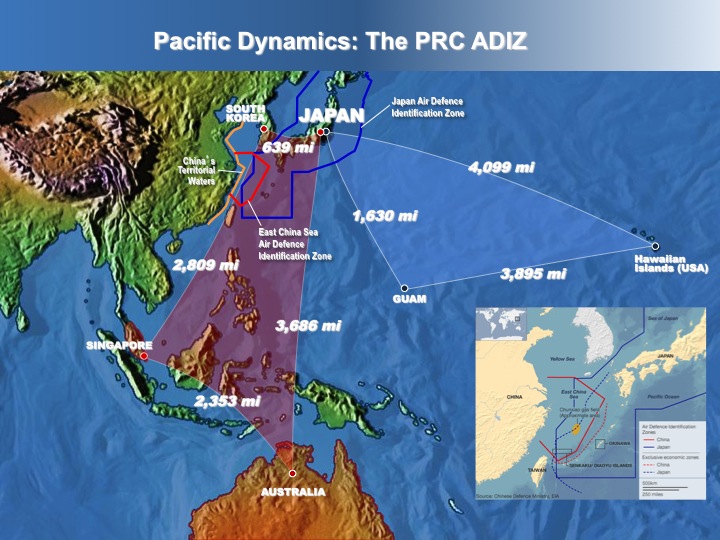
What we have called the strategic quadrangle in the Pacific is a central area where the U.S. and several core allies are reaching out to shape collaborative defense capabilities to ensure defense in depth.
This area is central to the operation of forces from Japan, South Korea, Australia, India, Singapore and the United States, to mention the most important allies.
These allies are adding new air and maritime assets and are working to expand the reach and range of those assets through various new capabilities, such as air tanking and the shaping of electronic surveillance and defense assets.
Freedom to operate in the quadrangle is a baseline requirement for allies to shape collaborative capabilities and policies. 
Effectiveness can only emerge from exercising evolving forces and shaping convergent concepts of operations.
This requires time; this requires practice; and this requires introducing new systems such as A330 tankers and F-35s, P-8s, or Wedgetails into the operational area.
In our book on the shaping of a 21st century strategy, we highlight Pacific operational geography as a key element for forging such a strategy.
In effect, U.S. forces operate in two different quadrants—one can be conceptualized as a strategic triangle and the other as a strategic quadrangle.
The first quadrant—the strategic triangle—involves the operation of American forces from Hawaii and the crucial island of Guam with the defense of Japan. 
U.S. forces based in Japan are part of a triangle of bases, which provide for forward presence and ability to project power deeper into the Pacific.
The second quadrant—the strategic quadrangle—is a key area into which such power needs to be projected. 
The Korean peninsula is a key part of this quadrangle, and the festering threat from North Korea reaches out significantly farther than the peninsula itself.
The continent of Australia anchors the western Pacific and provides a key ally for the United States in shaping ways to deal with various threats in the Pacific, including the PRC reach deeper into the Pacific with PRC forces. 
Singapore is a key element of the quadrangle and provides a key ally for the United States and others in the region.
A central pressure in the region is that each of the key allies in the region works more effectively with the United States than they do with each other.
This is why the United States is a key lynchpin in providing cross linkages and cross capabilities within the region. 
But it is clear that over time a thickening of these regional linkages will be essential to an effective 21st-century Pacific strategy.
The distances in these regions are immense.
For the strategic triangle, the distance from Hawaii to Japan are nearly 4,100 miles. 
The distance from Hawaii to Guam—the key U.S. base in the Western Pacific—is nearly 4,000 miles. 
And the ability of Guam to work with Japan is limited by the nearly 2,000-mile distance between them as well.
For the strategic quadrangle, the distances are equally daunting. 
It is nearly 4,000 miles from Japan to Australia. It is nearly 2,500 miles from Singapore to Australia and nearly 3,000 miles from Singapore to South Korea.
Clearly, air and naval forces face significant challenges in providing presence and operational effectiveness over such distances.
This is why a key element of shaping an effective U.S. strategy in the Pacific will rest on much greater ability for the allies to work together and much greater capability for U.S. forces to work effectively with those allied forces.
In an interview we did earlier this year with Lt. General Robling who is MARFORCPAC, the General highlighted the significance of the geographical challenge to the kind of persistent presence the US is seeking in working with allies:
To get from Hawaii into the strategic triangle or quadrangle takes significant time. 
 Between Hawaii and Okinawa is about 5 steaming days. 
 It is longer to get to Australia and Guam and then back up to Okinawa and Tokyo within the Quadrangle.
Strategic aircraft lift – C-17s – cuts that time down significantly…hours vice days. 
However, they are expensive to use, take several sorties to move the same amount of equipment you could move on shipping and are not always available.
Our strategic partners and allies are spread out over a significant geographical area.
They want to train with us, but not always bilaterally, they sometimes want us to work with them and some or several of their partner countries.
That means we must take the training to them.

Enter the PRC and its attempt to declare an Air Defense Identification Zone or ADIZ.
This is clearly a significant gambit to take a bit out of the strategic quadrangle and to foment discord among allies.
According to a Japan Times article about the ADIZ:
The (Japanese) government branded as “very dangerous” China’s announcement Saturday that it has set up an East China Sea air defense identification zone that includes the Japan-held Senkaku Islands.
The Chinese Defence Ministry said the zone was created to “guard against potential air threats,” but the move will only inflame a bitter sovereignty row over the islets.
Later Saturday, China scrambled air force jets, including fighter planes, to patrol the new zone…..
(The new zone) covers a wide area of the East China Sea between South Korea and Taiwan, and includes the Senkaku islets…..
Along with the new zone, the Chinese ministry released a set of aircraft identification rules that it says must be followed by all aircraft entering the area, under penalty of intervention by China’s military.
Aircraft are now expected to provide their flight path, clearly mark their nationality and maintain two-way radio communication in order to “respond in a timely and accurate manner to identification inquiries” from Chinese authorities….
This last point is an important one: for the PRC is asserting its right to verify the operations of all aircraft, whether commercial or military and whether intending to enter PRC territory or not.
This might seem a irrational act of a power hungry power but seem from the perspective of the strategic geography of the Pacific it is not.
The PRC is putting down its marker onto the quadrangle and if not dealt with will undoubtedly expand its definitions of air and maritime defense outward.
We have placed the ADIZ down upon the strategic geography we have identified and a key reality quickly emerges. 
Just by chance the zone covers reinforcements to Taiwan.
This is clearly a backhanded attempt to promote the PRC’s view of the nature of Taiwan and the South China Sea in their defense calculus.
There have been hints as well that the PRC is looking to do something similar with Vietnam in mind.
China is about to establish a second air defense identification zone over the South China Sea, Qin Gang, spokesperson for China’s foreign ministry, said on Nov. 25, according to the Moscow-based Voice of Russia.
Qin said the air defense identification zone over the East China Sea announced by Beijing on Nov. 23 was a buffer zone to defend the territorial integrity of China and said a second air defense identification zone which may cover the disputed South China Sea will be established in due course.
The Vietnamese case could prove interesting, not only in terms of expanding the Pacific defense equation dealing with the PRC seeking to expand its area of control out into the Pacific.
We have made the case in the book that focus of a 21st century US strategy is Pacific defense, not simply a U.S. military strategy in the Pacific.
The PRC focus on Vietnam is a good case in point because it will lead immediately to PRC-Indian “discussions.”
The recent Indian and Vietnamese summit focused among other things upon the further development of Vietnamese resources and augmenting its defense capabilities.
According to a Thanh Nien story drawing upon a Times of India story:
India’s navy is training over 500 Vietnamese submariners as part of the countries’ resolution to expand bilateral military ties, the Times of India reported last week.
During talks between Indian Prime Minister Manmohan Singh and visiting Communist Party general secretary Nguyen Phu Trong last Wednesday, it was decided that India would issue Vietnam a US$100 million line of credit for the purposes of enabling the latter to acquire four naval patrol vessels from the former, the report said.
The ongoing training of Vietnamese sailors in “comprehensive underwater combat operations” at the Indian Navy’s submarine training center,
INS Satavahana in Visakhapatnam, is a major bilateral initiative of the nations’ emerging strategic partnership.
Over 500 Vietnamese sailors will be trained in batches at the center, which is equipped with state of the art technology, by the Indian Navy, according to the report.
In December 2009, Vietnam signed a $2 billion deal to buy six submarines from Russia, which is due to deliver them all by 2016.
The Indian Navy’s extensive experience in operating Russian
Kilo-class submarines, which dates back to the mid-1980s, will be invaluable to Vietnam as its navy learns how to handle their new underwater vessels, according to the Times of India.
In the past, India has supplied spare parts for Russian Petya class warships and Vietnamese OSA-II class missile boats.
“India will continue to assist Vietnam to modernize and train its defense and security forces, including via the $100 million line of credit for defense purchases,” said PM Singh.
And The Japan Times added additional information, which highlighted the importance of the recent Vietnamese-Indian summit:
India and Vietnam made serious efforts to upgrade their bilateral relations earlier this month during the visit to New Delhi by Vietnamese Communist Party Secretary General Nguyen Phu Trong.
Eight pacts were inked, including ones on energy cooperation and protection of information, which are strategically significant areas that will influence the trajectory of this bilateral relationship.
Vietnam has offered seven oil blocks to India in South China Sea, including three on an exclusive basis where Hanoi is hoping for production-sharing agreements with India’s state-owned oil company ONGC Videsh Ltd. (OVL).
In a significant move, India has also decided to offer a $100 million credit line to Vietnam to purchase military equipment. 
Usually a privilege reserved for its immediate neighbors, this is the first time that New Delhi has made such an offer to a more distant nation.
Delhi and Hanoi have been working toward building a robust partnership for the past few years.
It is instructive that India entered the fraught region of the South China Sea via Vietnam.
New Delhi signed an agreement with Vietnam in October 2011 to expand and promote oil exploration in the South China Sea and then reconfirmed its decision to carry on despite the Chinese challenge to the legality of an Indian presence.
Beijing told New Delhi that its permission was needed for India’s state-owned oil and gas firm to explore for energy there. 
But Vietnam quickly cited the 1982 United Nations Convention on the Law of the Sea to claim its sovereign rights over the two blocks in question.
Hanoi has been publicly sparring with Beijing over the South China Sea for the last few years, so such a response was expected.
What was new, however, was New Delhi’s newfound aggression in taking on China.
It immediately decided to support Hanoi’s claims.
By accepting the Vietnamese invitation to explore oil and gas in Blocks 127 and 128, OVL not only expressed New Delhi’s desire to deepen its friendship with Vietnam, but also ignored China’s warning to stay away.

A clear message from our recent discussion with General Hawk Carlisle, the AFPAC commander, was that enhancing allied cooperation among themselves as well as working with the U.S. was a core American objective in shaping Pacific defense.
In the interview, he noted that the U.S.-Japanese relationship is undergoing a fundamental transformation. The Japanese are clearly rethinking their defense posture and he argued that the U.S. was working much more deeply and comprehensively with the Japanese defense forces than even two years ago. 
For example, “We have moved our air defense headquarters to Yokota Air Base and we are doing much closer coordination on air and missile defense with the Japanese to deal with a wider spectrum of regional threats.”
The Air Force is stepping up its collaborative efforts and capabilities with key regional air forces, including with Australia, Singapore, South Korea and Japan. 
And Carlisle emphasized that the service is pushing to enhance cross-collaborative capabilities among those allies as well.
While trying to get the allies to work more closely with each other, the Pacific commander also underscored that the US Air Force is adopting allied innovations.
“Singapore is doing very innovative things with their F-15s, notably in evolving the capabilities of the aircraft to contribute to maritime defense and security. We are looking very carefully at their innovations and can leverage their approach and thinking as well,” he said. 
“This will certainly grow as we introduce the fleet of F-35s in the Pacific where cross national collaboration is built in.”
Forging paths towards cross-domain synergy among joint and coalition forces is a key effort underway.
There is a tendency in Washington to believe that PRC actions are really just directed against the United States.
This misses a fundamental point: Pacific allies and the United States are seeking to shape an effective 21st century defense strategy, in which the US is clearly important but not the only player.
The PRC understands this and is working towards Ben Franklin moments for the US and its allies.
We must, indeed, all hang together, or assuredly we shall all hang separately.
The PRC leadership hopes that discord between the US and its allies and among the Pacific allies themselves will lead them to chose hanging separately.
It is a gamble but apparently one worth taking for the PRC leadership.
Read More
Posted in ADIZ, China’s aggressive expansionism, China's threat, East Sea, Pacific Defense Quadrangle, Pacific operational geography, security strategy, Vietnamese-Indian summit | No comments

Thursday, 5 December 2013

A South China Sea ADIZ: China’s Next Move

Posted on 07:37 by Unknown


American betrayal: Washington not only gave de facto approval of the East China Sea ADIZ, but also suggested that future Chinese moves would not be met with strong resistance. 
By Harry Kazianis

I hate making predictions. 
Truthfully, I am the type of person who likes to go to casinos for the latest sporting events or concerts and would never throw my money away in a slot machine or on the blackjack table. 
However, I can guarantee Vegas would lose its shirt on this bet, an easy wager to make: Look for China in the next year to eighteen months to declare an ADIZ over the South China Sea — in fact, Beijing’s ambassador to the Philippines appears to have alluded to such a move. 
Heck, I will even take it a step further and bet the wife and dog on this one: Beijing will create such a zone in the Yellow Sea as well at some point in the near future.
Why am I making such a prediction? 
Two recent factors come into play that in my view give China the rationale along with the ample cover they need to make such a move.
First, Washington appears to have given Beijing the green light to go forward — albeit unintentionally it seems.
Various reports based off a Kyodo news agency article have suggested a senior official traveling with Vice President Joseph Biden to Asia explained that “Washington is also asking China not to set up an air defense zone in the South China Sea, where Beijing is locked in territorial rows with Southeast Asian nations, without first consulting countries concerned.”
So let me see if I have this correct: It would be OK if China crafted an ADIZ in the South China Sea as long as it tells its neighbors in some fashion, in advance? 
Considering Beijing has already made a veiled reference that it could set up additional ADIZ in the future, the timing of such a comment was ill advised at best.
Honestly, I am hoping the official was misunderstood or misspoke because if accurate, Beijing could use such wording to openly declare such a new ADIZ in the South China Sea — an area with sovereignty disputes involving multiple claimants. 
In fact, Beijing has already gone so far to claim 80 percent of the area, effectively taking control of Scarborough Shoal last summer, which is well within the Exclusive Economic Zone (EEZ) of the Philippines and is pressing its claims now on Second Thomas Shoal. 
China has also deployed its new aircraft carrier to the region in what could be seen as a show of force (although, let’s be frank, the carrier won’t be operational for sometime, however, the point is still made).
Second, when America’s Federal Aviation Administration (FAA) gave guidance that U.S. domestic carriers should inform Beijing of their flight plans, Washington not only gave de facto approval of the East China Sea ADIZ, but also suggested that future moves would not be met with strong resistance. 
Yet, any move that gives this ADIZ declaration on China’s part any legitimacy will certainly be used by Beijing as a sign of acceptance. 
If we got away with it once, why not try the same move again and again?
As I explained in a piece for the Washington Times recently, creating an ADIZ, an area that is essentially an early-warning buffer zone for possible intrusions into a nation’s airspace, is not aggressive. 
It is the arc of Chinese actions dating back to 2006 onward that should worry the international community. Looked upon as a whole, the trend is truly concerning. 
No one is saying Beijing does not have the right as a great power and possible someday a superpower to shape the international stage in a way that is friendly to its own national interest. 
It is the optics of how it is going about doing it that frightens its neighbors. 
For all of China’s worries about being contained by the U.S. “pivot” to Asia, China is doing a great job of aligning its neighbors against its actions — effectively containing itself and giving credence to the growing narrative as Asia’s new regional bully. 
Bad move Beijing.
Read More
Posted in American tradition of betrayal, Beijing's expansionism, Chinese aggression, East Sea, Han hegemony, Scarborough Shoal, Second Thomas Shoal, South China Sea ADIZ | No comments

Monday, 2 December 2013

China’s Aggressive Expansionism Hits Archaeology

Posted on 00:27 by Unknown
China Has Begun Asserting Ownership of Thousands of Shipwrecks in the South China Sea
By JEREMY PAGE

A replica of a treasure ship sailed by Zheng He about 600 years ago at a museum in Nanjing. 
Underwater archaeologist Franck Goddio's team was exploring the wreckage of a 13th-century Chinese junk off the coast of the Philippines when it made an unwelcome discovery about China's maritime muscle in the 21st century.
As a twin-prop plane swooped overhead, a Chinese marine-surveillance vessel approached the team's Philippines-registered ship and began broadcasting instructions in English over a loudspeaker.
"They said this area belonged to the People's Republic of China, and they told us to scram," recalls one of the people on board last year. 
"It was pretty scary." 
Chinese officials confirm the incident took place but say the archaeologists' mission was illegal.

A boatman paddles away from the Sarangani, a ship on which archaeologists became embroiled in a standoff with China, in Manila Bay.

With territorial disputes escalating in the waters off China, the Chinese government has begun asserting ownership of thousands of shipwrecks within a vast U-shaped area that covers almost all of the South China Sea, which it says has been part of its territorial waters for centuries.
China has ordered its coast guard to prevent what it considers illegal archaeology in the waters it claims, and it is pouring money into a state-run marine-archaeology program. 
Chinese archaeologists are preparing their first comprehensive survey of undersea sites, including in disputed areas.
Chinese officials say their efforts will curb the theft and treasure hunting they say has destroyed numerous sites and flooded the global market with looted Chinese antiquities.

There is a political dimension to China's plans. 
Chinese archaeologists openly aspire to bolster their country's historical claims to the contested South China Sea, which overlap with those of Vietnam, Malaysia, Brunei, and the Philippines.
"We want to find more evidence that can prove Chinese people went there and lived there, historical evidence that can help prove China is the sovereign owner of the South China Sea," says Liu Shuguang, head of the Chinese government's Center of Underwater Cultural Heritage, set up in 2009 to oversee underwater archaeology in the country.
Tensions have been running high in the region over China's intensifying campaign to assert territorial claims, not only in the South China Sea, but in the East China Sea, which is contested by Japan. 
On Nov. 23, China proclaimed a new air-defense identification zone over Japanese Senkaku islands.
The South China Sea, one of the world's busiest trading routes, is littered with wrecks from the last two millennia, including Chinese junks, Indian and Arab dhows, Dutch and British trading schooners and World War II warships. 
Chinese archaeologists say they have gathered coordinates for 70 shipwrecks in those waters but estimate there are at least 2,000, and possibly many more.
A team working with French underwater archaeologist Franck Goddio, shown in 2010, was exploring the wreckage of a 13th-century Chinese junk off the coast of the Philippines when a Chinese marine-surveillance vessel ordered them to leave the area. 

Mr. Goddio, a Frenchman who is one of the world's leading marine archaeologists, had worked in the area since the 1980s, excavating 15th-century Chinese junks, 16th-century Spanish galleons and 18th-century British merchant ships. 
In addition to the trip last year, his team had visited the cluster of reefs and rocks off the Philippines, called the Scarborough Shoal, in 2011. 
Both expeditions were part of a joint research project with the National Museum of the Philippines, which collaborates with foreign archaeologists because of a shortage of state funding.
Different countries refer to the disputed islands by different names.
People involved in the project say it has no political or commercial agenda. 
During last year's trip, they say, they were examining pieces of celadon, a form of green-glazed ceramic, from a wreck that long ago broke apart on the sharp coral.
Chinese officials see ulterior motives.
"The Philippines sent some French archaeologists to do what? To drag away this shipwreck," says Mr. Liu of China's Center of Underwater Cultural Heritage. 
"Because this was material evidence that Chinese people first found the Scarborough Shoal, they wanted to destroy evidence that was beneficial to China." 
The archaeologists deny that.
Chinese archaeologists haven't started excavating sites at the Scarborough Shoal, but they have begun work on Chinese wrecks around the Paracel Islands, which lie about 200 miles from the coasts of China and Vietnam and are claimed by both countries. 
China has controlled the islands since 1974, when it defeated Vietnam in a brief naval battle.
Mike Hatcher prepares to dive from his ship in the South China Sea in 1986. On the expedition he found the 'Nanking cargo,' a haul of Chinese porcelain and gold from the wreck of the Geldermalsen, an 18th-century Dutch East India Co. ship that raised more than $20 million at auction in Amsterdam. 

"Marine archaeology is an exercise that demonstrates national sovereignty," Li Xiaojie, the vice minister of culture, was quoted as saying by state media in September 2012 as he examined porcelain retrieved from a wreck off the Paracels.
Chinese archaeologists say the survey encompassing other disputed areas will begin this year or next.
They also say they hope to support the government's efforts to re-establish China as a world maritime power, by focusing their research on the "Maritime Silk Road," which connected China by sea with India and Africa beginning in about the second century B.C.
China's five-year plan for 2011 to 2015 calls for the government to promote a seafaring heritage embodied by Zheng He, a eunuch admiral who sailed an armada of treasure ships as far as Africa about 600 years ago. 
The admiral is celebrated in China as the face of an era when it projected power far beyond its shores.
Xi Jinping, China's new president, has repeatedly emphasized the importance of maritime power—at times invoking Zheng He—as part of a vision to reclaim China's world prominence.
Zhang Wei, one of China's first underwater archaeologists, says the nation is "extremely focused on being a great and strong maritime power," which he calls the "grand backdrop" to China's marine-archaeology program. 
The program was launched, he says, under the auspices of President Xi's father, who served as vice premier under Deng Xiaoping in the 1980s.
Two enameled globular teapots painted with peony and bamboo below a border of trellis-pattern; the porcelain survived the wreck and lasted more than two centuries under the sea so well because it was packed inside the tea, which in turn was in wooden chests.

Mr. Zhang says interest was kindled by commercial treasure hunters who operated in the South China Sea. Among the most famous was Mike Hatcher, a Briton whose haul of Chinese porcelain from the wreck of the Geldermalsen, an 18th-century Dutch East India Co. ship that sank in the South China Sea, raised more than $20 million at auction in Amsterdam in 1986.
Chinese leaders dispatched two officials to that auction to try to buy some of the items with cash, according to Mr. Zhang. 
"They only took about $30,000, and they couldn't buy a single thing," he says.
China's National Museum established its Underwater Archaeology Center the following year and appointed Mr. Zhang to head it—mainly, he says, because he was one of the few Chinese archaeologists who could swim.
The first big find in Chinese waters—a roughly 800-year-old merchant ship named the Nanhai One—was made in 1987 while a British salvage company was searching for a Dutch East India Co. wreck. 
The British team was forced to withdraw after the Nanhai One was identified as a Chinese ship.
Since then, there has been almost no foreign participation in marine archaeology in China, according to Chinese and foreign archaeologists. 
And only Chinese wrecks have been excavated in Chinese waters.
Chinese authorities, meanwhile, have trained more than 100 marine archaeologists, built at least three underwater-archaeology museums and invested millions of dollars in research. 
On Thursday, they announced a new project to remove up to 80,000 artifacts from the Nanhai One, which was lifted off the seabed in 2007 and placed in a water tank in a museum.
Next year, China plans to launch a 184-foot ship designed for marine archaeology, the first of its kind in the country, according to state-media reports.
China also is funding joint projects in other countries' waters, focusing mostly on locating wrecks linked to Zheng He. 
Last year, Chinese archaeologists using sonar identified five wrecks they believe were part of his fleet in the Gulf of Oman and the Strait of Hormuz, according to Chinese state media.
One reason Chinese authorities are so interested in tracing Zheng He's travels is that he is said to have visited several rocks and islands in the South China Sea.
Chinese archaeologists work with porcelain artifacts from the Nanhai One shipwreck, which dated back to the Southern Song Dynasty (1127-1279), in a structure in Yangjiang, China, in 2009.

Foreign experts say they welcome China's new willingness to invest in underwater archaeology and relish the prospect of learning more about sites in China's waters.
But they are concerned that a political agenda might be driving China's choice of sites, its exclusion of foreign archaeologists and its relative lack of openness about its research.
"There's this strong sense of nationalism that flows through the Chinese program," says Jeffrey L. Adams, an anthropologist at the University of Minnesota who has written about Chinese archaeology.
Foreign archaeologists mostly agree that Chinese-built ships and cargo account for many of the sites in the South China Sea because of the international trade in Chinese porcelain and silk.
But many of the wrecks lie far from the Chinese mainland, around the reefs and rocks off the coast of Malaysia, Brunei and the Philippines, because ships used to hug those shores to help with navigation and avoid bad weather.
Even if a wreck isn't in a disputed area, tracing its national "ownership" is often complicated. 
A ship, its owner, its cargo and its crew all may have originated in different countries.
Internationally, the trend in recent years has been toward acknowledging "common heritage," pursuing joint excavation and sharing results among academics from different nations. 
A 2001 Unesco convention on underwater cultural heritage encouraged states to cooperate when they had a shared interest in a site, but offered no guidance on jurisdiction and no mechanism for dealing with sites in disputed areas.
"If there's a disputed site, what we recommend is just get together and don't get into a fight over it," says Ulrike Guerin, who oversees protection of underwater cultural heritage at Unesco, the United Nations Educational, Scientific and Cultural Organization. 
"If you look around the world now, the majority of projects are multinational ones."
None of the countries involved in the South China Sea disputes have ratified the Unesco convention. 
Only China has the resources to enforce its claims to wrecks in the area and to excavate them.
China did little to enforce those claims until March 2012, when the government announced its first-ever crackdown on illegal salvage and archaeological work in China's territorial waters.
The incident at the Scarborough Shoal occurred less than a month later.
China says the standoff stemmed from an incident that April when a Philippines navy ship detained some Chinese fishermen near the Scarborough Shoal. 
But Chinese officials also have made it clear they regarded Mr. Goddio's project as illegal.
The Chinese marine-surveillance ship that approached the archaeologists was one of three Chinese vessels that took turns monitoring them over the next week or so, according to two people on board the archaeologists' ship and accounts in Chinese state media.
A Philippines coast guard ship was sent to the area but kept its distance. 
A tense standoff ensued as Chinese and Filipino officials accused one another of violating territorial boundaries.
Eventually, on April 18, the archaeologists' ship was forced to leave, prompting a formal protest from the Philippines' government. 
China has had effective control of the area since then.
The team abandoned its project. Mr. Goddio declined to comment.
Neither he nor the National Museum of the Philippines has a track record of using finds to justify territorial or ownership claims. 
"We don't really care who owns the ship," says Sheldon Clyde B. Jago-on, the head of underwater archaeology at the National Museum of the Philippines. 
"It's our shared heritage. It should be about collaboration. We care about the trade patterns, the trade routes, the cargo, the boat building."
Some experts say the overlap between politics and archaeology is neither surprising nor unique to China. Vietnam is expanding investment in its state-run archaeological program, and this year its Institute of Archaeology opened an underwater-archaeology department.
One of Vietnam's first projects has obvious political resonance—excavation of the site of a naval battle in which Vietnamese forces defeated a Chinese army in 938 A.D., bringing an end to centuries of Chinese rule over Vietnam. 
That site is on a river inside Vietnam.
The Scarborough Shoal incident, by contrast, marked the first time a country in the region used force to stop another nation's underwater archaeological project, experts say.
"China has the largest navy and the ability to chase people off, and then follow up with archaeological work," says Mark Staniforth, a marine archaeologist at Australia's Monash University who is working with Vietnam's Institute of Archaeology. 
"There's no sense they want to cooperate or collaborate with anyone."
Read More
Posted in Beijing bully, China’s aggressive expansionism, East Sea, Han hegemony, marine archaeology, National Museum of the Philippines, paracel islands, Scarborough Shoal, shipwrecks, Zheng He | No comments

Saturday, 30 November 2013

Face-off

Posted on 06:38 by Unknown
Like a teenager on a growth spurt who doesn’t know his own strength, China has underestimated the impact of its actions. 
The Economist

THE announcement by a Chinese military spokesman on November 23rd sounded bureaucratic: any aircraft flying through the newly designated Air Defence Identification Zone (ADIZ) in the East China Sea must notify Chinese authorities in advance and follow instructions from its air-traffic controllers. 
America’s response was rapid. 
On November 26th Barack Obama sent two B-52 bombers to fly through the new zone without notifying China. 
This face-off marks the most worrying strategic escalation between the two countries since 1996, when China’s then president, Jiang Zemin, ordered a number of exclusion zones for missile tests in the Taiwan Strait, leading America to send two aircraft-carriers there.
Plenty of countries establish zones in which they require aircraft to identify themselves, but they tend not to be over other countries’ territory. 
The Chinese ADIZ overlaps with Japan’s own air-defence zone (see map). 
It also includes some Japanese specks of rock called the Senkaku islands, as well as a South Korean reef, known as Ieodo. 
The move is clearly designed to bolster China’s claims. 
On November 28th Japan and South Korea sent aircraft into the zone.

Teenage testosterone

Growing economic power is bound to go hand-in-hand with growing regional assertiveness. 
That is fine, so long as the behaviour of the rising power remains within international norms. 
In this case, however, China’s does not; and America, which has guaranteed free navigation of the seas and skies of East Asia for 60 years, is right to make that clear.
How worrying China’s move is depends partly on the thinking behind it.
It may be that, like a teenager on a growth spurt who doesn’t know his own strength, China has underestimated the impact of its actions. 
The claim that America’s bombers had skirted the edge of the ADIZ was gawkily embarrassing. 
But teenagers who do not realise the consequences of their actions often cause trouble: China has set up a casus belli with its neighbours and America for generations to come.
It would thus be much more worrying if the provocation was deliberate. 
The “Chinese dream” of Xi Jinping, the new president, is a mixture of economic reform and strident nationalism. 
The announcement of the ADIZ came shortly after a party plenum at which Mr Xi announced a string of commendably radical domestic reforms. 
The new zone will appeal to the nationalist camp, which wields huge power, particularly in the armed forces. It also helps defend Mr Xi against any suggestions that he is a westernising liberal.
If this is Mr Xi’s game, it is a dangerous one. 
East Asia has never before had a strong China and a strong Japan at the same time. 
China dominated the region from the mists of history until the 1850s, when the West’s arrival spurred Japan to modernise while China tried to resist the foreigners’ influence. 
China is eager to re-establish dominance over the region. 
Bitterness at the memory of the Japanese occupation in the second world war sharpens this desire. 
It is this possibility of a clash between a rising and an established power that lies behind the oft-used parallel between contemporary East Asia and early 20th-century Europe, in which the Senkakus play the role of Sarajevo.
Seas of troubles
Tensions are not at that level. 
Japan’s constitution bans it from any military aggression and China normally goes to great lengths to stress that its rise—unlike that of Japan in the 1920s and 1930s—will be peaceful. 
But the neighbours are nervous, especially as the establishment of the ADIZ appears to match Chinese ambitions in the South China Sea.
Chinese maps show what is known as the “nine-dash line” encompassing all the South China Sea. 
In the wake of the global financial crisis, perhaps believing its own narrative of Chinese rise and American decline, it began to overreach in its dealings with its neighbours. 
It sent ships to disputed reefs, pressed foreign oil companies to halt exploration and harassed American and Vietnamese naval vessels in the South China Sea. 
These actions brought a swift rebuke from America’s then secretary of state, Hillary Clinton, and China appeared to back off and return to its regional charm offensive. 
Some observers say that the government is using the ADIZ to establish a nine-dash line covering the East China Sea as well. 
They fear China’s next move will be to declare an ADIZ over the South China Sea, to assert control over both the sea and the air throughout the region.
Whether or not China has such specific ambitions, the ADIZ clearly suggests that China does not accept the status quo in the region and wants to change it. 
Any Chinese leader now has an excuse for going after Japanese planes. 
Chinese ships are already ignoring Japanese demands not to enter the waters surrounding the disputed islands.
What can be done? 
Next week Joe Biden, America’s vice-president, arrives in China. 
The timing may be uncomfortable, but it is fortuitous. 
Mr Biden and Mr Xi know each other well: before Mr Xi became president, he spent five days in America at Mr Biden’s invitation. 
Mr Biden is also going to South Korea and Japan.
America’s “pivot” towards Asia is not taken very seriously there: Mr Obama is seen as distracted by his domestic problems. 
Mr Biden could usefully make clear America’s commitment to guaranteeing freedom of navigation in the region. 
Japan and South Korea, who squabble over petty issues, need to be told to get over their differences. 
As for China, it needs to behave like a responsible world power, not a troublemaker willing to sacrifice 60 years of peace in north-east Asia to score some points by grabbing a few windswept rocks. 
It should accept Japan’s suggestion of a military hotline, similar to the one that is already established between Beijing and Washington.
The region must work harder to build some kind of architecture where regional powers can discuss security. If such a framework had existed in Europe in 1914, things might have turned out differently.
Read More
Posted in ADIZ, air defence identification zone, Beijing bully, China’s aggressive expansionism, East Sea, Ieodo, japan, nine-dash line maritime grab, South Korea, teenager, USA | No comments

Friday, 29 November 2013

China looks to redraw Asian airspace

Posted on 04:32 by Unknown


By Demetri Sevastopulo in Hong Kong

When China created a controversial “air defence identification zone” last Saturday, it sparked alarm about the rising risk of Sino-Japanese conflict over the Senkaku Islands.
But while the focus has been on the Japanese chain, China also said in the same statement it “will establish other air defence identification zones at the right moment after necessary preparations are completed”, raising the spectre of tensions spreading across the region.
The Senkaku spat has attracted much attention over the past year because of the potential for war between Asia’s two biggest economies.
But China is engaged in a number of equally contentious territorial disputes with Southeast Asian nations – particularly the Philippines and Vietnam – over the resource-rich South China Sea.
Ian Storey, a security expert at the Institute of Southeast Asian Studies in Singapore, said the most obvious candidates for any new Chinese air defence zones were the northern part of the South China Sea and the Yellow Sea.
Chinese maps often include a controversial “nine-dash line” that loops the South China Sea, running close to the coasts of Vietnam, the Philippines and Malaysia, and stretching south to Indonesia.
It first emerged in a 1947 Republic of China map that was later used by the Communist government of Mao Zedong when it came to power in 1949.
While some Chinese scholars say China does not claim the entire South China Sea, the use of the map has sparked concern among Southeast Asian nations.

China last year started issuing passports that included an image of the “nine-dash line”, provoking angry responses from Vietnam, Indonesia and the Philippines.
Mr Storey said China would probably not create an ADIZ for the whole South China Sea, saying it would be “absolutely outrageous” if they included the whole area inside the “nine-dash line”.
Instead, he said China was more likely to establish a zone in the northern part of the sea, and particularly surrounding Hainan Island.
Hainan hosts the Chinese navy’s South Sea fleet – one of its three naval fleets – and also a new generation of nuclear submarines that are an increasingly important part of China’s naval capabilities in the South China Sea.
But Mr Storey added that creating an ADIZ over even some of the South China Sea would be “unnecessarily provocative” at a time when China is trying to reduce tensions with its Southeast Asian neighbours.
In October, Chinese President Xi Jinping took advantage of the absence of US President Barack Obama at the Apec summit in Indonesia to launch a charm offensive with Southeast Asian countries, including by floating the idea of creating an “Asian infrastructure bank” to promote development in the region.
Chinese Premier Li Keqiang then embarked on a tour of Southeast Asia that was widely seen as an effort to repair relations.
The creation of an ADIZ over the South China Sea would be unlikely to generate the same kind of military response that occurred this week when the US flew B-52 bombers near the Senkaku without alerting China – mainly because, with the exception of Singapore, most Southeast Asian nations have limited air power.
But Gary Li, a senior analyst at IHS maritime, said a Chinese ADIZ in the northern South China Sea would be “very, very sensitive”.
He said it would almost certainly overlap with Vietnam’s ADIZ, which reaches north to about 100km from Hainan Island, and includes the disputed Paracel Islands.
Mr Li said the Yellow Sea was also a contender for a new Chinese ADIZ.
China has repeatedly criticised the US and South Korea for holding joint military exercises in the Yellow Sea, which lies between east China and the Korean peninsula, and particularly so when the US sails its aircraft carriers through the area.
Wu Shicun, president of the National Institute for South China Sea Studies in Hainan, a think-tank that advises the Chinese foreign ministry, said that while China had the right to create new zones, it would take its time.
“We cannot rule out the possibility of setting up new ADIZs, but not in the short term,” said Mr Wu.
“Given the strong reaction from the international community to the East China Sea ADIZ, China will further evaluate when and how to set up new ADIZs. But it will happen sooner or later, since it is related to its national security.”
Shi Yinhong, an international relations expert at Renmin University, agreed that China was unlikely to create a zone in the South China Sea anytime soon, mainly because Beijing does not see the same urgency, but he said that could change if “confrontations in the South China Sea escalate”.
China and Japan had for decades put the Senkaku dispute to the side.
But Beijing reacted angrily last year when Japan bought three of the islands from their private owner, in a move that sparked anti-Japan protests across China.
Mr Li said China probably decided to create an ADIZ – which other countries such as Japan and the US did long ago – because Tokyo has routinely pointed to the number of Chinese incursions into Japan’s zone as a way to rally public support.
“That caused the Chinese side to say we need to get one too. There is a huge PR war here,” said Mr Li.
Read More
Posted in air defense identification zone, Asian airspace, China's aggressive expansionism, Chinese aggression, East Sea, paracel islands, Philippines, Southeast Asia | No comments

China's Latest Territorial Moves Renew Fears In Philippines

Posted on 03:27 by Unknown
by FRANK LANGFITT

U.S. and Philippine navy personnel patrol the seas off a naval base west of Manila in June as part of joint exercises.

China is flexing its muscles these days. 
Over the weekend, it declared a sprawling air defense identification zone that covers disputed islands controlled by Japan. 
And it has sent its lone aircraft carrier for first-time trials in the South China Sea, where Beijing has territorial feuds with other neighbors, including Vietnam, Brunei and the Philippines.
None of this was making China any friends in Manila, where the Chinese government is particularly unpopular these days.
"It only tends to confirm and reinforce the fears and worries of many people in the region," says Jay Batongbacal, a University of the Philippines law professor, who has spent a decade and a half studying territorial disputes in the South China Sea. 
"Right now, I think they are seen more as a bully, because of the actions that they've taken."
Among those actions was last year's takeover of a disputed and potentially strategic shoal in the South China Sea that had been under Philippine control.
It started when Philippine authorities tried to arrest Chinese they accused of illegally fishing inside the shoal, which is really a shallow, triangle-shaped reef with a small opening at one end. 
China sent marine surveillance ships to block action by a Philippine navy frigate.
"One of the measures that they put in place was to string a line across the mouth of that entrance," says Batongbacal, "because if any vessel tries to cross that line, it will get entangled in the propellers."
The Chinese effectively sealed off the reef from Philippine fishermen and took control of Scarborough Shoal without firing a shot.
The shoal, rich in fish, is about 140 miles from the Philippine mainland and more than 500 miles from China. At high tide, only five rocks stick up out of the water, but Philippine officials worry China might one day declare them Chinese territory.
Batongbacal says in the worst-case scenario — from the Philippine perspective — China could turn the shoal into a safe harbor for Chinese government vessels and a way to extend its influence and power in the region.
"Right now, it's clear that their motivation is that they want to vindicate their claim to the entire South China Sea," Batongbacal says.
A huge amount of trade and oil passes through the South China Sea, which China has claimed since the 1940s. Back then, though, it was militarily too weak to do anything about it. 
Today, China is the world's No. 2 economy and a rapidly rising military power.
Dindo Manhit, president of Stratbase Research Institute, a strategic think tank in Manila, says China now wants to ensure it has a major say in what happens in the South China Sea. 
Like all economic powers, Manhit says, China wants to spread its influence.
"At the end of the day, any economic influence needs to be protected by either strong military or political influence," Manhit says. 
"I think that's where it's coming from."
Chito Santa Romana, who spent nearly four decades living in China where he served as the bureau chief for ABC News, thinks it also comes from a desire to restore China, which means "Middle Kingdom" in Mandarin, to what it sees as its rightful place as a respected global player.
"I would attribute it to what I call the resurgence of the 'Middle Kingdom Complex,' " says Santa Romana, who works in Manila with a think tank, trying to forge understanding on the South China Sea dispute between the two countries. 
"The 'China Dream' that the Chinese talk about, they want to recover the glory that was lost when they were a pre-eminent power."
The U.S. has dominated East Asia militarily for decades, ensuring the peace and security that allowed the region's economies to grow so rapidly. 
The Philippines hopes America will back it up if its dispute with China turns violent, but some worry Washington's deep and complex ties with Beijing will win out in the end.
"We just hope and expect that the U.S. remembers us really as the true ally here," says Manhit, "because some people are saying that in a conflict between China and the Philippines, the U.S. will choose China because of the economic relationship."
Jay Batongbacal, the University of the Philippines law professor, says turning its back on a longtime ally with whom it has a mutual defense treaty would have serious implications for America and its other diplomatic relationships. 
Most people in the Philippines are hoping it never comes to that.
Read More
Posted in Beijing bully, China's aggressive expansionism, Chinese aggression, East Sea, Philippines, Scarborough Shoal | No comments

Tuesday, 26 November 2013

All-Out Intimidation

Posted on 11:59 by Unknown
China carrier steams towards disputed South China Sea for "drills"
By Ben Blanchard

China sent its sole aircraft carrier on a training mission into the South China Sea on Tuesday amid maritime disputes with the Philippines and other neighbors and tension over its plan to set up an airspace defense zone in waters disputed with Japan.
The Liaoning, bought used from Ukraine and refurbished in China, has conducted more than 100 exercises and experiments since it was commissioned last year but this is the first time it has been sent to the South China Sea.
The Liaoning left port from the northern city of Qingdao accompanied by two destroyers and two frigates, the Chinese navy said on an official news website (navy.81.cn/).
While there, it will carry out "scientific research, tests and military drills", the report said.
"This is the first time since the Liaoning entered service that it has carried out long-term drills on the high seas," it added.
The timing of the drills is bound to raise eyebrows with its neighbors, given the overlapping maritime disputes. China has lodged formal protests with the United States and Japan after both criticized its plan to impose new rules on airspace over disputed waters in the East China Sea.
On Tuesday, Australia said it had summoned China's ambassador to express concern over its imposition of the Air Defense Identification Zone.
China also claims almost the entire oil- and gas-rich South China Sea, conflicting with claims from Malaysia, Brunei, the Philippines and Vietnam.
That dispute is one of the region's biggest flashpoints amid China's military build-up and the U.S. strategic "pivot" back to Asia.
Though considered decades behind U.S. technology, the Liaoning represents the Chinese navy's blue-water ambitions and has been the focus of a campaign to stir patriotism.

'NOT OVERLY CONCERNED'
Rommel Banlaoi, executive director of the Philippine Institute for Peace, Violence and Terrorism Research, said he thought the Liaoning was still years away from representing a real threat.
"China is still developing its own model of carrier operations and its technology is (far) behind the United States," he said. 
"Personally, I would not be overly concerned with an old diesel-powered aircraft carrier on a training mission."
The navy did not specify exactly what training would be done, only noting that previous exercises involving aircraft landing and taking off had gone well.
Previously reported training exercises have mostly been in the Yellow Sea, between China and the Korean peninsula.
"Obviously the Chinese authorities have been adopting a series of measures to strengthen their claim on the sovereignty of the disputed territories," said Joseph Cheng, a political science professor at City University of Hong Kong.
"You see Japan and Southeast Asian countries have also been making gestures and taking steps to strengthen sovereignty, so China has to respond."
China's navy said the mission was routine, adding that the Liaoning was still in a testing phase.
"This test visit to the South China Sea is part of normal arrangements for testing and training for the Liaoning," it said.
"...Long cross-sea voyages are a necessary stage of experimentation and training to test equipment and troops under continuous work and different hydrological and meteorological conditions."
Read More
Posted in China carrier, China's threat, Chinese aggression, East Sea, Liaoning | No comments

Friday, 22 November 2013

Japan Seeks Friends in Asia—but Not China

Posted on 02:36 by Unknown
China needs to think twice before taking aggressive actions in the South China Sea
By Bruce Einhorn and Matthew Philips 

Prime Minister Shinzō Abe is the first Japanese premier to visit all 10 members of the Association of Southeast Asian Nations. 
In late November, Emperor Akihito will make the first visit by a Japanese monarch to India. 
Not on either dignitary’s itinerary—China. 
And that’s no accident.
Abe, a foreign-policy hawk who’s clashed with the Chinese over the ownership of some Japanese islands, wants to shore up relations with the swath of nations forming a semicircle around China. 
Some have their own beefs, including India, which shares a disputed border with China. 
Abe will visit India next year, and in mid-December will host Asean leaders. 
It’s all part of his campaign to thwart China’s rulers, who, as he wrote in a column last December, see the South China Sea as “Lake Beijing.”
This is powerful talk. 
China is throwing its considerable weight around more in the region, and it may react aggressively.
As all sides buy more warships, missiles, and fighter jets, such confrontations could escalate. 
“Nobody has said this is surrounding China,” says Chiaki Akimoto, director of RUSI Japan, an arm of Britain’s Royal United Services Institute, a think tank. 
What Abe wants “is just a friendship network with nations around China.”
Whatever Japan’s policy is called, Abe is even pursuing it in areas within China’s sphere of influence. 
In November, he took his charm campaign to Cambodia and Laos. 
Despite a pacifist tradition dating to the end of World War II, Japan is increasing military cooperation with Vietnam, Indonesia, and the Philippines, which have felt China’s wrath over territorial claims. 
Abe’s actions, says Tetsuo Kotani, research fellow at the Japan Institute of International Affairs, make clear that “China needs to think twice before taking assertive actions” in the South China Sea. 
The official China Daily dismissively says Abe has been “hyping South China Sea tension to gain popularity in the region.”
One reason Abe is getting a warm welcome is that China’s defense spending hit $172 billion last year, up 64 percent from 2008, according to the Stockholm International Peace Research Institute. 
India has one Russian-made nuclear submarine and may lease a second. 
It just took delivery of its third aircraft carrier. 
It has test-fired a supersonic cruise missile that can reach Beijing.
In the same Dec. 27 column where he made his “Lake Beijing” comment, Abe wrote, “The ongoing disputes... mean that Japan’s top foreign-policy priority must be to expand the country’s strategic horizons... I envisage a strategy whereby Australia, India, Japan, and the U.S. state of Hawaii form a diamond to safeguard the maritime commons from the Indian Ocean region to the western Pacific.” 
Abe also wants Japan to join the Five Power Defence Arrangements of Britain, Australia, Malaysia, New Zealand, and Singapore.
Operation Dawn Blitz: retaking the Senkaku islands

In June, Japan and the U.S. conducted Dawn Blitz, a military exercise in California that included a mock assault on a remote island. 
Japan’s self-defense force wouldn’t have joined such an exercise five years ago, says James Brown, a military fellow at the Lowy Institute for International Policy in Sydney. 
The stress on offensive action has spread to the navy. 
“We see the commissioning of warships that in external appearance look like assault ships,” says Dean Cheng, East Asian military analyst for the Heritage Foundation. 
“These are things that Japan shied away from.” 
Abe has long backed repealing the article of the country’s constitution that renounces war forever.
As the region’s militaries get bigger, so do the risks. 
“It strikes me how much the current situation in Asia looks like a replay of the 1930s in Europe,” says Daniel Goure, a vice president with the Lexington Institute, a think tank in Arlington, Va. 
Brown warns that “there are going to be a lot more submarines, a lot more amphibious vessels, a lot more aircraft, and we haven’t gotten agreement on how everybody is going to avoid accidents. It’s a huge problem.”
Read More
Posted in anti-China containment policy, ASEAN, Asia, Asia’s Democratic Security Diamond, Chinese aggression, diplomacy, East Sea, Five Power Defence Arrangements, japan, Lake Beijing, Shinzo Abe | No comments

Friday, 15 November 2013

Asia Rivalries Play Role in Aid to the Philippines

Posted on 02:54 by Unknown


By ANDREW JACOBS

CEBU, the Philippines — The American aircraft carrier George Washington has arrived, its 5,000 sailors and 80 aircraft already busy ferrying relief supplies to storm-battered survivors, and the United States has committed an initial $20 million in humanitarian assistance.
Japan is dispatching a naval force of 1,000 troops, in what officials say is that country’s largest ever disaster-relief deployment.
Also on the way: the Illustrious, a British aircraft carrier stocked with transport planes, medical experts and $32 million worth of aid.
The outpouring of foreign assistance for the hundreds of thousands left homeless and hungry by Typhoon Haiyan is shaping up to be a monumental show of international largess — and a dose of one-upmanship directed at the region’s fastest-rising power, China.
China, which has its own newly commissioned aircraft carrier and ambitions of displacing the United States, the dominant naval power in the Pacific, has been notably penurious.

A shipment of food unloaded from an American military helicopter in Guiuan, Philippines, on Thursday.
Beijing increased its total contribution to the relief effort to $1.6 million on Thursday after its initial pledge of $100,000 was dismissed as stingy, even by some state-backed news media in the country.
The typhoon, described as the most devastating natural calamity to hit the Philippines in recent history, is emerging as a showcase for the soft-power contest in Asia.
The geopolitical tensions have been stoked by China’s territorial claims in the South China Sea, and heightened by American efforts to reassert its influence in the region.
China has showered aid on countries it considers close friends, becoming the largest lender in Africa, rushing to help Pakistan after an earthquake in September and showing a more humanitarian side to its neighbors in Asia.
But the typhoon struck hardest at the country China considers its biggest nemesis in the legal, diplomatic and sometimes military standoff over control of tiny but strategic islands in the South China Sea.
Over the past year, Chinese and Philippine vessels have faced off over a reef called Scarborough Shoal, and the Philippines has angered China by taking the dispute to an international arbitration tribunal.
It did not help that the Philippines earlier this year said it would accept a gift of 10 coast guard vessels from Japan and voiced support for Tokyo’s plans to strengthen its military ties in the region, or that it is in discussions with the United States about hosting more American troops there.
The challenge for China comes shortly after the United States appeared to suffer a setback of its own in the contest for Pacific influence.
President Obama had to cancel a high-profile visit to the region this fall to grapple with the fiscal shutdown in the United States, an event that seemed to many in Asia to showcase American dysfunction.
So when the typhoon struck an old ally, the Pentagon did not waste much time offering a robust show of assistance.
“There is no other military in the world, there is no other navy in the world, that can do what we can do,” one American official said.
Michael Kulma, an expert on East Asia at the Asia Society in New York, said the Chinese reluctance to give more aid could hurt its chances to make a favorable impression in the country.
“There was an opportunity, right up front, for China to make a commitment,” he said.
“At the end of the day it could be that the Chinese end up giving more. But on the front end of it, they didn’t stand out.”
At the same time, the relief efforts by the United States could give a lift to its already strong influence in the Philippines.
Despite its longtime alliance with the United States, the Philippines has been tentative over what Washington sees as the country’s role in its so-called Asian pivot, which includes efforts to increase the presence of American troops on Philippine soil.
But the American relief effort — which is receiving a lot of news media attention in the country — might wear away at some of that reluctance, a legacy of the years when the Philippines was an American colony.
Already, some in Tacloban said they would not mind American boots on the ground there temporarily, if it would help.
“If the United States will come in, if it will be allowed to come, or if the United Nations can come in, it will really help us secure the city,” said Jerry Yaokasin, a senior municipal official.
China’s rise has been shifting geopolitics in the region for years.
With China’s investments in Southeast Asia mounting, even some countries worried about being overwhelmed by their imposing regional neighbor have found it hard to resist the pull of its economy — a dynamic that is very likely to continue.
But China’s increasing power has also in some cases worked against it, including in the Philippines, where the battle over maritime territory, including the Scarborough Shoal, has softened the wariness of Japan and the bitter memories of World War II, when Japan invaded.
In announcing their assistance on Thursday, Japanese officials spoke of it mostly as an effort to provide humanitarian assistance, though there was also an acknowledgment of growing security ties.
“The Philippines is geographically close to Japan and an important strategic partner,” said Japan’s defense minister, Itsunori Onodera.
The donated coast guard vessels are meant to help the Philippines better patrol its waters, including those contested with China.
On Thursday, officials said Japan’s military would send C-130 transport aircraft and helicopters to ferry supplies to areas that have been cut off by the disaster.
Japan will also send three navy ships, led by the Ise, Japan’s largest warship.
Tokyo also offered $10 million in emergency aid.
As more countries came forward with impressive aid packages — and after days of ignoring criticism that it was offering too little aid — China on Thursday said it would increase its assistance.
The Foreign Ministry spokesman, Qin Gang, said that China had never intended the amount of assistance to remain fixed, and insisted that it had adjusted its contribution according to growing needs.
“An overwhelming majority of Chinese people are sympathetic with the people of the Philippines,” he said.
Analysts, however, said one factor in determining the initial size of the assistance was the hostility among Chinese Internet commentators toward foreign aid, and to help for the Philippines in particular because of territorial disputes.
“There must have been a debate” inside the government about how much aid to give and how to supply it, said Qin Yaqing, professor of international studies at the Foreign Affairs University in Beijing.
He continued, “Chinese culture takes an incremental way of doing things so as not to cause more trouble with the domestic” audience.
In an unusual turn, Global Times, a newspaper that often projects a nationalist editorial line, criticized the initial offer of aid as too small.
In an editorial on Tuesday, it noted that the Philippines was a two-hour flight from China’s southern coast, but that countries much farther away responded quickly.
“A twisted relationship between the two countries caused by maritime disputes is not the reason to block joint efforts to combat natural disaster,” the editorial said.
Read More
Posted in Asia rivalries, Chinese aggression, Chinese pettiness, East Sea, humanitarian assistance, Philippines, relief supplies, Scarborough Shoal, soft-power contest, Typhoon Haiyan | No comments

Saturday, 9 November 2013

Off China's coast, U.S. carrier displays teeth behind the pivot

Posted on 07:47 by Unknown
By Greg Torode
A U.S. Navy personnel works in the control room of the U.S. Navy aircraft carrier USS George Washington, during a tour of the ship in the South China Sea November 7, 2013.

ABOARD THE USS GEORGE WASHINGTON, South China Sea -- While cuts in Pentagon budgets and political gridlock in Washington have cast doubt on the sustainability of a U.S. "pivot" back to Asia, its military realities are all too clear from the flight deck of the USS George Washington aircraft carrier.
F-18 Super Hornet jet fighters roar from its decks with chest-thumping velocity less than 300 km (185 miles) from the Chinese coast -- a symbol of U.S. naval dominance in Asia that Chinese analysts fear could contain Beijing's rising power for decades.
Yet just 30 km (19 miles) away is a lone Chinese naval frigate, well within the protective screen of U.S. ships and aircraft that protect the carrier across a vast swathe of the disputed South China Sea.
The officers of the Washington are hosting People's Liberation Army officers on-board as part of efforts to engage a Chinese military wary of being contained by U.S. forces across Asia.
The frigate has not been invited.
The Washington strike group commander, Rear Admiral Mark Montgomery, stretches his arm to the left horizon where the frigate is obscured by haze and acknowledges such encounters by the rival powers are now more common.
"You can definitely see the Chinese navy is modernizing and expanding," he said.
"It would be a natural conclusion they would be operating in the vicinity of us."
Montgomery said routine communication with Chinese naval ships was "professional" and that the U.S. navy was determined to aid the long-troubled relationship with "transparency and openness".
"I don't have any issues with them operating in the vicinity of our ships," he said.
The Washington strike group -- that often includes destroyers, cruisers and a fast-attack submarine backed by up to 90 aircraft -- protects the only one of 10 carriers deployed permanently outside the continental United States.
Based in Yokosuka, Japan, the Washington is the most visible sign of an increased U.S. naval presence across Asia that has been steadily growing for the last five years -- a key element in the controversial U.S. "pivot".
On Friday, it is due to arrive in the financial hub of Hong Kong after months across the region running joint exercises, maneuvers and training.
While U.S. military brass attempt to ease China's fears that the United States is determined to hem China in, as it re-engages the region, its old allies and newer friends are wanting reassurances the United States is going to stay around.
Last month, U.S. President Barack Obama said China had probably taken advantage of his absence from two summits in Asia which he could not attend because of the partial U.S. government shutdown and fiscal debate.

COMBAT READINESS
The presence of the strike group in the South China Sea appears geared to addressing the core of U.S. engagement in the region.
The overlapping claims of China, the Philippines, Vietnam, Brunei and Malaysia in the oil- and gas-rich sea is emerging as a regional flashpoint.
The United States has said it is neutral in the dispute -- centered on China's controversial historic claim of waters deep in the maritime heart of Southeast Asia -- but is determined to preserve peace and ensure that sea-lanes vital for the world economy are not hindered.
Even as it grapples with budget cuts, over the next few years the United States will significantly expand joint exercises, live-firing tests and anti-submarine drills in the region, in part to cope with advancing Chinese weaponry, according to the Stars and Stripes, the U.S. military newspaper.
And on board the George Washington, officers and crew say combat readiness is being maintained through costly flight schedules that see 100 sorties routinely flown from the ship on most days.
Chinese officials and commentators often bristle at the U.S. efforts.
Despite years of double-digit increases in defense spending by China, it lags far behind the United States in terms of firepower.
Chinese pilots are still testing landings aboard the Liaoning, a Soviet-era ship that has been re-tooled as China's first aircraft carrier.
China's first domestically built carriers are not expected to be completed before 2020, according to military analysts, even as its shipyards produce new nuclear and conventional submarines, destroyers and other heavily armed surface ships faster than any other nation.
Its expanding fleet has started routinely exercising far beyond China's coastal waters, moving beyond the so-called first island chain that has long effectively contained China's navy and into open ocean east of Japan.
Both Asian and Western analysts, however, believe China's navy would struggle for some years to sustain protracted battles far from its shores.
Assessing the situation from the bridge, high above the flight deck, Montgomery insists his navy is committed, both in terms of operational capabilities and engagement.
Put simply, he says: "There are more ships involved here."
Read More
Posted in anti-China containment policy, Chinese aggression, East Sea, pivot to Asia, USS George Washington | No comments

Thursday, 31 October 2013

China’s Expanding Cabbage Strategy

Posted on 01:31 by Unknown
By Harry Kazianis

In one of the best pieces on the subject in recent years, the New York Times magazine released what can best be described as an interactive feast regarding the delicate subject of the South China Sea. 
Beneath all the interactive maps, previously unreleased photos and eye-catching video were some interesting aspects of China’s strategy regarding this disputed area that is sure to be of interest to Asia hands.
The article itself is certainly worth your time just for the sheer artistic quality in which this important issue is covered. 
Sticking to the business at hand, there was one specific section that caught my eye. 
The piece notes comments from PLA General Zhang Zhaozhong regarding what is being called China’s “cabbage strategy.” 
The Times describes it as “surrounding a contested area with so many boats — fishermen, fishing administration ships, marine surveillance ships, navy warships” that the disputed island is essentially wrapped like layers of cabbage. 
A friend of mine has another name for this strategy: small-stick diplomacy.
While General Zhang is not one to shy away from controversial statements, the actual idea is nothing new and has made the pages of many other publications. 
Yet, looking at Chinese actions over the last two years or so, one has to wonder whether such a cabbage strategy has moved into a more active phase beyond the South China Sea and into even more deadly waters.
In the East China Sea, China’s claims over the Senkaku islands continue to press ahead. 
On Monday, according to Kyodo News, four Chinese coast guard vessels entered the area around the islands. The report explained it was the first such incursion since October 1st. 
More importantly — it was the sixty-eighth such incident since Tokyo purchased the islands from private Japanese owners in September of last year. 
When a Japanese patrol craft told the Chinese vessels to leave, one of the ships responded the islands had been “China’s inherent territory since ancient times.”
Making matters even more complex, China’s claims could be even reaching new heights. 
In May, The Diplomat reported on a commentary piece in the People’s Daily in which the authors pressed China’s claims over Okinawa and the Ryukyu islands. 
While the Chinese government is quick to move away from such claims, recent actions may prove quite telling.
The Financial Times reports that Tokyo scrambled fighter aircraft for a third straight day on Sunday. 
This was in response to flights by Chinese military aircraft over the Okinawan islands. 
The article also noted that “a Chinese reconnaissance plane was spotted by the Japanese Air Self-Defense Force on Friday and again over the weekend, this time accompanied by a bomber jet.”
The interesting and natural question to me is would China press its claims in an even more rigorous manner? For example, could we see Beijing surround the Senkakus in a cabbage like way in the near future. 
To be blunt, I doubt it.
Obviously, Japan is not the Philippines, the subject of the New York Times magazine article. 
Tokyo has many ways it could respond to such an action, including the backing of a powerful ally that has many assets on its shores that could prove most helpful if tough words needed to be matched by even stronger actions (AKA the United States).
Beijing also may have already reached the limits of what Tokyo is willing to stomach over such aggressive actions in the East China Sea. 
In an interview that appeared on the pages of the Wall Street Journal, Japanese Prime Minister Shinzo Abe seemed to suggest that his country is ready to take a more assertive security role in Asia, especially when it comes to Chinese actions that have stirred tensions in recent years.
“There are concerns that China is attempting to change the status quo by force, rather than by rule of law. But if China opts to take that path, then it won't be able to emerge peacefully," Abe explained.
"So it shouldn't take that path, and many nations expect Japan to strongly express that view. And they hope that as a result, China will take responsible action in the international community."
Such comments, combined with news that Japan could shoot down foreign drones that might pass over its territory all seem like veiled threats aimed at China to back off claims that could spark a crisis.
For its part, China must carefully assess whether such actions are truly in its own interests. 
As many scholars have pointed out, anytime a rising power attains a certain level of might, fear of its intentions, even if undeserved, can spark a classic security dilemma.
The question for Beijing is quite simple: is a possible fight over such islands worth it? 
Considering the worst case scenario, I would be hard pressed to see how.
In the end, a cabbage strategy might be worth just as much as the name it has been bestowed.
Read More
Posted in Cabbage Strategy, Chinese aggression, East Sea, Senkaku Islands, small-stick diplomacy | No comments
Older Posts Home
Subscribe to: Comments (Atom)

Popular Posts

  • Time To Get Tough With China
    Vice President Biden cooled tensions in his talks with Chinese leaders, but many in Asia and the U.S. now question whether that’s the right ...
  • Beautiful China tourism pitch misfires amid smog
    "When you have all the stories about the pollution, and the air pollution in particular, people are not going to buy the myth that Chin...
  • China detains teenager over web post amid social media crackdown
    Purge of 'internet rumours' and 'fabricated facts' continues after 16-year-old blamed 'corrupt police' for man's...
  • Chinese leaders control media, academics to shape the perception of China
    How Chinese officials shape and limit what Americans learn about China. By Fred Hiatt Paramilitary policemen stand in formation as they pay ...
  • China’s Aggressive Expansionism Hits Archaeology
    China Has Begun Asserting Ownership of Thousands of Shipwrecks in the South China Sea By JEREMY PAGE A replica of a treasure ship sailed by ...
  • Tibetan immolations: Desperation as world looks away
    By Damian Grammaticas It's sunrise and 20 degrees below zero.  The sound of monks at prayer drifts across the snow-lined valley. We are ...
  • Lonely Chinese Men Are Looking to Vietnam for Love
    By  Freya Wang China's imbalanced sex ratio also contributes to the shortage of brides on the Chinese marriage marketplace. Unlucky in l...
  • The Thorny Challenge of Covering China
    By MARGARET SULLIVAN HOW do major American news organizations write about a Communist country with the world’s second-largest economy — a co...
  • China's Ghost Cities Are Multiplying
    By Tyler Durden The fact that China has an unprecedented excess capacity glut, also known as an epic overinvestment/construction bubble, is ...
  • China's ADIZ Challenges the Pacific Defense Quadrangle
    By Robbin Laird and Ed Timperlake The PRC has recently declared an Air Defense Identification Zone, which covers not just its territory but ...

Categories

  • “Marching Westwards” policy
  • “pivot” toward Asia
  • "Totally Ghoul" toy set
  • 11th Central Committee
  • 122nd self-immolation
  • 1952 U.S.-Japan Mutual Defense Treaty
  • 1989 Tiananmen Square Massacre
  • 2002 Declaration on Conduct of Parties in the South China Sea
  • 2007 Best Documentary Academy Award
  • 2013 Guangzhou International Documentary Film Festival
  • 204 Hikotai
  • 21st Century Fox
  • 35 hours
  • 50th Golden Horse Awards
  • 55 Tuan
  • 798 Art Zone
  • A Touch of Sin
  • A2/AD
  • Aba
  • Abbott
  • Abenomics
  • absolute corruption
  • Abu Dhabi Film Festival
  • abuse of foreign correspondents
  • abuse of power
  • academic freedom
  • accidental conflict
  • accountability
  • activists
  • ADIZ
  • Adobe Systems Inc
  • Advanced Persistent Threat
  • Africa
  • Africans
  • Ai Weiwei
  • Air China
  • air defence identification zone
  • air defense identification zone
  • air defense zone
  • air pollution
  • air purifiers
  • Air Quality Index
  • air-defense identification zone
  • aircraft carrier
  • airpocalypse
  • airport
  • AirSea Battle
  • Aksai Chin
  • Aksu
  • Alan Cantos
  • alienation
  • Alim Seytoff
  • All Nippon Airways
  • allenchow89
  • America-bashing
  • America's image
  • American academe
  • American betrayal
  • American consul general
  • American core values
  • American journalist
  • American media
  • American news organizations
  • American patriotism
  • American tradition of betrayal
  • amino acids
  • Amnesty International
  • amoral company
  • amphibious landing drill
  • Amphibious Preparatory Unit
  • ANA Holdings Inc.
  • anachronistic expansionist territorial claims
  • analysts
  • ancient Chinese relics
  • Andrea Yu
  • Andrew Higgins
  • Andrew J. Nathan
  • anger
  • Anglo-Chinese history
  • Anhui
  • animal waste
  • Ann Lau
  • annual maneuvers
  • AnnualEx 2013
  • Anthony Tao
  • anti-American conspiracy film
  • anti-bribery laws
  • anti-bribery measures
  • anti-censorship group
  • anti-China containment policy
  • anti-China protests
  • anti-China resistance
  • anti-China sentiment
  • anti-Chinese sentiment
  • anti-corruption campaign
  • anti-corruption drive
  • anti-firewall app
  • anti-hero
  • anti-Japan sentiment
  • Anti-Rightist Campaign
  • anti-satellite test
  • Anti-Ship Missile systems
  • anti-surveillance technology
  • anti-terrorism case
  • antimony
  • antipathy
  • antiques
  • APEC
  • Apple
  • Apple self-censorship
  • APT
  • aquatic delicacy
  • Arab Spring
  • arbitrary jailing
  • armed drone
  • arms exporter
  • arms industry
  • arms race
  • arrest orders
  • arrest warrants
  • arsenic
  • art
  • art auctions
  • art market
  • artificial hymens
  • Arunachal Pradesh
  • ASEAN
  • Asia
  • Asia Pacific
  • Asia rivalries
  • Asia-Pacific Economic Cooperation
  • Asia’s Democratic Security Diamond
  • Asian airspace
  • Asian maritime disputes
  • Asian rebalance
  • atithi dev bhav
  • attempted genocide
  • auction houses
  • Aurora Panda
  • Australia
  • Australian journalist
  • authors
  • autism
  • AVIC
  • Avon Products Inc.
  • AWACS planes
  • Ayungin Shoal
  • B-52
  • baby daughter
  • baby milk powder
  • backdoor capitulation
  • backpedal
  • bad-air crisis
  • baijiu
  • Bain Capital
  • balance of power
  • Bali
  • Bambi in Beijing
  • Bank of China
  • Bao Tong
  • baopo
  • bar-tabacs
  • Barack Obama
  • Barbie
  • Bashar al-Assad
  • beatings
  • Beautiful Ambition
  • bee.businessconsults.net
  • Beidahuang Group
  • Beihang University in Beijing
  • Beijing air pollution
  • Beijing bully
  • Beijing Foreign Studies University
  • Beijing's expansionism
  • Beijing’s toxic toy
  • Beineu-Bozoi pipeline
  • Bell-Boeing MV-22B Osprey
  • Benigno S. Aquino III
  • bias
  • big American businesses
  • Big Brother
  • Big V
  • biggest emitter of greenhouse gases
  • billionaire activist
  • bingtuan
  • Bit9
  • black jails
  • Blake Kerr
  • bling
  • blockade
  • blocked keywords
  • blocked sites
  • blocked websites
  • blocking
  • blogs
  • Bloomberg
  • Bloomberg LP
  • Bloomberg News
  • Bloomberg reporter
  • Blue Whale
  • Blueair
  • Bo Xilai
  • Bob Corker
  • Border Defense and Cooperation Agreement
  • border dispute
  • Boris Johnson
  • Boxer Rebellion
  • boy's arrest
  • Brahmaputra
  • brainwashing
  • breastfeeding
  • bribery
  • bribery allegations
  • bribery investigation
  • bribetaking
  • BRICS
  • Britain
  • British adventurer
  • British trade mission
  • British volte-face
  • Brunei
  • brutal clampdown
  • brutal oppression
  • budget deficits
  • bully
  • bureaucratic red tape
  • business
  • business opportunities
  • business strategies
  • buyer beware
  • BZK-005
  • C:MANO
  • Cabbage Strategy
  • cadmium
  • cadmium-tainted rice
  • California
  • Cambodia
  • campaign of intimidation
  • campaign of repression
  • canada
  • canals
  • Cannes film festival
  • Canton Fair
  • Cao Shunli
  • capital flows
  • capitalism
  • capitulation
  • carbon dioxide emissions
  • carbon emissions
  • carcinogens
  • Carl Thayer
  • carrefour
  • carving graffiti
  • CCTV
  • censorship
  • censorship circumvention app
  • Center for International Media Assistance
  • Central Asia
  • Central Propaganda Department
  • Chad
  • Changjian-10
  • Charles Schumer
  • Charles Xue
  • Charter 08
  • cheap labor
  • chemically-treated pork
  • Chen Guangcheng
  • Chen Kuiyuan
  • Chen Xiaolu
  • Chen Yi
  • Chen Yongzhou
  • chengdu
  • Chengdu Aircraft Industry Corporation
  • chengguan
  • chengyu
  • Chery Automobile Co.
  • Chiang Mai
  • chicken
  • chief executive
  • child-size sex doll
  • children
  • Chin P’ing Mei
  • China Beige Book
  • China carrier
  • China Daily
  • China Digital Times
  • China Everbright Group
  • China fever
  • China Guardian
  • China hacking
  • China military hackers
  • China National Petroleum Corp.
  • China National Petroleum Corporation
  • China National Tourism Administration
  • China Precision Machinery Export-Import Corp
  • China Precision Machinery Export-Import Corporation
  • China Precision Machinery Import and Export Corp.
  • China Railway Group
  • China sex trade
  • China State Grid
  • China trips
  • China visa
  • China Watch
  • China-U.S. tensions
  • China's aggressive expansionism
  • China’s aggressive expansionism
  • China's ailments
  • China's art market
  • China's Beverly hillbillies
  • China’s blogosphere
  • China’s bribery culture
  • China’s constant warfare
  • China's cyberwar
  • China's debt problem
  • China’s education system
  • China’s environmental horrors
  • China's food demand
  • China’s health care system
  • China’s hegemonic designs
  • China’s hubris
  • China's hydropower projects
  • China's illegal fishing expeditions
  • China's imbalanced sex ratio
  • China’s influence
  • China’s investing environment
  • China’s labor camps
  • China's mafia state
  • China’s Ministry of Space
  • China's mistress culture
  • China’s National Development and Reform Commission
  • China's oppression
  • China's propaganda machine
  • China's smog
  • China’s social media
  • China’s soft invasion
  • China's space programme
  • China's strongest advocate
  • China's Syria strategy
  • China's threat
  • China’s treatment of foreign journalists
  • China's ultrawealthy
  • China’s uncivilized behavior
  • China’s unilateral territorial assertions
  • China’s water problem
  • ChinaWhys
  • Chinese Academy of Social Sciences
  • Chinese adult toys
  • Chinese aggression
  • Chinese ambassador
  • Chinese American
  • Chinese apple juice
  • Chinese appliances
  • Chinese barbarity
  • Chinese blacklists
  • Chinese border incursions
  • Chinese bull tongue
  • Chinese bullying
  • Chinese business practices
  • Chinese bystanders
  • Chinese cartographic aggression
  • Chinese censors
  • Chinese censorship
  • Chinese characteristics
  • Chinese cheating
  • Chinese colonialism
  • Chinese communism
  • Chinese Communist Party
  • Chinese corruption
  • Chinese corruption probe
  • Chinese counterfeiters
  • Chinese cultural exception
  • Chinese cyber espionage
  • Chinese cyberaggression
  • Chinese cyberattacks
  • Chinese cyberspying
  • Chinese dictatorship
  • Chinese diplomacy
  • Chinese dissidents
  • Chinese drones
  • Chinese economic miracle
  • Chinese espionage
  • Chinese Exclusion Act
  • Chinese expansion
  • Chinese fifth column
  • Chinese flag
  • Chinese food-safety system
  • Chinese hackers
  • Chinese hacking
  • Chinese Honker Union
  • Chinese hostess club
  • Chinese human rights abuses
  • Chinese Human Rights Defenders
  • Chinese human rights violations
  • Chinese hydro-aggression
  • Chinese immigrants
  • Chinese imperialism
  • Chinese Industrial Espionage
  • Chinese influence
  • Chinese influx
  • Chinese Internet censorship
  • Chinese invasion
  • Chinese investment
  • Chinese investments
  • Chinese jerky treats
  • Chinese junk
  • Chinese labor camp
  • Chinese mafia state
  • Chinese male model
  • Chinese market
  • Chinese media censorship
  • Chinese medicine
  • Chinese microbloggers
  • Chinese microblogging
  • Chinese missiles
  • Chinese mistresses
  • Chinese mythomania
  • Chinese netizens
  • Chinese nuclear attacks
  • Chinese nuclear strikes
  • Chinese paranoia
  • Chinese pettiness
  • Chinese propaganda
  • Chinese propaganda machine
  • Chinese protectionism
  • Chinese regional hegemony
  • Chinese repression
  • Chinese repressive policies
  • Chinese secondary schools
  • Chinese social media
  • Chinese soft power
  • Chinese space junk
  • Chinese spatial ambition
  • Chinese spying
  • Chinese stinginess
  • Chinese street food
  • Chinese superstition
  • Chinese targeting maps
  • Chinese telecommunications firm
  • Chinese territorial ambition
  • Chinese thieves
  • Chinese threat
  • Chinese tourists
  • Chinese TV viewers
  • Chinese urbanization
  • Chinese veterans
  • Chinese weirdness
  • Chinese women
  • Chinese xenophobia
  • choking smog
  • Chongqing
  • Chongqing Grain Group
  • Chris Smith
  • Christian Dior exhibition
  • chromium
  • Chuck Hagel
  • Circle Surrogacy
  • circumvention service
  • circumvention tools
  • Citigroup
  • civil liberties
  • civil rights movement
  • civil society
  • Cixi
  • CJ-10
  • CJ-20
  • classical music
  • Clifford A. Hart Jr.
  • cloud storage services
  • CNPC
  • coal
  • coal power plant
  • coal-powered heating systems
  • cockroach farming
  • cockroach farms
  • Code 204
  • code of conduct
  • coercive tactics
  • cold-hearted China
  • Collateral Freedom
  • collision course
  • collisions
  • Collum Coal Mine
  • Comite de Apoyo al Tibet
  • Comité de Apoyo al Tíbet
  • Command: Modern Air/Naval Operations
  • Comment Crew
  • Comment Group
  • commercial airlines
  • commercial flights
  • commercial space sector
  • Commission on the Theft of American Intellectual Property
  • commitment to its alliance partners
  • Committee of Concerned Scientists
  • Communist Chinese propaganda
  • Communist one-party dictatorship
  • Communist Party of China
  • Communist Party official
  • competition
  • complaints
  • computer game
  • concrete blocks
  • concubinage
  • concubines
  • confidence
  • Confucius Institutes
  • connoisseurs
  • constitution
  • consumerism
  • control of expression
  • controversial entries
  • cooking oil
  • copper
  • Cornelis Willem Heuckeroth
  • corporate responsibility
  • corrupt lovers
  • corrupt officials
  • corrupt sales practices
  • corruption
  • corruption investigations
  • cosmetics
  • Costa Rica
  • counterfeit cooking oil
  • court intrigues
  • CPMIEC
  • crackdown
  • crackdown on dissent
  • cram classes
  • credit cards
  • Credit Suisse
  • crime gang
  • crimes against humanity
  • criminal doubles
  • criminal review panel
  • criticisms and self-criticisms
  • Croesus of Lydia
  • cronyism
  • cross-cultural marriage
  • Crowdstrike
  • cry of desperation
  • cultural environment
  • cultural genocide
  • cultural hegemony
  • cultural heritage
  • Cultural Revolution
  • culture
  • cup of coffee
  • currency manipulation
  • currying favor
  • cutting in lines
  • cyber espionage campaign
  • cyber-security concerns
  • cyberattacks
  • cyberespionage
  • Cyrus the Great
  • Daily Mail
  • Dalai Lama
  • Dalai Lama
  • Dalian Wanda
  • Dana Rohrabacher
  • Daniel S. Markey
  • Danone
  • daughters
  • Daulat Beg Oldi
  • Daulat Beg Oldie
  • David Cameron
  • David Tod Roy
  • de-Americanized world
  • death threats
  • debris belt
  • debt
  • debt bondage
  • debt ceiling
  • deception
  • Decrypt Weibo
  • defensive measures
  • deluxe brands
  • democracy
  • democratic reforms
  • demographic aggression
  • demographic collapse
  • Deng Xiaoping
  • Deng Zhengjia
  • Dennis Blair
  • Denso
  • denunciations
  • depression
  • designer baby
  • despair
  • detention
  • detention conditions
  • detentions
  • deterrent
  • Deutsche Bank
  • DF-21D
  • DF-21D anti-ship ballistic missile
  • DF-31A
  • Dharamsala
  • DHgate
  • Dianchi College
  • Dianne Feinstein
  • diminishing superpower
  • ding zui
  • Dining for Dignity
  • diplomacy
  • diplomatic incident
  • diplomatic relations
  • diplomatic spat
  • Diru
  • disanzhe
  • disappearance
  • disaster aid
  • disaster relief assistance
  • discrimination
  • disgusting kowtow
  • divorce
  • do-it-yourself ethic
  • Doan Van Vuon
  • doctored picture
  • doctors
  • Document No. 9
  • dogfight
  • dollar-denominated debt
  • domestic turmoil
  • Dongguan
  • Dorje Draktsel
  • drinking water
  • Driru
  • Driru County
  • drone technology
  • drone war
  • drones
  • dual-use military technology
  • due diligence
  • Dumex
  • duty free shops
  • dysfunctional America
  • dysfunctional Washington
  • dysprosium
  • E-2C Hawkeye
  • e-commerce site
  • earthquakes
  • East Asia
  • East Asia Summit
  • East Asian Summit
  • East China Sea
  • East China Sea Air Defense Identification Zone
  • East Sea
  • East Turkestan
  • East Turkestan Islamic Movement
  • East Turkestan republics
  • East Turkistan
  • eastern Dnipropetrovsk
  • EB-5 visa
  • eBay
  • economic concessions
  • economic crisis
  • economic development
  • economic growth
  • economic inequality
  • economic interests
  • economic miracle
  • economic mismanagement
  • economic nationalism
  • economic opportunities
  • economic policies
  • economic reforms
  • economic rejuvenation
  • economic slowdown
  • economics professor
  • economy
  • editor in chief
  • education
  • education company
  • eight-year probe
  • electric irons
  • Elephant Hunting
  • embezzlement
  • emergency situation
  • emigration
  • Empire of Lies: The Truth About China in the XXI Century
  • Employing Land-Based Anti-Ship Missiles in the Western Pacific
  • Empress Dowager Cixi: The Concubine Who Launched Modern China
  • Empress in the Palace
  • encrypted-only access
  • endemic corruption
  • ending online censorship
  • Energias de Portugal
  • energy
  • energy deals
  • English name
  • enigma
  • environment
  • environmental cleanup
  • environmental degradation
  • EOS Holdings
  • equity research firm
  • er laopo
  • Eric Schmidt
  • ernai
  • escalation
  • escape routes
  • Esprit Dior
  • ethnic minorities
  • EU
  • Europe
  • European Union
  • European weapons
  • Eva Orner
  • Eve Ensler
  • excess capacity glut
  • exclusive economic zone
  • execution
  • exoplanets
  • Expanded ASEAN Maritime Forum
  • expatriates
  • expensive alcohol
  • expired beef pastries
  • exploding watermelons
  • explosion of credit
  • export
  • export fair
  • export restrictions
  • expulsion
  • extradition treaty
  • extrajudicial detention
  • extravagant lifestyles
  • extreme air pollution
  • Ezra F. Vogel
  • F-15J Eagle
  • F-22 Raptor
  • F-35 Joint Strike Fighters
  • fabricated facts
  • fake eggs
  • fake marriage
  • fake photograph
  • fake photos
  • fakes
  • false confessions
  • falsifiability
  • Falun Gong
  • Fan Yue
  • far blockade
  • farmland
  • farting
  • faux historical continuity
  • FDA
  • FDA incompetence
  • fear
  • federal bribery investigation
  • federal government shutdown
  • Feitian Moutai
  • feminism
  • feng shui
  • fertility
  • film
  • final solution
  • financial crisis
  • financial news sites
  • financial news terminal subscriptions
  • Financial Times
  • financial-information providers
  • FireEye
  • first island chain
  • fish
  • Five Power Defence Arrangements
  • flag
  • flight safety
  • flight-plan data
  • flood
  • Foley Hoag LLP
  • Fonterra Co-operative Group
  • food consumption
  • food production
  • food safety
  • food scandal
  • food scandals
  • food security policy
  • food supply
  • forced evictions
  • forced labor
  • forced marriage
  • foreign business
  • foreign companies
  • foreign correspondent
  • Foreign Correspondents' Club of China
  • Foreign Corrupt Practices Act
  • foreign financial data services
  • foreign investors
  • foreign journalists
  • foreign media
  • foreign media sites
  • foreign milk powder makers
  • foreign news bureaus
  • foreign news media
  • foreign news organizations
  • foreign press
  • foreign press crackdown
  • foreign reporting
  • foreign-exchange reserves
  • forgeries
  • Framework Agreement on Increased Rotational Presence and Enhanced Defense Cooperation
  • Frank Wolf
  • fraud
  • free markets
  • free speech
  • free trade
  • freedom
  • Freedom House
  • freedom of expression
  • freedom of navigation
  • freedom of overflight
  • freedom of religion
  • Freedom on the Net
  • FreeWeibo
  • French
  • Friedrich A. Hayek
  • fruit-juice manufacturers
  • Fujian
  • Fuling
  • Fullmark Consultants
  • Fundacion Casa del Tibet
  • Futenma Base
  • Fuzhou
  • Gabon
  • Gabriel Lafitte
  • Galkynysh
  • Gambia
  • gangsters
  • Gansu
  • Gao Quanxi
  • Gao Zhisheng
  • garbage
  • gas masks
  • gas pipeline
  • gastrointestinal bleeding
  • gay rights activist
  • Gazprom
  • Gedhun Choekyi Niyma
  • General Political Department
  • genocide
  • genocide charges
  • genuine universal suffrage
  • George Macartney
  • George Osborne
  • Georgetown University
  • German-designed engines
  • ghettoization
  • ghost cities
  • giant bronze tribute
  • gift cards
  • Gion district
  • GitHub
  • GlaxoSmithKline
  • GlaxoSmithKline Plc
  • Global Hawks
  • global leadership
  • global services
  • Global Slavery Index
  • global strategy
  • glow-in-the-dark pork
  • Golden Passport
  • Goldman Sachs
  • Gongmeng
  • GONGO
  • google
  • Google Inc
  • google.com.hk
  • governance
  • government default
  • government export subsidies
  • government inaction
  • government surveillance
  • Grace Geng
  • Great Firewall
  • Great Firewall of China
  • Great Han Chauvinism
  • Great Leap Forward
  • Greatfire
  • GreatFire.org
  • Greece
  • greed
  • group confessions
  • GSK
  • Gu Kailai
  • guangdong
  • Guangzhou
  • Guangzhou National Sex Culture Festival
  • guanxi
  • guanyao
  • Guidebook for Civilised Tourism
  • Guo Feixiong
  • Guo Meimei
  • gutter oil
  • Guy Sorman
  • H-6K
  • H.I.V. infections
  • hacking attacks
  • Halloween decorations
  • Hamas
  • Han hegemony
  • Han Junhong
  • Hangzhou
  • harassment
  • Harbin
  • hardball tactics
  • hardship bonuses
  • harmful children’s products
  • Hayek Association
  • health
  • health care
  • healthcare expenses
  • healthy female virgins
  • Heathrow Airport
  • heavy environmental damage
  • heavy metals
  • hedge fund
  • henan
  • hidden crime
  • hidden financial ties
  • Hidden Lynx
  • high mercury levels
  • Hillary Rodham Clinton
  • hiring practices
  • historical facts
  • historical fiction
  • history
  • HMS Poseidon
  • Holland's Got Talent
  • Home Depot
  • homosexuality
  • Hong Kong
  • Hong Kong University
  • Hongzha-6K
  • horror
  • horse urine
  • horseshoe bats
  • hospitals
  • house arrest
  • household responsibility system
  • HQ-9
  • https
  • Hu Jia
  • Hu Jintao
  • Hua Guofeng
  • Huaming Township
  • Huawei
  • Huizhou
  • human papilloma virus
  • human rights
  • human rights abuses
  • Human Rights Council
  • Human Rights Watch
  • human trafficking
  • human-rights abuses
  • humanitarian aid
  • humanitarian assistance
  • humiliation
  • humor
  • Huynh Thuc Vy
  • hydroelectric power
  • hypocritical nation
  • IBM
  • ICANN
  • ideological rectification
  • idioms
  • Ieodo
  • Ikea
  • illegal immigrants
  • imminent collapse
  • implosion
  • independent judiciary
  • india
  • India-China border
  • Indian press
  • indictment
  • indiscriminate killing
  • inefficiency
  • infant formula
  • influence peddling
  • information gathering
  • Information Technology Agreement
  • inhumane persecutions
  • inhumane prosecutions
  • Inner Mongolia
  • innovation
  • INS Vikramaditya
  • INS Vikrant
  • INS Viraat
  • insecurity
  • instant messaging apps
  • Intercontinental Hotel
  • InterContinental Hotels Group
  • interest rates
  • international airspace
  • international arrest warrant
  • International Campaign for Tibet
  • International Civil Aviation Organization
  • international companies
  • International Court Of Justice
  • international education rankings
  • international hotels
  • international law
  • international outlaw
  • international politics
  • International POPs Elimination Network
  • international relations issue
  • international ridicule
  • international scrutiny
  • International Space Station
  • international trade
  • internet
  • internet access
  • Internet censorship
  • Internet control
  • Internet crackdown
  • Internet freedom
  • Internet idioms
  • internet monitors
  • internet opinion analysts
  • internet rumours
  • internet thought police
  • Interpol
  • intimidation
  • investigative stories
  • investment bankers
  • investors
  • iPhone
  • iPhone app
  • IQAir
  • irreparable environmental harm
  • irresponsible spending
  • Irvine Shipbuilders
  • Isa Yusuf Alptekin
  • Islamic Jihad
  • Israel
  • Israeli security official
  • Itsunori Onodera
  • J-11
  • J-11B
  • J-15
  • J-31 Falcon Hawk
  • J.P. Morgan
  • Jakarta
  • James Murdoch
  • japan
  • Japan Air Self-Defense Force
  • Japan Airlines
  • Japan Airlines Co.
  • Japan Bank of International Cooperation
  • Japan-China war
  • Japan-U.S. Security Consultative Committee
  • Japan’s Civil Aviation Bureau
  • Japan's lower house
  • Japanese airlines
  • Japanese carmakers
  • Japanese lawmakers
  • Japanese manufacturers
  • Japon
  • Jasmine Revolution
  • JF-17
  • Ji Jianye
  • Ji Yingnan
  • Jia
  • Jia Zhangke
  • Jiang Zemin
  • Jiangsu
  • Jiangyin
  • Jiaxing
  • jihadis
  • Jim Chanos
  • Jimmy Kimmel
  • Jimmy Kimmel Live!
  • Jimmy Lai
  • Jīn Píng Méi
  • Jin Xide
  • jinü
  • JL-2 missile strike
  • jobs
  • Joe Biden
  • John Kerry
  • joint patrols
  • jokes
  • Jonathan Greenert
  • journalists
  • JP Morgan
  • JPMorgan Chase
  • JPMorgan Chase & Co.
  • Julie Bishop
  • Julie Keith
  • Jung Chang
  • Junheng Li
  • Justin Trudeau
  • Kalayaan island group
  • Karicare
  • Kashagan oil field
  • Kashgar
  • Kazakhstan
  • Kempinski Hotel
  • Kepler telescope
  • keyword censorship
  • kidney failure
  • kids
  • kill everyone in China
  • Kmart store
  • kowtow
  • KPMG
  • Kun Huang
  • Kunming
  • Kyoto
  • Kyrgyz workers
  • Kyrgyzstan
  • L-3
  • labor costs
  • labor force
  • labor violations
  • Labrang Monastery
  • lack of coordination
  • lack of transparency
  • LACM
  • Ladakh
  • Lake Beijing
  • land seizures
  • land shortages
  • land-based anti-ship cruise missiles
  • lanthanum
  • Lanzhou New Area
  • Laos
  • lax environmental controls
  • lax food-safety standards
  • layoffs
  • LDOZ
  • lead
  • leadership role
  • leading space polluter
  • Lee Teng-hui
  • Leed International Education Group
  • left-over woman
  • legal warfare
  • legitimacy
  • Lei Zhengfu
  • Leninist corporatism
  • letter of remorse
  • LG Group
  • LG U+
  • LGFV
  • Li Jianli
  • Li Keqiang
  • Li Peng
  • liaison
  • Liang Chao
  • Lianwo 连我
  • Liaoning
  • lies
  • life sentence
  • life-size female dolls
  • Lijia Zhang
  • Lily Chang
  • Lin Xin
  • Line
  • Line application
  • Line of Actual Control
  • line-cutting
  • littering
  • Little Red Book
  • Liu Tienan
  • Liu Xia
  • Liu Xianbin
  • Liu Xiaobo
  • Liu Yazhou
  • Liverpool
  • Lloyds Registry Canada
  • local government debt
  • local government financing vehicles
  • Lockheed Martin
  • locusts
  • lonely Chinese male
  • long-range land attack cruise missile
  • long-range missile defense system
  • Lost in Thailand
  • loudness
  • Louis Vuitton
  • love lives
  • low Earth orbit
  • low-quality tourists
  • loyalty
  • Lu Xun
  • Lunar Defense Obliteration Zone
  • lung cancer
  • Luo Yang
  • lust
  • luxury
  • luxury brands
  • luxury goods
  • luxury goods industry
  • luxury watches
  • LVMH
  • mafia state
  • magnetic powders
  • mainland Chinese
  • mainland dogs
  • Malawi
  • Malaysia
  • malware
  • Mandiant
  • Mao Tse-tung
  • Mao Zedong
  • Mao's Great Famine
  • Maoism
  • Maoist restoration
  • Maoist techniques
  • Maotai
  • map application
  • marine archaeology
  • maritime disputes
  • maritime security cooperation
  • maritime sovereignty
  • Mark Stokes
  • market reforms
  • market stabilization
  • Masanjia Labor Camp
  • mass line
  • mass line rectification campaign
  • mass shootings
  • massive disaster
  • massive online censorship
  • Mattel
  • Matthew Winkler
  • Mauritania
  • Mead Johnson
  • media independence
  • media self-censorship
  • media warfare
  • medical conflicts
  • medical research
  • medicines
  • mega-dams
  • Meiji Holdings
  • Mekong
  • Mekong River
  • melamine
  • Melissa Chan
  • mercury
  • Mersey river
  • Michael A. Turton
  • Michael Forsythe
  • microbloggers
  • microblogging
  • Mid-Autumn Festival
  • Middle East oil
  • Middle School Number Eight
  • Mig-29K
  • migrant worker
  • migrant workers
  • Mike Forsythe
  • military alliance
  • military dominance
  • military occupation
  • milk powder products
  • minimum deterrent military capacity
  • mining industry
  • minyao
  • miracle cure
  • mirror sites
  • mirrored version
  • misallocation of capital
  • misogyny
  • missile defense system
  • missiles
  • mixed marriages
  • mob boss
  • modern slavery
  • modernization strategy
  • MolyCorp Inc.
  • monopoly on rumors
  • mooncakes
  • moral victory
  • Morgan Stanley
  • Mount Fuji
  • Mowa
  • Mowa Village
  • multinationals
  • multiple-unit ownership
  • Munk School of Global Affairs
  • murder
  • Murong Xuecun
  • Museum of Contemporary Art
  • mutual suspicion
  • MV-22 Osprey
  • Nagchu
  • names
  • Nanjing
  • NASA
  • National Arts Centre orchestra
  • National Broadband Network
  • National Court
  • National Day
  • National Endowment for Democracy
  • national habit
  • national holiday
  • National Intelligence Council
  • National Museum of China
  • National Museum of the Philippines
  • national security
  • National Shipbuilding Procurement Strategy
  • NATO
  • natural gas
  • naval exercise
  • naval secrets
  • Nazi Germany
  • Nazi-era Germany
  • neo-Maoist rhetoric
  • nepotism
  • Nestle
  • New Century Global Centre
  • New Citizens Movement
  • New Citizens' Movement
  • New Citizens’ Movement
  • New Horizon Capital
  • new reserve currency
  • new rich
  • new type of great-power relations
  • New York Times
  • news distributor
  • news terminals
  • news war
  • Next Media Animation
  • Ni Yulan
  • Niger
  • Nigerians
  • Nike
  • Nikki Aaron
  • nine haves
  • nine-dash line maritime grab
  • Ningguo
  • No Exit From Pakistan: America’s Troubled Relationship With Islamabad
  • No. 8 Middle School
  • Nobel Peace Prize
  • Nomura Holdings Inc.
  • North Korea
  • nose-picking
  • nouveau riche
  • Novatek
  • novel
  • nuclear “countervalue” strategy
  • nuclear attacks
  • nuclear option
  • nuclear strikes
  • nuclear submarines
  • nuclear war
  • nuclear-armed missile submarines
  • Nutricia
  • Nyoma air strip
  • obligations
  • OECD
  • official rumors
  • oil deals
  • one-child policy
  • online dissent
  • online rumor-mongering
  • online rumors
  • OPEC
  • Open Constitution Initiative
  • OpenDoor
  • Operation Aurora
  • Operation Beebus
  • oppression
  • oppressive occupier
  • orbital debris
  • Ordos
  • organ donations
  • organ harvesting from prisoners
  • organ transplants
  • organised prostitution
  • outlandish names
  • outrage
  • overcapacity
  • overseas agricultural project
  • P-3C Orion
  • P-8 Poseidon
  • Pacific Defense Quadrangle
  • Pacific operational geography
  • paintings
  • Pakistan
  • Palestinian terror groups
  • Panchen Lama
  • paper tiger
  • paracel islands
  • paranoid authoritarian government
  • Park Geun-hye
  • party discipline and purity
  • Party Plenum
  • Party's Third Plenum
  • patients’ anger
  • Patriot air defense systems
  • patriotism
  • patriotism campaign
  • Paul Mooney
  • Paul Reichler
  • payment defaults
  • pedophilia
  • Peel Group
  • Peel Holdings
  • peinü
  • Peking
  • Peking University
  • Peking University Cancer Hospital
  • Peng Ming
  • Periplaneta americana
  • Perry Link
  • persecution
  • personal liberty
  • pet food
  • Peter Humphrey
  • Pfizer
  • Pfizer Inc.
  • Phiblex
  • Philippines
  • Photoshop
  • Phuket International Airport
  • physical abuses
  • physical assaults
  • pig trotters
  • Ping An
  • PISA
  • pivot to Asia
  • pivot to Eurasia
  • PLA Navy
  • PLA's National Defence University
  • placebo effect
  • PM 2.5
  • PM2.5
  • poison jerky treats
  • poisonous baby milk
  • police interference
  • police state
  • political corruption
  • political education sessions
  • political freedom
  • political persecution
  • political prisoners
  • political reform
  • political struggle sessions
  • political trust
  • political warfare
  • pollution
  • Poly International Auction company
  • poor behaviour
  • population growth
  • Portland
  • Portugal
  • positivist science
  • potential brides
  • power
  • power struggle
  • Powerful Sex Shop
  • Pranab Mukherjee
  • PRC’s candidacy
  • premature deaths
  • premodern and imperialist expansionism
  • press event
  • press freedom
  • price fixing
  • price-fixing accusations
  • prices
  • princeling
  • Princeton University Press
  • prisoner of conscience
  • pro-democracy manifesto
  • Probe International
  • professional body double
  • profitable industry
  • Program for International Student Assessment
  • Program of International Student Assessment
  • Project 2049 Institute
  • Project Seascape
  • propaganda
  • property bubble
  • property bubbles
  • prostitution
  • protest
  • protests
  • pseudoscience
  • psychological warfare
  • public apology
  • public money
  • public opinion
  • public opinion analysts
  • public skepticism
  • publishing houses
  • Pudong
  • puffer fish
  • qi
  • Qi Baishi
  • Qiao Shi
  • Qihoo 360 Technology Co. Ltd.
  • Qing Dynasty
  • Qing Quentin Huang
  • Qiu Xiaolong
  • quad tiltrotor
  • quantitative easing
  • Quotations from Chairman Mao
  • race
  • Ramada Plaza
  • RAND Corporation
  • rare earth elements
  • Raytheon
  • RCMP
  • re-education
  • re-education through labor
  • Reagan National Defense Forum
  • real estate prices
  • real-estate investments
  • real-name registration
  • Reaper
  • Rebiya Kadeer
  • reckless government spending
  • recklessness
  • reconciliation
  • recovery efforts
  • Red Cross Society of China
  • Red Guards
  • red restoration
  • Reed Bank
  • reeducation through labor
  • reform struggle
  • refurbished Soviet-era vessel
  • regional A2/AD alliance
  • regional security
  • regional security architecture
  • regional stability
  • regional status quo
  • Rei Mizuna
  • rejection of orthodoxy
  • relief effort
  • relief supplies
  • religious repression
  • Ren Zhiqiang
  • RenRen
  • replica
  • reporting
  • repression
  • repressive Web controls
  • reproductive health
  • repugnance
  • residency visa
  • resistance to China
  • resolution
  • resource scarcity
  • responsible state
  • restorative surgery
  • Reuters
  • Reuters Chinese website
  • reverse engineering
  • Revolution to Riches
  • rich Chinese offenders
  • rights activists
  • rising costs
  • rising labor costs
  • risk of conflict
  • rivalry
  • river pollution
  • river systems
  • rivers
  • Rob Hutton
  • Robert Ford
  • Robert Menendez
  • Rosneft
  • rotten apples
  • RQ-4 Global Hawk
  • rule of law
  • rumormongers
  • Rupert Murdoch
  • Russell Hsiao
  • Russia
  • Russian defense technology
  • ruthless tyranny
  • sabotage
  • Sakashima Islands
  • salami slicing
  • Salween
  • Sam Wa
  • Sam Wa Resources Holdings
  • Samsung
  • San Francisco Treaty
  • San Leandro
  • Sao Tome and Principe
  • Sarah Cook
  • SARS epidemic
  • satire
  • scam artists
  • Scarborough Shoal
  • schoolgirl
  • schoolteacher
  • SCO
  • sculpture
  • sea row
  • Sears
  • SEC
  • second island chain
  • Second Thomas Shoal
  • second-class citizens
  • secret salvage
  • secure communications systems
  • security
  • security balance
  • security codes
  • security diamond
  • Security of Information Act
  • security strategy
  • security ties
  • self-castration
  • self-censorship
  • self-criticism
  • self-criticism sessions
  • self-immolation
  • self-immolation protests
  • Senkaku Islands
  • Sensitive Reconnaissance Operations
  • Severe Acute Respiratory Syndrome
  • sewers
  • sex
  • sex classes
  • sex education
  • sex education courses
  • sex product industry
  • sex scandals
  • sex toys
  • sex workers
  • sexual contact
  • sexual revolution
  • shadow banking
  • Shai Oster
  • Shandong
  • Shanghai
  • Shanghai Cooperation Organization
  • shao guan xian shi
  • shengnü
  • Shenyang
  • Shenzhou space capsule
  • Shi Tao
  • Shichung
  • Shinzo Abe
  • shipwrecks
  • short sellers
  • short-selling
  • shouting
  • show trials
  • shrinking leverage
  • Sichuan
  • Sierra Madre
  • silence
  • Silk Road Economic Belt
  • Silvercorp Metals
  • Sina Weibo
  • Sina Weibo tweets
  • Sino-American conflict
  • Sino-India relations
  • Sino-Indian border
  • Sino-Indian relations
  • Sino-Vietnamese War
  • Sinopec
  • Skynet
  • slaughterhouses
  • small-stick diplomacy
  • smear campaigns
  • smog
  • smog-related cancer
  • social dysfunction
  • social media
  • social media crackdown
  • social media monitoring
  • social morality
  • society
  • Socotra Rock
  • soft power
  • soft-power contest
  • soft-power failure
  • Sora Aoi
  • South China Mall
  • South China Sea ADIZ
  • South Korea
  • South-North Water Diversion project
  • South-to-North Diversion
  • Southeast Asia
  • Southeast Asian pressure
  • Southern European
  • sovereignty
  • space debris
  • space program
  • space science
  • Spain
  • Spain-China relations
  • Spain’s national court
  • spam attacks
  • Spanish court
  • Spanish criminal court
  • Spanish justice
  • Spanish National Court
  • spas
  • spearphishing
  • spending spree
  • spiritual civilization
  • spitter
  • spitting
  • spoiling of the negotiations
  • Spoiling Tibet: China and Resource Nationalism on the Roof of the World
  • Spratly Islands
  • spurious claim
  • stability
  • Starbucks
  • Starbucks latte
  • state capitalism
  • state decadence
  • State Information Office
  • statism
  • Stella Shiu
  • Stephen Cassidy
  • Stephen M. Walt
  • Steven Schwankert
  • strategic bomber
  • strategic partnership
  • strategic quadrangle
  • strategy of harassment
  • street food
  • street vendor’s execution
  • struggle session
  • study sessions
  • Su Ling
  • Su-27
  • Su-33
  • Su-35
  • submarine
  • subpoena
  • substitute criminals
  • suburbia
  • suicide bombers
  • suicides
  • Sunday trading rules
  • superblock
  • Supertyphoon Haiyan
  • supply and demand
  • surrogacy agencies
  • surrogates
  • surveillance
  • surveillance cameras
  • surveillance systems
  • sustainable fishing practices
  • sustainable growth
  • sweeping crackdown on dissent
  • Swiss watchmakers
  • Symantec
  • symbolism
  • taboo
  • taboo topic
  • tailings pond
  • taiwan
  • Tang Shuangning
  • Tang Xiaoning
  • Tank Man
  • Taobao
  • taste for luxury
  • tax evasion
  • tax on second home
  • tea kettles
  • teenage romance
  • teenager
  • teenagers
  • telecom network equipment
  • televised confession
  • televised confessions
  • televised public pre-trial confessions
  • television drama series
  • terra nullius
  • territorial dispute
  • territorial sovereignty
  • territorial tensions
  • terrorism
  • terrorist funding
  • test of wills
  • testimony
  • Thailand
  • Thames Water
  • the final solution of the Chinese question
  • The Long Shadow of Chinese Censorship: How Chinese Media Restrictions Affect News Outlets around the World
  • The Media Kowtow
  • The Network
  • The New York Times
  • The Plum in the Golden Vase
  • The Silent Contest
  • the Tibet House Foundation
  • The Vagina Monologues
  • theft of intellectual property
  • thefts
  • Theodore H. Moran
  • Third Plenum
  • Thomson Reuters
  • thorium
  • threats
  • Three Gorges Corporation
  • Thubten Wangchen
  • Ti-Anna Wang
  • Tiananmen Massacre
  • Tiananmen Square
  • Tiananmen Square attack
  • Tiananmen Square crash
  • Tianducheng
  • Tianjin
  • Tibet
  • Tibet Action Institute
  • Tibet flag
  • Tibet genocide case
  • Tibet Support Committee
  • Tibet's cultural dilution
  • Tibetan exile groups
  • Tibetan National Congress
  • Tibetan plateau
  • Tibetan Support Committee
  • Tibetans
  • Tiger Woman on Wall Street
  • time stamp
  • TiSA
  • toddler
  • Tom Clancy
  • Tombstone: The Untold Story of Mao's Great Famine
  • Tony Abbott
  • top schools
  • Toronto
  • torture
  • total fertility rate
  • totalitarian China
  • totalitarianism
  • tourism
  • toxic air pollution
  • toxic legacy
  • toxic smog
  • toxic substances
  • toy safety
  • TPP
  • trade balance
  • Trade in Services Agreement
  • tradition
  • traffic accident
  • train ride
  • Trans-Pacific Partnership
  • Transparency International
  • trash
  • trashy habits
  • Treasury bonds
  • Treasury securities
  • Treaty of Westphalia
  • Trojan Horse
  • Trojan Moudoor
  • Trojan Naid
  • Trottergate
  • Trường Sa
  • tuhao
  • Turkey
  • Turkmenistan
  • Type 092 Xia-class nuclear powered submarine
  • Typhoon Fitow
  • Typhoon Haiyan
  • tyranny
  • U.N. hearing
  • U.N. resolutions
  • U.S. capitulation
  • U.S. cities
  • U.S. citizenship
  • U.S. congressional panel
  • U.S. Consulate in Chengdu
  • U.S. Director of National Intelligence
  • U.S. dominance
  • U.S. Embassy
  • U.S. fertility clinics
  • U.S. food safety protests
  • U.S. government debt
  • U.S. government shutdown
  • U.S. journalists
  • U.S. media firms
  • U.S. senators
  • U.S. Treasury
  • U.S. Treasury bonds
  • U.S. West Coast
  • U.S. women
  • U.S.-China Business Council
  • U.S.-China Economic and Security Review Commission
  • U.S.-China Economic Security Review Commission
  • U.S.-Japan Security Treaty
  • UAV
  • Uighur democracy movement
  • Uighurs
  • UK
  • UK infrastructure
  • UK Trade and Industry
  • Ukraine
  • Ullens Center for Contemporary Art
  • UN Committee on the Rights of the Child
  • UN Convention on the Rights of the Child
  • UN Human Rights Council
  • UN human rights review
  • UN sanctions
  • unbridled materialism
  • uncivilized Chinese tourists
  • UNCLOS
  • underground organ sales
  • unemployment
  • unencrypted version
  • Unit 61398
  • united front
  • United Nations arbitration process
  • United Nations Human Rights Council
  • United Nations International Tribunal on the Law of the Sea
  • universal competence
  • universal jurisdiction
  • universal justice principle
  • Universal Periodic Review
  • University of Chicago
  • University of Toronto’s Citizen Lab
  • unmanned arms race
  • unpaid meals
  • unreasonable expansionism
  • unruly behaviour
  • unsophisticated marketing
  • urban management officials
  • urbanism
  • urbanization
  • urinating in swimming pools
  • Urumqi
  • US
  • US anti-terrorism laws
  • US Congress
  • US Food and Drug Administration
  • US government debt
  • US government intelligence adviser
  • US journalists
  • US military preeminence
  • US think-tank
  • US Treasurys
  • US war with China
  • US-China Economic and Security Review Commission
  • US-Japan Security Treaty
  • USA
  • Usmen Hasan
  • USS George Washington
  • Uyghur Human Rights Project
  • Uyghurs
  • Uzi Shaya
  • Vancouver
  • Venice Film Festival
  • very troublesome human rights record
  • veteran Beijing protester
  • vice-mayor
  • video
  • video surveillance technologies
  • vietnam
  • Vietnam’s Communist Party
  • Vietnamese brides
  • Vietnamese-Indian summit
  • villainess
  • Vincent Wu
  • vineyards
  • virginity
  • virgins’ blood
  • visa regulations
  • visa rules
  • visa terrorism
  • vital waterways
  • Voho
  • Voltaire Gazmin
  • wage increases
  • Walk Free Foundation
  • Wall Street Journal
  • Walter Slocombe
  • Wanda
  • Wang Bingzhang
  • Wang Gongquan
  • Wang Hun
  • Wang Jianlin
  • Wang Keping
  • Wang Lijun
  • Wang Xiuying
  • Wang Zhiwen
  • Wangluo
  • war
  • war crimes
  • war games
  • Warner Technology and Investment Corp.
  • warp-speed engine
  • Washington D.C.
  • Washington Post
  • Washington’s muddled response
  • wasting food
  • water
  • water shortages
  • water supply
  • water usage
  • wave of repression
  • wealth migrations
  • wealthy Chinese
  • Web censorship
  • WeChat
  • wedge politics
  • weibo
  • Wellesley College
  • Wen Jiabao
  • Wen Jiabao family empire
  • Wen Ruchun
  • Wen Yunsong
  • Wenchuan quake
  • Wenzhou
  • West Philippine Sea
  • Western businesses
  • western constitutional ­democracy
  • Western culture
  • Western media
  • Western monikers
  • Western news organizations
  • White House
  • Wikimania
  • Wikipedia China
  • Wing Loong
  • wireless network
  • Witherspoon Institute
  • work ethos
  • working-age population
  • World Uyghur Congress
  • world waters
  • world's biggest building
  • world’s leading executioner
  • world’s leading superpower
  • worsening cycle of repression
  • worst online oppressors
  • WTO
  • Wu Dong
  • wumao
  • Wyeth
  • Wyndham Hotel Group
  • Xi Jinping
  • Xi Jinping's family wealth
  • Xia Junfeng
  • Xia Yeliang
  • Xiahe
  • xiaojie
  • xiaosan
  • Ximen Qing
  • Xinhua
  • Xinjiang
  • Xinjiang independence
  • Xinjiang mosque
  • Xinjiang Production and Construction Corps
  • Xu Beihong
  • Xu Ming
  • Xu Qiya
  • Xu Zhiyong
  • Xue Manzi
  • Yahoo
  • Yamazaki Mazak
  • Yang Jisheng
  • Yang Luchuan
  • Yang Zhong
  • Yangzhong
  • Yantian
  • young love
  • Yu Hua
  • Yu Jianming
  • Yunnan
  • Yunnan Tin
  • Yuyao
  • Zambia
  • zaolian
  • Zhang Daqian
  • Zhang Shuguang
  • Zhang Xixi
  • Zhang Xuezhong
  • Zhang Yuhong
  • Zhejiang
  • Zhen Huan
  • Zheng He
  • Zhu Jianrong
  • Zhu Ruifeng
  • Zhu Xingliang
  • Zipingpu dam
  • Zoomlion Heavy Industry Science Technology Co.
  • Zubr landing craft
  • 人艰不拆
  • 喜大普奔
  • 成语
  • 温如春
  • 茉莉花革命
  • 金瓶梅

Blog Archive

  • ▼  2013 (499)
    • ▼  December (79)
      • Time To Get Tough With China
      • The US Waffles on China’s Air Defense Zone
      • China Declares Lunar Defense Obliteration Zone
      • Lonely Chinese Men Are Looking to Vietnam for Love
      • Joe Biden: The Bull in the China Shop
      • The Thorny Challenge of Covering China
      • Bank Charted Business Linked to China Hiring
      • ‘China’s planned ADIZ over West Phl Sea to trigger...
      • Impending Japan-China war has the makings of a Cla...
      • U.S. senators to Chinese ambassador: Senkakus unde...
      • Horse urine a profitable industry in China
      • Our Kind of Traitor
      • Dark matter
      • China meets its own worst enemy
      • A Leader in Mao’s Cultural Revolution Faces His Past
      • Decades After the Cultural Revolution, a Rare Lett...
      • The Meaning of China’s Crackdown on the Foreign Press
      • China’s labor camps close, but grim detention cond...
      • U.S. Media Firms Stymied in China
      • Julie Bishop stands firm in diplomatic spat with C...
      • Debate on Air Zones Continues in South Korea
      • China: the must-visit destination for cash-seeking...
      • China pulls out of UN process over territorial dis...
      • China Toddler Beaten and Killed By Schoolgirl in E...
      • China Pressures U.S. Journalists, Prompting Warnin...
      • Japan Passes Resolution Urging China to Scrap ADIZ
      • China's Threat: South Korea Plans to Expand Defens...
      • How to Answer China's Aggression
      • U.S., China Signal Retreat From Standoff Over Air-...
      • ADIZ stirs fears for South China Sea
      • Daughters of activists imprisoned in China call on...
      • New York Times and Bloomberg facing expulsion from...
      • China's ADIZ Challenges the Pacific Defense Quadra...
      • Forget Japan: China’s ADIZ Threatens Taiwan
      • Hack Tibet
      • Homosexuality ‘Against Spiritual Civilization,’ Ch...
      • Fighting Joe Biden vs. kowtowing David Cameron—a l...
      • Hong Kong people dislike mainland Chinese more tha...
      • Salesman David Cameron makes up to China
      • A South China Sea ADIZ: China’s Next Move
      • China needs to change view of Tibet
      • Biden Faults China on Foreign Press Crackdown
      • Kowtowing Cameron comes under fire in China
      • China stands to lose in island spat
      • Japan caught in dilemma over China air defence zone
      • Joe Biden mum on airspace tensions after meeting w...
      • Biden Visit Leaves Tokyo Worried About American Mu...
      • Island spat dulls appeal of China as production ba...
      • China is Cheating the World Student Rankings System
      • U.S. Raises Concerns About South Korea Deal With C...
      • U.S. Senators Say South Korea Should Not Hire Chin...
      • We Need to Stop Letting China Cheat on Internation...
      • If China's Airspace Grab Turns Violent, Here's How...
      • Tibetan immolations: Desperation as world looks away
      • Biden Condemns China Air Zone
      • China's 'UK Is No Big Power' Snub To Cameron
      • Blonde Ambition: How Xinhua Used A Foreign “Report...
      • Safeguarding the Seas
      • China’s Hubris on the High Seas
      • My Dinner With Alptekin
      • In the East China Sea, a Far Bigger Test of Power ...
      • Xi Jinping’s Rise Came With New Attention to Dispu...
      • The Hijacking of Chinese Patriotism
      • China is treading on thin ice in the Pacific
      • UK protests after China bars Bloomberg reporter fr...
      • China air zone divides US and its allies
      • U.S. Split With Japan on China Zone Puts Carriers ...
      • China’s creeping ‘cabbage’ strategy
      • China pushing to change order
      • David Cameron will be China's strongest advocate i...
      • RCMP arrest Chinese man for attempt to give naval ...
      • China’s Aggressive Expansionism Hits Archaeology
      • China's ADIZ undermines regional stability
      • Japan Takes Airspace Issue to U.N. Agency
      • Spat over air space lost on ordinary Chinese
      • Britain wins little reward from China in retreat o...
      • Barack Obama Throws Japan Under Bus – Capitulates ...
      • China’s gradual expansion in the East China Sea po...
      • China’s Limited Influence
    • ►  November (181)
    • ►  October (178)
    • ►  September (61)
Powered by Blogger.

About Me

Unknown
View my complete profile